

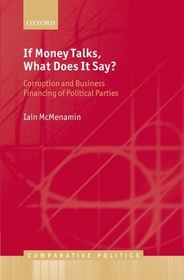
If Money Talks, What Does it Say?
Corruption and Business Financing of Political Parties
Sorozatcím: Comparative Politics;
-
10% KEDVEZMÉNY?
- A kedvezmény csak az 'Értesítés a kedvenc témákról' hírlevelünk címzettjeinek rendeléseire érvényes.
- Kiadói listaár GBP 120.00
-
57 330 Ft (54 600 Ft + 5% áfa)
Az ár azért becsült, mert a rendelés pillanatában nem lehet pontosan tudni, hogy a beérkezéskor milyen lesz a forint árfolyama az adott termék eredeti devizájához képest. Ha a forint romlana, kissé többet, ha javulna, kissé kevesebbet kell majd fizetnie.
- Kedvezmény(ek) 10% (cc. 5 733 Ft off)
- Kedvezményes ár 51 597 Ft (49 140 Ft + 5% áfa)
Iratkozzon fel most és részesüljön kedvezőbb árainkból!
Feliratkozom
57 330 Ft

Beszerezhetőség
Megrendelésre a kiadó utánnyomja a könyvet. Rendelhető, de a szokásosnál kicsit lassabban érkezik meg.
Why don't you give exact delivery time?
A beszerzés időigényét az eddigi tapasztalatokra alapozva adjuk meg. Azért becsült, mert a terméket külföldről hozzuk be, így a kiadó kiszolgálásának pillanatnyi gyorsaságától is függ. A megadottnál gyorsabb és lassabb szállítás is elképzelhető, de mindent megteszünk, hogy Ön a lehető leghamarabb jusson hozzá a termékhez.
A termék adatai:
- Kiadó OUP Oxford
- Megjelenés dátuma 2013. január 31.
- ISBN 9780199665709
- Kötéstípus Keménykötés
- Terjedelem192 oldal
- Méret 240x162x17 mm
- Súly 440 g
- Nyelv angol 0
Kategóriák
Rövid leírás:
Why do businesses contribute to political parties? Is money a universal language? Do business contributions to political parties convey different messages in different countries? This book answers these questions based on intensive case studies of Australia, Canada, and Germany.
TöbbHosszú leírás:
Why do businesses contribute to political parties? Is money a universal language? Do business contributions to political parties convey different messages in different countries? This book answers these questions based on intensive case studies of Australia, Canada, and Germany, as well as data from other countries. Business money does talk politics. In liberal Australia and Canada, the competitive short-term focus of firms generated substantial demand for private goods that could help firms develop an advantage over their rivals. Thus, business financing of parties conveyed a pragmatic message: in exchange for small but certain financial benefits, contributing businesses expect, as a reciprocation, to receive special consideration of their lobbying efforts. Australia's left-right party system created an awareness of policy risk, which motivated ideological payments, but there was no ideological bias in business financing of politics in centrist Canada. In Germany's co-ordinated economy, the most important policies for firms tend to be the public goods defined, championed, and delivered by their business associations. In this context, the pragmatic motivation for contributions to political parties is weak. The combination of consensual political institutions and constrained parties means there is a very low risk of major policy change from election to election. So, there is also little interest in ideological financing of political parties. If money talks, what does it say? places business financing of political parties in the context of debates about political corruption and offers advice on political reform.
Comparative Politics is a series for students, teachers, and researchers of political science that deals with contemporary government and politics. Global in scope, books in the series are characterised by a stress on comparative analysis and strong methodological rigour. The series is published in association with the European Consortium for Political Research. For more information visit: www.ecprnet.eu
The Comparative Politics series is edited by Professor David M. Farrell, School of Politics and International Relations, University College Dublin, Kenneth Carty, Professor of Political Science, University of British Columbia, and Professor Dirk Berg-Schlosser, Institute of Political Science, Philipps University, Marburg.
the book is an interesting contribution to a highly relevant discussion
Tartalomjegyzék:
List of Tables
List of Figures
Introduction
Theory and Research Design
Canada: Pragmatism and Centrism
Australia: Pragmatism and Ideological Bias
Germany: Symbolic Expenditure
Widening the Argument
Conclusions: Money is Multi-lingual
Appendices
References

