

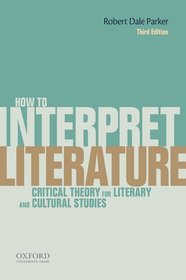
How To Interpret Literature
Critical Theory for Literary and Cultural Studies
-
10% KEDVEZMÉNY?
- A kedvezmény csak az 'Értesítés a kedvenc témákról' hírlevelünk címzettjeinek rendeléseire érvényes.
- Kiadói listaár GBP 29.99
-
13 540 Ft (12 895 Ft + 5% áfa)
Az ár azért becsült, mert a rendelés pillanatában nem lehet pontosan tudni, hogy a beérkezéskor milyen lesz a forint árfolyama az adott termék eredeti devizájához képest. Ha a forint romlana, kissé többet, ha javulna, kissé kevesebbet kell majd fizetnie.
- Kedvezmény(ek) 10% (kb. 1 354 Ft)
- Kedvezményes ár 12 186 Ft (11 606 Ft + 5% áfa)
Iratkozzon fel most és részesüljön kedvezőbb árainkból!
Feliratkozom
13 540 Ft

Beszerezhetőség
A kiadónál véglegesen elfogyott, nem rendelhető. Érdemes újra keresni a címmel, hátha van újabb kiadás.
Why don't you give exact delivery time?
A beszerzés időigényét az eddigi tapasztalatokra alapozva adjuk meg. Azért becsült, mert a terméket külföldről hozzuk be, így a kiadó kiszolgálásának pillanatnyi gyorsaságától is függ. A megadottnál gyorsabb és lassabb szállítás is elképzelhető, de mindent megteszünk, hogy Ön a lehető leghamarabb jusson hozzá a termékhez.
A termék adatai:
- Kiadás sorszáma 3
- Kiadó OUP USA
- Megjelenés dátuma 2014. november 6.
- ISBN 9780199331161
- Kötéstípus Puhakötés
- Terjedelem416 oldal
- Méret 211x141x21 mm
- Súly 475 g
- Nyelv angol
- Illusztrációk 34 illustrations 0
Kategóriák
Rövid leírás:
How to Interpret Literature presents a concise yet wide-ranging historicist survey of contemporary thinking in critical theory. Ideal for courses in literary and critical theory, this is the only book that thoroughly merges literary and cultural studies, including film. Parker weaves connections among chapters, showing how different ways of thinking respond to and build on each other. The revised and expanded third edition includes many updates, extensive revision in
every chapter, and new discussions of ecocriticism and disability studies.
Hosszú leírás:
Offering a refreshing combination of accessibility and intellectual rigor, How to Interpret Literature: Critical Theory for Literary and Cultural Studies, Third Edition, presents an up-to-date, concise, and wide-ranging historicist survey of contemporary thinking in critical theory. The only book of its kind that thoroughly merges literary studies with cultural studies, this text provides a critical look at the major movements in literary studies since the
1930s, including those often omitted from other texts. It is also the only up-to-date survey of literary theory that devotes extensive treatment to Queer Theory and Postcolonial and Race Studies. How to Interpret Literature is ideal as a stand-alone text or in conjunction with an anthology of primary readings
such as Robert Dale Parker's Critical Theory: A Reader for Literary and Cultural Studies.
Distinctive Features
* A conversational and engaging tone that speaks directly to today's students
* Wider coverage than any book of its kind
* A rich assortment of pedagogical features (charts, text boxes, photos, and suggestions for further reading)
How to Interpret Literature takes on an immense and formidable task- presenting to students the corpus of twentieth-century literary theory and its differing schools, conflicts, and developments-and it succeeds with a minimum of fuss, grandstanding, ponderousness at synthesizing all of this in one handy volume. Parker's sensitive, responsive, measured, ethically minded, and dazzlingly well-informed approach makes theory lucid, accessible, and inviting while
also acknowledging that it is an irreducibly complex, simultaneously graspable intellectual project that demands a lifetime's worth of repeated inquiry.
Tartalomjegyzék:
Preface
Acknowledgments
1. Introduction
2. New Criticism
Before New Criticism
How to Interpret: Key Concepts for New Critical Interpretation
Historicizing the New Criticism: Rethinking Literary Unity
The Intentional Fallacy and the Affective Fallacy
How to Interpret: A New Critical Example
The Influence of New Criticism
Further Reading
3. Structuralism
Key Concepts in Structuralism
How to Interpret: Structuralism in Cultural and Literary Studies
The Death of the Author
How to Interpret: The Detective Novel
Structuralism, Formalism, and Literary History
The Structuralist Study of Narrative: Narratology
How to Interpret: Focalization and Free Indirect Discourse
Narrative Syntax, and Metaphor and Metonymy
Further Reading
4. Deconstruction
Key Concepts in Deconstruction
How to Interpret: A Deconstructionist Example
Writing, Speech, and Différance
Deconstruction beyond Derrida
Deconstruction, Essentialism, and Identity
How to Interpret: Further Deconstructionist Examples
Further Reading
5. Psychoanalysis
Clinical Psychoanalysis
Key Concepts in Psychoanalysis: The Psychoanalytic Understanding of the Mind
Sigmund Freud
How to Interpret: Models of Psychoanalytic Interpretation
From the Interpretation of Dreams to the Interpretation of Literature
How to Interpret: Further Psychoanalytic Examples
Jacques Lacan
How to Interpret: A Lacanian Example
Further Reading
6. Feminism
What Is Feminism?
Early Feminist Criticism
Sex and Gender
Feminisms?
How to Interpret: Feminist Examples
Feminism and Visual Pleasure
Intersectionality and the Interdisciplinary Ethos of Contemporary Feminism
Further Reading
7. Queer Studies
Key Concepts in Queer Studies
How to Interpret: A Queer Studies Example
Queer Studies and History
Outing: Writers, Characters, and the Literary Closet
Homosociality and Homosexual Panic
Queer of Color Critique
How to Interpret: Another Queer Studies Example
Questions that Queer Studies Critics Ask
Further Reading
8. Marxism
Key Concepts in Marxism
Lukács, Gramsci, and Marxist Interpretations of Culture
Contemporary Marxism, Ideology, and Agenc
How to Interpret: An Example from Popular Culture
How to Interpret: Further Marxist Examples
Further Reading
9. Historicism and Cultural Studies
New Historicism
How to Interpret: Historicist Examples
Michel Foucault
Cultural Studies
How to Interpret: A Cultural Studies Example
Cultural Studies, Historicism, and Literature
Further Reading
10. Postcolonial and Race Studies
Postcolonialism
From Orientalism to Deconstruction: Edward Said, Homi Bhabha, and Gayatri Chakravorty Spivak
How to Interpret: A Postcolonial Studies Example
Race Studies
How to Interpret: Postcolonial and Race Studies Examples
Further Reading
11. Reader Response
Ideal, Implied, and Actual Readers
Structuralist Models of Reading and Communication
Aesthetic Judgment, Interpretive Communities, and Resisting Readers
Reception Theory and Reception History
Readers and the New Technologies
Further Reading
12. Recent and Emerging Developments: Ecocriticism and Disability Studies
Works Cited
Photographic Credits
Index

