

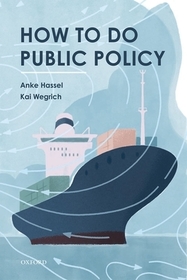
How to Do Public Policy
-
10% KEDVEZMÉNY?
- A kedvezmény csak az 'Értesítés a kedvenc témákról' hírlevelünk címzettjeinek rendeléseire érvényes.
- Kiadói listaár GBP 30.99
-
14 805 Ft (14 100 Ft + 5% áfa)
Az ár azért becsült, mert a rendelés pillanatában nem lehet pontosan tudni, hogy a beérkezéskor milyen lesz a forint árfolyama az adott termék eredeti devizájához képest. Ha a forint romlana, kissé többet, ha javulna, kissé kevesebbet kell majd fizetnie.
- Kedvezmény(ek) 10% (cc. 1 481 Ft off)
- Kedvezményes ár 13 325 Ft (12 690 Ft + 5% áfa)
Iratkozzon fel most és részesüljön kedvezőbb árainkból!
Feliratkozom
14 805 Ft

Beszerezhetőség
Megrendelésre a kiadó utánnyomja a könyvet. Rendelhető, de a szokásosnál kicsit lassabban érkezik meg.
Why don't you give exact delivery time?
A beszerzés időigényét az eddigi tapasztalatokra alapozva adjuk meg. Azért becsült, mert a terméket külföldről hozzuk be, így a kiadó kiszolgálásának pillanatnyi gyorsaságától is függ. A megadottnál gyorsabb és lassabb szállítás is elképzelhető, de mindent megteszünk, hogy Ön a lehető leghamarabb jusson hozzá a termékhez.
A termék adatai:
- Kiadó OUP Oxford
- Megjelenés dátuma 2022. március 15.
- ISBN 9780198747192
- Kötéstípus Puhakötés
- Terjedelem400 oldal
- Méret 234x156x20 mm
- Súly 680 g
- Nyelv angol 204
Kategóriák
Rövid leírás:
This book offers a guide to students and practitioners on how to improve problem-solving with policies in a political world.
TöbbHosszú leírás:
How to Do Public Policy offers a guide to students and practitioners on how to improve problem-solving with policies in a political world. It integrates insights from applied policy analysis and studies of the policy process to develop a framework that conceives policy-making as structured by two spheres of action - the 'engine room' of specialists and experts in government agencies, NGOs, research organizations etc., on the one hand, and the political 'superstructure' of politicians, key public stakeholders and the public, on the other hand. Understanding the different logics of the engine room and the superstructure is key for successful policy-making. The dual structure of policy-making provides a perspective on policy-analysis (interactive policy analysis) and policy-making (actor-centred policy-making) that moves from the focus on individual and specific measures, towards understanding and shaping the relation and interaction between policy interventions, the institutional context and the stakeholders involved or affected. Part I of the book presents the basic analytical concepts needed to understand the policy process and the structures and dynamics involved in it, as well as to understand how and why actors behave the way they do-and how to engage with different types of actors. Part II moves further into the nuts and bolts of policy-making, including policy design, implementation, and evaluation. Part III introduces and explores three key aspects of the capacity to make good policies: engagement with stakeholders, the process of policy coordination in a context of interdependence, and the role of institutions.
This is an excellent textbook to prepare students in public policy programmes for professional roles in the "engine room" of the policy process. It is well-structured and presents the approaches and analytical methods of public-policy studies lucidly. The authors uniquely and most impressively achieve to integrate technical policy analysis with the perspective of empirical political science. They discuss the tools and limits of evidence-based policy analysis brilliantly and combine them with a sophisticated, but non-cynical, awareness of how policy choices are shaped by multi-actor politics, responding to the contingent salience of political scandals, crises, and windows of opportunity. The book effectively conveys the teachable skills for policy analysts with a realistic awareness of the importance and the limits of their role in the irreducible contingencies of political processes.
Tartalomjegyzék:
Part I: Process
Intro to Part I: Understanding the Policy Process
Public Policy
The Dual Structure of Policy Making
How to Set the Agenda
Part II Policies
Intro to Part II: Understanding the Toolbox
How to Choose and Design Policy Instruments
How to Implement Public Policy
How to Evaluate Policies
Part III: Capacities
Intro to Part III: Understanding Capacities
How to Engage with Stakeholders
How to Coordinate Public Policy
How to Work with Institutions
Conclusions
Annex

