

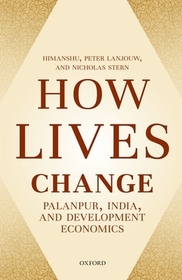
How Lives Change
Palanpur, India, and Development Economics
-
10% KEDVEZMÉNY?
- A kedvezmény csak az 'Értesítés a kedvenc témákról' hírlevelünk címzettjeinek rendeléseire érvényes.
- Kiadói listaár GBP 60.00
-
27 090 Ft (25 800 Ft + 5% áfa)
Az ár azért becsült, mert a rendelés pillanatában nem lehet pontosan tudni, hogy a beérkezéskor milyen lesz a forint árfolyama az adott termék eredeti devizájához képest. Ha a forint romlana, kissé többet, ha javulna, kissé kevesebbet kell majd fizetnie.
- Kedvezmény(ek) 10% (kb. 2 709 Ft)
- Kedvezményes ár 24 381 Ft (23 220 Ft + 5% áfa)
Iratkozzon fel most és részesüljön kedvezőbb árainkból!
Feliratkozom
27 090 Ft

Beszerezhetőség
Becsült beszerzési idő: A Prosperónál jelenleg nincsen raktáron, de a kiadónál igen. Beszerzés kb. 3-5 hét..
A Prosperónál jelenleg nincsen raktáron.
Why don't you give exact delivery time?
A beszerzés időigényét az eddigi tapasztalatokra alapozva adjuk meg. Azért becsült, mert a terméket külföldről hozzuk be, így a kiadó kiszolgálásának pillanatnyi gyorsaságától is függ. A megadottnál gyorsabb és lassabb szállítás is elképzelhető, de mindent megteszünk, hogy Ön a lehető leghamarabb jusson hozzá a termékhez.
A termék adatai:
- Kiadó OUP Oxford
- Megjelenés dátuma 2018. augusztus 22.
- ISBN 9780198806509
- Kötéstípus Keménykötés
- Terjedelem528 oldal
- Méret 241x162x32 mm
- Súly 918 g
- Nyelv angol 0
Kategóriák
Rövid leírás:
Development economics is about understanding how and why lives change. This book assesses the performance and potential of development in a single village in a crucially important country. By studying Palanpur in India over seven decades it shows how the changes in one village can provide insight into changes in India since independence.
TöbbHosszú leírás:
Development economics is about understanding how and why lives change. How Lives Change: Palanpur, India, and Development Economics studies a single village in a crucially important country to illuminate the drivers of these changes, why some people do better or worse than others, and what influences mobility and inequality.
How Lives Change draws on seven decades of detailed data collection by a team of dedicated development economists to describe the evolution of Palanpur's economy, its society, and its politics. The emerging story of integration of the village economy with the outside world is placed against the backdrop of a rapidly transforming India and, in turn, helps to understand the transformation. It puts development economics into practice to assess its performance and potential in a unique and powerful way to show how the development of one village since India's independence can be set in the context of the entire country's story.
How Lives Change sets out the role of, and scope for, public policy in shaping the lives of individuals. It describes how changes in Palanpur's economy since the late 1950s were initially driven by the advance of agriculture through land reforms, the expansion of irrigation and the introduction of "green revolution" technologies. Since the mid-1980s, newly emerging off-farm opportunities in nearby towns and outside agriculture became the key driver of growth and change, profoundly influencing poverty, income mobility, and inequality in Palanpur. Village institutions are shown to have evolved in subtle but clear ways over time, both shaping and being shaped by economic change. Individual entrepreneurship and initiative is found to play a critical role in driving and responding to the forces of change; and yet, against a backdrop of real economic growth and structural transformation, this book shows that human development outcomes have shown only weak progress and remain stubbornly resistant to change.
How Lives Change is a remarkable book which brings together two qualities seldom seen concurrently-empathy for the subject, in this case the inhabitants of Palanpur, usually found in anthropological writings, and the rigor of statistics and theory, associated with economics. This new book provides a keen, bird'seye view of research in rural India, with scholarship and a lightness of touch rare in economics. What makes this latest book especially valuable is the authors' use of Palanpur as a testing ground of what has happened all over India. The experience of Palanpur is used by the authors to offer useful tips to India-the importance of education, human capital and better vocational training, and the need for even greater connectivity to towns and cities.
Tartalomjegyzék:
Part I: Foundations
The Study of Villages and the Understanding of Development: Building the Evidence
Palanpur: The Village through Seven Decades
India and Palanpur: A Story of Change
Theory and India
Part II: Economy
Changing Activities, Changing Markets: Agriculture
Tenancy in Palanpur
Changing Activities, Changing Markets: Beyond Agriculture
Poverty, Inequality, and Mobility in Palanpur
Part III: Society
Human Development: Education, Health, Public Services
Women: Possibilities and Constraints
Society and Politics: Inertia and Change
Part IV: Reflections
Future Prospects
Lessons for India, Policy, and the Economics of Development

