

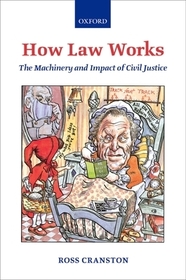
How Law Works
The Machinery and Impact of Civil Justice
-
10% KEDVEZMÉNY?
- A kedvezmény csak az 'Értesítés a kedvenc témákról' hírlevelünk címzettjeinek rendeléseire érvényes.
- Kiadói listaár GBP 142.50
-
64 338 Ft (61 275 Ft + 5% áfa)
Az ár azért becsült, mert a rendelés pillanatában nem lehet pontosan tudni, hogy a beérkezéskor milyen lesz a forint árfolyama az adott termék eredeti devizájához képest. Ha a forint romlana, kissé többet, ha javulna, kissé kevesebbet kell majd fizetnie.
- Kedvezmény(ek) 10% (kb. 6 433 Ft)
- Kedvezményes ár 57 905 Ft (55 148 Ft + 5% áfa)
Iratkozzon fel most és részesüljön kedvezőbb árainkból!
Feliratkozom
64 338 Ft

Beszerezhetőség
Megrendelésre a kiadó utánnyomja a könyvet. Rendelhető, de a szokásosnál kicsit lassabban érkezik meg.
Why don't you give exact delivery time?
A beszerzés időigényét az eddigi tapasztalatokra alapozva adjuk meg. Azért becsült, mert a terméket külföldről hozzuk be, így a kiadó kiszolgálásának pillanatnyi gyorsaságától is függ. A megadottnál gyorsabb és lassabb szállítás is elképzelhető, de mindent megteszünk, hogy Ön a lehető leghamarabb jusson hozzá a termékhez.
A termék adatai:
- Kiadó OUP Oxford
- Megjelenés dátuma 2006. január 12.
- ISBN 9780199292073
- Kötéstípus Keménykötés
- Terjedelem344 oldal
- Méret 242x163x24 mm
- Súly 661 g
- Nyelv angol
- Illusztrációk 4 tables 0
Kategóriák
Rövid leírás:
This book looks at the civil justice system - the courts and what they do; legal aid and other methods of providing access to justice; lawyers and their conduct; and the role of legal procedure. It also looks at the impact the civil justice system has on wider society, and its relationship with economics and commercial development. The book is largely focused on Britain, but includes material from the USA, the Indian sub-continent, south-east Asia, and Aboriginal society in Australia.
TöbbHosszú leírás:
Access to justice, equality before the law, and the rule of law are three fundamental values underpinning the civil justice system. This book examines these values and how, although they do not have great leverage in decision making by the courts, they are a crucial foundation of the civil justice system and a powerful argument for arrangements such as legal aid, the impartial application of law, and the independence of the judiciary.
The second theme of this book concerns the role of procedure, often regarded as of secondary importance compared with substantive law. Taking the definition of procedure at its widest, the book discusses Lord Woolf's Inquiry, and demonstrates how procedural reform can maximize a fundamental value like access to justice. This linkage is furthered in a later analysis of access to justice comparatively, in relation to civil and commercial law.
Thirdly, the book looks at understanding how law works, and how it could be made to work better, and concludes that this demands both a knowledge of law and of law's context. This theme offers a framework for the book, which then goes on to deal with the machinery of the law, and discusses what the courts do, civil procedure, and the ethics of lawyer's conduct, all in relation to the broader context of access to justice.
This broader context of the law is particularly prominent in the latter half of the book which deals with various dimensions of the impact of the law. Including studies of civil and social rights in practice, the role of European law in the destruction of Aboriginal society in Australia, and commercial law in Asia, these examples raise issues about the gap between the law and reality, the potential law has to destroy social patterns, and the relationship between law and economic development.
This is a thought-provoking, critical exploration which has much to offer those interested in the operation of the civil justice system.
Tartalomjegyzék:
Preface
Introduction
I The Machinery of Justice
Access to Justice: I
Access to Justice: II
Courts
Procedure
Lawyers' Conduct: The Professional Standards
II Law's Impact
Rights in Practice
Civil Rights and Social Wrongs: The Australian Aboriginals
Law and Economic Development: Credit and Security in South and South-East Asia
Legal Transplants: The Sri Lankan Experience
Conclusion

