

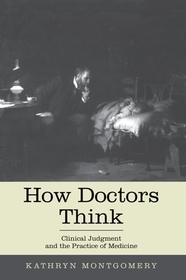
How Doctors Think
Clinical Judgment and the Practice of Medicine
-
10% KEDVEZMÉNY?
- A kedvezmény csak az 'Értesítés a kedvenc témákról' hírlevelünk címzettjeinek rendeléseire érvényes.
- Kiadói listaár GBP 38.99
-
18 627 Ft (17 740 Ft + 5% áfa)
Az ár azért becsült, mert a rendelés pillanatában nem lehet pontosan tudni, hogy a beérkezéskor milyen lesz a forint árfolyama az adott termék eredeti devizájához képest. Ha a forint romlana, kissé többet, ha javulna, kissé kevesebbet kell majd fizetnie.
- Kedvezmény(ek) 10% (cc. 1 863 Ft off)
- Kedvezményes ár 16 764 Ft (15 966 Ft + 5% áfa)
Iratkozzon fel most és részesüljön kedvezőbb árainkból!
Feliratkozom
18 627 Ft

Beszerezhetőség
Megrendelésre a kiadó utánnyomja a könyvet. Rendelhető, de a szokásosnál kicsit lassabban érkezik meg.
Why don't you give exact delivery time?
A beszerzés időigényét az eddigi tapasztalatokra alapozva adjuk meg. Azért becsült, mert a terméket külföldről hozzuk be, így a kiadó kiszolgálásának pillanatnyi gyorsaságától is függ. A megadottnál gyorsabb és lassabb szállítás is elképzelhető, de mindent megteszünk, hogy Ön a lehető leghamarabb jusson hozzá a termékhez.
A termék adatai:
- Kiadó OUP USA
- Megjelenés dátuma 2012. november 22.
- ISBN 9780199942053
- Kötéstípus Puhakötés
- Terjedelem256 oldal
- Méret 233x153x7 mm
- Súly 481 g
- Nyelv angol 0
Kategóriák
Rövid leírás:
How Doctors Think defines the nature and importance of clinical judgment. Although physicians make use of science, this book argues that medicine is not itself a science but rather an interpretive practice that relies on clinical reasoning. A physician looks at the patient's history along with the presenting physical signs and symptoms and juxtaposes these with clinical experience and empirical studies to construct a tentative account of the illness.
TöbbHosszú leírás:
How Doctors Think defines the nature and importance of clinical judgment. Although physicians make use of science, this book argues that medicine is not itself a science but rather an interpretive practice that relies on clinical reasoning. A physician looks at the patient's history along with the presenting physical signs and symptoms and juxtaposes these with clinical experience and empirical studies to construct a tentative account of the illness.
How Doctors Think is divided into four parts. Part one introduces the concept of medicine as a practice rather than a science; part two discusses the idea of causation; part three delves into the process of forming clinical judgment; and part four considers clinical judgment within the uncertain nature of medicine itself. In How Doctors Think, Montgomery contends that assuming medicine is strictly a science can have adverse side effects, and suggests reducing these by recognizing the vital role of clinical judgment.
"This is a book that will be read with pleasure by anyone interested in how medicine is done and it is a book that should be required reading for all students starting their clinical training."--Journal of the Royal Society of Medicine
"Montgomery has certainly written a piece that will stimulate people to think more deeply about medical and wider health professional practice. It is a text I will recommend to students and colleagues."--PsycCRITIQUES
Tartalomjegyzék:
PART I. MEDICINE AS A PRACTICE
1. Medicine and the Limits of Knowledge
2. The Misdescription of Medicine
PART II. CLINICAL JUDGMENT AND THE IDEA OF CAUSE
3. Clinical Judgment and the Interpretation of the Case
4. "What Brings You Here Today?": The Idea of Cause in Medical Practice
5. The Simplification of Clinical Cause
6. Clinical Judgment and the Problem of Particularizing
PART III. THE FORMATION OF CLINICAL JUDGMENT
7. Aphorisms, Maxims, and Old Saws: Some Rules of Clinical Reasoning
8. "Don't Think Zebras": A Theory of Clinical Knowing
9. Knowing One's Place: The Evaluation of Clinical Judgment
PART IV. CLINICAL JUDGMENT AND THE NATURE OF MEDICINE
10. The Self in Medicine: The Use and Misuse of the Science Claim
11. A Medicine of Neighbors
12. Uncertainty and the Ethics of Practice

