

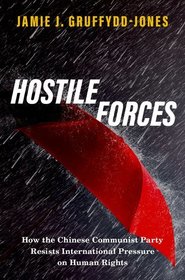
Hostile Forces
How the Chinese Communist Party Resists International Pressure on Human Rights
-
10% KEDVEZMÉNY?
- A kedvezmény csak az 'Értesítés a kedvenc témákról' hírlevelünk címzettjeinek rendeléseire érvényes.
- Kiadói listaár GBP 84.00
-
40 131 Ft (38 220 Ft + 5% áfa)
Az ár azért becsült, mert a rendelés pillanatában nem lehet pontosan tudni, hogy a beérkezéskor milyen lesz a forint árfolyama az adott termék eredeti devizájához képest. Ha a forint romlana, kissé többet, ha javulna, kissé kevesebbet kell majd fizetnie.
- Kedvezmény(ek) 10% (cc. 4 013 Ft off)
- Kedvezményes ár 36 118 Ft (34 398 Ft + 5% áfa)
Iratkozzon fel most és részesüljön kedvezőbb árainkból!
Feliratkozom
40 131 Ft

Beszerezhetőség
Megrendelésre a kiadó utánnyomja a könyvet. Rendelhető, de a szokásosnál kicsit lassabban érkezik meg.
Why don't you give exact delivery time?
A beszerzés időigényét az eddigi tapasztalatokra alapozva adjuk meg. Azért becsült, mert a terméket külföldről hozzuk be, így a kiadó kiszolgálásának pillanatnyi gyorsaságától is függ. A megadottnál gyorsabb és lassabb szállítás is elképzelhető, de mindent megteszünk, hogy Ön a lehető leghamarabb jusson hozzá a termékhez.
A termék adatai:
- Kiadó OUP USA
- Megjelenés dátuma 2023. március 9.
- ISBN 9780197643198
- Kötéstípus Keménykötés
- Terjedelem260 oldal
- Méret 235x156x18 mm
- Súly 499 g
- Nyelv angol
- Illusztrációk 24 294
Kategóriák
Rövid leírás:
Hostile Forces shines a light on how China has learned to manage, manipulate, and resist foreign pressure on human rights, and illustrates how support for authoritarian and nationalist policies can actually grow in response to such critiques from powers within the liberal international system.
TöbbHosszú leírás:
How do authoritarian regimes deal with pressure from the international community? China's leaders have been subject to decades of international attention, condemnation, resolutions, boycotts, and sanctions over their treatment of human rights. We assume that hearing about all this pressure will make the public more concerned about human rights, and so regimes like the Chinese Communist Party (CCP) should do what they can to prevent this from happening. In Hostile Forces, Jamie Gruffydd-Jones argues that while international pressure may indeed embarrass authoritarian leaders on the international stage, it may, in fact, benefit them at home. The targets of human rights pressure, regimes like the Communist Party, are not merely passive recipients, but actors who can proactively shape and deploy that pressure for their own advantage.
Taking us through an exploration of the history of the Communist Party's reactions to foreign pressure, from condemnation of Mao's crackdowns in Tibet to outrage at the outbreak of COVID-19, analysis of a novel database drawn from state media archives, as well as multiple survey experiments and hundreds of interviews, Gruffydd-Jones shows that the CCP uses the most 'hostile' pressure strategically - and successfully - to push citizens to view human rights in terms of international geopolitics rather than domestic injustice, and reduce their support for change. The book shines a light on how regimes have learnt to manage, manipulate, and resist foreign pressure on their human rights, and illustrates how support for authoritarian and nationalist policies might grow in the face of a liberal international system.
In this provocative new study, Jamie Gruffydd-Jones argues that international criticism of human rights violations by the Chinese government have not worked and are unlikely to without a fundamental change of strategy. Everyone interested in the promotion of human rights, in China or elsewhere, needs to read this book and heed its advice.
Tartalomjegyzék:
Part I: The Argument
Introduction
A Theory of Responses to Human Rights Pressure
Part II: The Regime
Pressure as Propaganda: From Mao to Hu
Hostile Human Rights: Tibet, Hong Kong, and Beyond
When does Pressure become Propaganda?
Part III: The Citizens
Experimental Activism
People on the Street
Pressure in Real Time
Part IV: The Implications
Implications for China and Beyond
Notes
Appendices
Bibliography

