

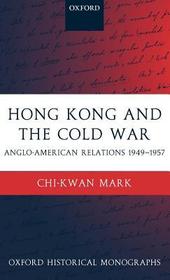
Hong Kong and the Cold War
Anglo-American Relations 1949-1957
Sorozatcím: Oxford Historical Monographs;
-
10% KEDVEZMÉNY?
- A kedvezmény csak az 'Értesítés a kedvenc témákról' hírlevelünk címzettjeinek rendeléseire érvényes.
- Kiadói listaár GBP 200.00
-
95 550 Ft (91 000 Ft + 5% áfa)
Az ár azért becsült, mert a rendelés pillanatában nem lehet pontosan tudni, hogy a beérkezéskor milyen lesz a forint árfolyama az adott termék eredeti devizájához képest. Ha a forint romlana, kissé többet, ha javulna, kissé kevesebbet kell majd fizetnie.
- Kedvezmény(ek) 10% (cc. 9 555 Ft off)
- Kedvezményes ár 85 995 Ft (81 900 Ft + 5% áfa)
Iratkozzon fel most és részesüljön kedvezőbb árainkból!
Feliratkozom
95 550 Ft

Beszerezhetőség
Megrendelésre a kiadó utánnyomja a könyvet. Rendelhető, de a szokásosnál kicsit lassabban érkezik meg.
Why don't you give exact delivery time?
A beszerzés időigényét az eddigi tapasztalatokra alapozva adjuk meg. Azért becsült, mert a terméket külföldről hozzuk be, így a kiadó kiszolgálásának pillanatnyi gyorsaságától is függ. A megadottnál gyorsabb és lassabb szállítás is elképzelhető, de mindent megteszünk, hogy Ön a lehető leghamarabb jusson hozzá a termékhez.
A termék adatai:
- Kiadó OUP Oxford
- Megjelenés dátuma 2004. augusztus 5.
- ISBN 9780199273706
- Kötéstípus Keménykötés
- Terjedelem270 oldal
- Méret 223x146x20 mm
- Súly 454 g
- Nyelv angol
- Illusztrációk 2 maps 0
Kategóriák
Rövid leírás:
After 1949, the British Empire in Hong Kong was more vulnerable than it appeared to be. Its vulnerability stemmed as much from Britain's imperial decline and America's Cold War requirements as from an imminent Chinese threat. This is the first scholarly study that explores the interactions of British and US policies towards Hong Kong, and reveals the dynamics of the Anglo-American alliance and the dilemmas of small allies in the global Cold War
TöbbHosszú leírás:
After 1949, the British Empire in Hong Kong was more vulnerable than the lack of Chinese demand for return and the success of Hong Kong's economic transformations might have suggested. Its vulnerability stemmed as much from Britain's imperial decline and America's Cold War requirements as from a Chinese threat. It culminated in the little known '1957 Question', a year when the British position in Hong Kong appeared more uncertain than any time since 1949.
This is the first scholarly study that places Hong Kong at the heart of the Anglo-American relationship in the wider context of the Cold War in Asia. Unlike existing works, which tend to treat British and US policies in isolation, this book explores their dynamic interactions - how the two allies perceived, responded to, and attempted to influence each other's policies and actions. It also provides a major reinterpretation of Hong Kong's involvement in the containment of China. Dr Mark argues that, concerned about possible Chinese retaliation, the British insisted and the Americans accepted that Hong Kong's role should be as discreet and non-confrontational in nature as possible. Above all, top decision-makers in Washington evaluated Hong Kong's significance not in its own right, but in the context of the Anglo-American relationship: Hong Kong was seen primarily as a bargaining chip to obtain British support for US policy elsewhere in Asia.
By using a variety of British and US archival material as well as Chinese sources, Dr Mark examines how the British and US government discussed, debated, and disagreed over Hong Kong's role in the Cold War, and reveals the dynamics of the Anglo-American alliance and the dilemmas of small allies in a global conflict.
Mark's book is impeccably researched and eloquently written.
Tartalomjegyzék:
Hong Kong in British, Chinese, and American Cold War Thinking
Defending the Indefensible Colony: Anglo-American Exchanges Over the Security of Hong Kong
Meeting the Political Threat: Hong Kong in Britain's and America's China Policy
Containing the Economic Warfare: Hong Kong and Export Controls Against China
Controlling the 'American Diaspora' in Hong Kong: Intelligence, Covert Action, and Propaganda
Conclusion
Epilogue
Bibliography
Index

