

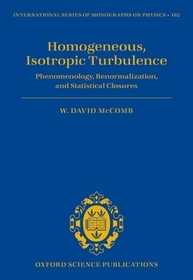
Homogeneous, Isotropic Turbulence
Phenomenology, Renormalization and Statistical Closures
Sorozatcím: International Series of Monographs on Physics; 162;
-
10% KEDVEZMÉNY?
- A kedvezmény csak az 'Értesítés a kedvenc témákról' hírlevelünk címzettjeinek rendeléseire érvényes.
- Kiadói listaár GBP 115.00
-
51 922 Ft (49 450 Ft + 5% áfa)
Az ár azért becsült, mert a rendelés pillanatában nem lehet pontosan tudni, hogy a beérkezéskor milyen lesz a forint árfolyama az adott termék eredeti devizájához képest. Ha a forint romlana, kissé többet, ha javulna, kissé kevesebbet kell majd fizetnie.
- Kedvezmény(ek) 10% (kb. 5 192 Ft)
- Kedvezményes ár 46 730 Ft (44 505 Ft + 5% áfa)
Iratkozzon fel most és részesüljön kedvezőbb árainkból!
Feliratkozom
51 922 Ft

Beszerezhetőség
Megrendelésre a kiadó utánnyomja a könyvet. Rendelhető, de a szokásosnál kicsit lassabban érkezik meg.
Why don't you give exact delivery time?
A beszerzés időigényét az eddigi tapasztalatokra alapozva adjuk meg. Azért becsült, mert a terméket külföldről hozzuk be, így a kiadó kiszolgálásának pillanatnyi gyorsaságától is függ. A megadottnál gyorsabb és lassabb szállítás is elképzelhető, de mindent megteszünk, hogy Ön a lehető leghamarabb jusson hozzá a termékhez.
A termék adatai:
- Kiadó OUP Oxford
- Megjelenés dátuma 2014. február 27.
- ISBN 9780199689385
- Kötéstípus Keménykötés
- Terjedelem430 oldal
- Méret 247x181x28 mm
- Súly 884 g
- Nyelv angol
- Illusztrációk 40 b/w illustrations 0
Kategóriák
Rövid leírás:
This book addresses the idealised problem posed by homogeneous, isotropic turbulence. It is written from the perspective of a theoretical physicist, but is designed to be accessible to all researchers in turbulence, both theoretical and experimental, and from all disciplines.
TöbbHosszú leírás:
Fluid turbulence is often referred to as `the unsolved problem of classical physics'. Yet, paradoxically, its mathematical description resembles quantum field theory. The present book addresses the idealised problem posed by homogeneous, isotropic turbulence, in order to concentrate on the fundamental aspects of the general problem. It is written from the perspective of a theoretical physicist, but is designed to be accessible to all researchers in turbulence, both theoretical and experimental, and from all disciplines. The book is in three parts, and begins with a very simple overview of the basic statistical closure problem, along with a summary of current theoretical approaches. This is followed by a precise formulation of the statistical problem, along with a complete set of mathematical tools (as needed in the rest of the book), and a summary of the generally accepted phenomenology of the subject. Part 2 deals with current issues in phenomenology, including the role of Galilean invariance, the physics of energy transfer, and the fundamental problems inherent in numerical simulation. Part 3 deals with renormalization methods, with an emphasis on the taxonomy of the subject, rather than on lengthy mathematical derivations. The book concludes with some discussion of current lines of research and is supplemented by three appendices containing detailed mathematical treatments of the effect of isotropy on correlations, the properties of Gaussian distributions, and the evaluation of coefficients in statistical theories.
At the end of reading this book I felt exuberant in several distinct ways: progress has been made, but there are still vast areas of turbulence that are hardly understood; there is beautiful mathematics underpinning the analyses in HIT in particular and turbulence in general; and one has a sense of optimism that theoretical progress is gaining momentum.
Tartalomjegyzék:
Part I: The fundamental problem, the basic statistical formulation, and the phenomenology of energy transfer
Overview of the statistical problem
Basic equations and definitions in x-space and k-space
Formulation of the statistical problem
Turbulence energy: its inertial transfer and dissipation
Part II: Phenomenology: some current research and unresolved issues
Galilean invariance (GI)
Kolmogorov's (1941) theory revisited
Turbulence dissipation and decay
Theoretical constraints on mode reduction and the turbulence response
Part III: Statistical theory and future directions
The Kraichnan-Wyld-Edwards (KWE) covariance equations
Two-point closures: some basic issues
Renormalization group (RG) applied to turbulence
Work in progress and future directions
Part IV: Appendices
Implications of isotropy and continuity for correlation tensors
Properties of Gaussian distributions
Evaluation of the L(k; j) coefficient

