

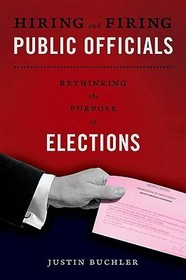
Hiring and Firing Public Officials
Rethinking the Purpose of Elections
-
10% KEDVEZMÉNY?
- A kedvezmény csak az 'Értesítés a kedvenc témákról' hírlevelünk címzettjeinek rendeléseire érvényes.
- Kiadói listaár GBP 32.99
-
14 894 Ft (14 185 Ft + 5% áfa)
Az ár azért becsült, mert a rendelés pillanatában nem lehet pontosan tudni, hogy a beérkezéskor milyen lesz a forint árfolyama az adott termék eredeti devizájához képest. Ha a forint romlana, kissé többet, ha javulna, kissé kevesebbet kell majd fizetnie.
- Kedvezmény(ek) 10% (kb. 1 489 Ft)
- Kedvezményes ár 13 405 Ft (12 767 Ft + 5% áfa)
Iratkozzon fel most és részesüljön kedvezőbb árainkból!
Feliratkozom
14 894 Ft

Beszerezhetőség
Megrendelésre a kiadó utánnyomja a könyvet. Rendelhető, de a szokásosnál kicsit lassabban érkezik meg.
Why don't you give exact delivery time?
A beszerzés időigényét az eddigi tapasztalatokra alapozva adjuk meg. Azért becsült, mert a terméket külföldről hozzuk be, így a kiadó kiszolgálásának pillanatnyi gyorsaságától is függ. A megadottnál gyorsabb és lassabb szállítás is elképzelhető, de mindent megteszünk, hogy Ön a lehető leghamarabb jusson hozzá a termékhez.
A termék adatai:
- Kiadó OUP USA
- Megjelenés dátuma 2011. augusztus 25.
- ISBN 9780199759972
- Kötéstípus Puhakötés
- Terjedelem274 oldal
- Méret 231x152x20 mm
- Súly 340 g
- Nyelv angol 0
Kategóriák
Rövid leírás:
Conventional theories of elections hold that an election is analogous to a consumer product market. This analogy underlies decades of electoral theory, but in Hiring and Firing Public Officials, Justin Buchler contends that it does not capture the real nature of elections. As Buchler shows, an election is a mechanism by which voters hire and fire public officials. Thus, the health of democracy depends not on regular competitive elections, but on posing a credible threat to fire public officials who do not perform their jobs well. However, the purpose of that threat is to force public officials to act as faithful public servants so that they do not have to be fired. Thus, competitive elections, by most definitions, are indicative of a failure of the democratic system.
TöbbHosszú leírás:
Conventional theories of elections hold that an election is analogous to a consumer product market. According to the market paradigm, voters are consumers, candidates are competing firms, and an election is a market in which voters exchange votes for policy by voting for the candidates whose policies they prefer. According to this logic, a healthy democracy requires frequent competitive elections. The market analogy underlies decades of electoral theory, but in Hiring and Firing Public Officials, Justin Buchler contends that it does not capture the real nature of elections. In fact, our widespread dissatisfaction with the current state of electoral politics derives from a fundamental misunderstanding of what elections are and what purpose they serve. As Justin Buchler shows, an election is a mechanism by which voters hire and fire public officials. It is not a consumer product market--it is a single employment decision. Thus, the health of democracy depends not on regular competitive elections, but on posing a credible threat to fire public officials who do not perform their jobs well. However, the purpose of that threat is to force public officials to act as faithful public servants so that they do not have to be fired. Thus, competitive elections, by most definitions, are indicative of a failure of the democratic system.
Justin Buchler is hunting big game. His book forces scholars to question basic assumptions upon which many scholarly conclusions regarding politics rest. Supporters of rational choice theory will have their assumptions challenged, and opponents of rational choice may welcome the book. But both supporters and opponents may take this work as the academic equivalent of an inside job as the challenge is made by someone who knows the terrain very well, with a critique that is deeply grounded in actual politics.
Tartalomjegyzék:
1. Elections and the Politics of Threats
2. What is Electoral Competition?
3. Elections as Employment Mechanisms
4. Market Competition
5. Electoral Actors in the Market and Employment Models
6. Competitive Elections in the Market and Employment Models
7. Competitive Behavior and Competitive Elections
8. Corruption and Competition
9. Policy Implications of the Market and Employment Models
10. Conclusions
References

