

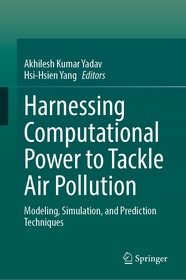
Harnessing Computational Power to Tackle Air Pollution
Modeling, Simulation, and Prediction Techniques
-
12% KEDVEZMÉNY?
- Kiadói listaár EUR 171.19
-
66 866 Ft (63 682 Ft + 5% áfa)
Az ár azért becsült, mert a rendelés pillanatában nem lehet pontosan tudni, hogy a beérkezéskor milyen lesz a forint árfolyama az adott termék eredeti devizájához képest. Ha a forint romlana, kissé többet, ha javulna, kissé kevesebbet kell majd fizetnie.
- Kedvezmény(ek) 12% (cc. 8 024 Ft off)
- Kedvezményes ár 58 842 Ft (56 040 Ft + 5% áfa)
58 842 Ft

Beszerezhetőség
Megrendelésre a kiadó utánnyomja a könyvet. Rendelhető, de a szokásosnál kicsit lassabban érkezik meg.
Why don't you give exact delivery time?
A beszerzés időigényét az eddigi tapasztalatokra alapozva adjuk meg. Azért becsült, mert a terméket külföldről hozzuk be, így a kiadó kiszolgálásának pillanatnyi gyorsaságától is függ. A megadottnál gyorsabb és lassabb szállítás is elképzelhető, de mindent megteszünk, hogy Ön a lehető leghamarabb jusson hozzá a termékhez.
A termék adatai:
- Kiadó Springer Nature Switzerland
- Megjelenés dátuma 2026. május 12.
- ISBN 9783032139528
- Kötéstípus Keménykötés
- Terjedelem270 oldal
- Méret 235x155 mm
- Nyelv angol
- Illusztrációk XIV, 270 p. 56 illus., 54 illus. in color. 695
Kategóriák
Hosszú leírás:
This book examines the central role of computational methods in understanding, predicting, and mitigating air pollution, a critical challenge for both public health and environmental sustainability. The book offers foundations of air pollution modeling, emphasizing computational fluid dynamics for simulating pollutant dispersion and transport in relation to urban landscapes, meteorological conditions, and airflow. These approaches are complemented by statistical methods and models that broaden the scope of air quality simulations.
While highlighting major advances, the book also addresses persistent challenges: the demand for greater model accuracy, the need to manage uncertainty, the complexity of urban systems, and the computational intensity of many techniques. Developments such as parallel computing and reduced-order models are presented as promising directions for overcoming these obstacles.
TöbbTartalomjegyzék:
1 Computational Approaches for Air Pollution Assessment.- 2 Advanced Computational Methods for Air Pollution Modeling and Simulation.- 3 Adaptive Holistic Air Quality Modeling and Machine Learning.- 4 Transforming Air Quality Monitoring Through Artificial Intelligence.- 5 AI-driven Approaches to Air Pollution and Environmental Ethics.- 6 Artificial Intelligence for Real-time Air Quality Monitoring and Forecasting.- 7 Artificial Intelligence Driven Models for Air Pollution and Related Health Outcomes.- 8 Artificial Intelligence for Enhanced Air Pollution Monitoring and Prediction.- 9 Collaborative Data Science for Citizen-driven Air Pollution Monitoring and Prediction.- 10 Neural Network-Based PM10 Prediction of Mandideep.- 11 Enhancing Industrial Emission Predictions with the AirGuard Framework.- 12 Ethical Considerations for Air Pollution Research.- 13 Bridging the Gap in Sustainable Urban Development Through Pollution Control.- 14 Clean Air Insights Evaluating the Impact of Pollution Control Regulations in India.- 15 Harmful Effects of Indoor Air Pollution on Women.
Több
