

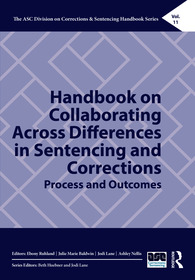
Handbook on Collaborating Across Differences in Sentencing and Corrections
Process and Outcomes
Sorozatcím: The ASC Division on Corrections & Sentencing Handbook Series;
-
10% KEDVEZMÉNY?
- Kiadói listaár GBP 260.00
-
117 390 Ft (111 800 Ft + 5% áfa)
Az ár azért becsült, mert a rendelés pillanatában nem lehet pontosan tudni, hogy a beérkezéskor milyen lesz a forint árfolyama az adott termék eredeti devizájához képest. Ha a forint romlana, kissé többet, ha javulna, kissé kevesebbet kell majd fizetnie.
- Kedvezmény(ek) 10% (kb. 11 739 Ft)
- Kedvezményes ár 105 651 Ft (100 620 Ft + 5% áfa)
105 651 Ft

Beszerezhetőség
Még nem jelent meg, de rendelhető. A megjelenéstől számított néhány héten belül megérkezik.
Why don't you give exact delivery time?
A beszerzés időigényét az eddigi tapasztalatokra alapozva adjuk meg. Azért becsült, mert a terméket külföldről hozzuk be, így a kiadó kiszolgálásának pillanatnyi gyorsaságától is függ. A megadottnál gyorsabb és lassabb szállítás is elképzelhető, de mindent megteszünk, hogy Ön a lehető leghamarabb jusson hozzá a termékhez.
A termék adatai:
- Kiadás sorszáma 1
- Kiadó Routledge
- Megjelenés dátuma 2026. október 5.
- ISBN 9781041315339
- Kötéstípus Keménykötés
- Terjedelem478 oldal
- Méret 254x178 mm
- Nyelv angol
- Illusztrációk 19 Illustrations, black & white; 10 Halftones, black & white; 9 Line drawings, black & white; 18 Tables, black & white 700
Kategóriák
Rövid leírás:
This volume offers a collection of chapters exploring a range of research collaborations within the field of sentencing and corrections, focusing on both process and results.
TöbbHosszú leírás:
This volume offers a collection of chapters exploring a range of research collaborations within the field of sentencing and corrections, focusing on both process and results. Chapters cover partnerships between people and organizations with different trainings, backgrounds, and/or purposes, such as academics in different fields, practitioners, policymakers, and those with and without lived experience in the justice system, with mental health issues, and/or with substance use disorders. The range of sentencing and corrections agencies includes courts, diversion programs or alternatives to incarceration, community supervision departments, and correctional institutions.
Contributions provide valuable insights into the development of such partnerships, highlighting effective strategies, identifying key factors that contribute to successful collaborations, and addressing challenges alongside practical solutions. The sections are organized to focus on critical aspects of collaboration, including the processes of working together in the field, advancing partnerships, achieving desired outcomes, and bridging the gap between academic research and its application by policymakers, practitioners, and the broader public.
The volume shines a light on the importance and impact of collaborating across differences in sentencing and corrections and advances best practices for achieving successful partnerships. This is Volume 11 of The ASC Division on Corrections and Sentencing Handbook Series. The handbooks provide in-depth coverage of seminal and topical issues around sentencing and corrections for scholars, students, practitioners, and policymakers.
"The Handbook on Corrections and Sentencing volume “Collaborating Across Differences in Sentencing and Corrections,” is a literal handbook for establishing and maintaining ethical, engaged, and truly collaborative partnerships in research across an array of contexts within courts and corrections. The editors have brought together an impressive group of contributors who have decades of collective experience, who share their experiences from a variety of perspectives, and who offer insights into the unique challenges that often confront those seeking to not just do translational work, but to do it well. The volume covers it all: the when, the why, the how (and the how-not!) of every aspect of collaborating from nurturing relationships, to establishing and maintaining partnerships, to ensuring their longevity. The consistent emphasis across contributions is rightly on the importance of ensuring mutual benefit in partnerships, whether between researchers, practitioners, community groups, and/or individuals with lived experience. Those interested in ensuring their justice system work has impact must engage in collaborative partnerships to effectively do so and will surely return to this handbook again and again."
Natasha Frost, Professor, Northeastern University, President, American Society of Criminology
"This much needed resource brings together practitioners and researchers to delve into the details of criminal justice collaborations - successes, lessons learned, and tricks of the trade. The chapters highlight the strengths of practitioners and their on the ground expertise of people directly impacted by the criminal justice system, and researchers who have broad in depth knowledge across programs and practices."
Eileen M. Ahlin, Ph.D. Professor, Criminal Justice, Interim Director, School of Public Affairs, Penn State Harrisburg
"This comprehensive and authoritative handbook explores the challenges posed by collaborative partnerships and describes the salient lessons learned from partnerships involving courts and correctional institutions in the United States and elsewhere. The 25 papers included in the volume illustrate how researchers and practitioners can effectively partner to translate research into policy and practice."
Cassia Spohn, PhD, Regents Professor School of Criminology and Criminal Justice, Arizona State University
"Effective implementation of evidence-based policy and practice continues to be among the most pressing challenges facing justice agencies and, by extension, crime and justice researchers. Rather than just assert the importance of research and practitioner partnership, the Eleventh ASC Division of Corrections and Sentencing Handbook, edited by Ruhland, Lane, Baldwin, and Nellis, blends research and accounts of lived experience to assess where we are and chart a path forward. The chapters included in this volume touch on all aspects of building and sustaining vital partnerships. This handbook is an essential resource for anyone interested in evidence-based sentencing and corrections."
Chris Sullivan, Department Chair. Professor, Department of Criminology and Criminal Justice, University of Missouri-St. Louis
Tartalomjegyzék:
Introduction: Collaborating Across Differences in Sentencing and Corrections;1 The Black-Hole Problem in Science and Policy: The Translational Work and Researcher–Practitioner Partnership Solution;2 Building a Culture of Data, Transparency, and Innovation in Corrections With Researcher–Practitioner Partnerships;3 From Storytelling to Structural Change: Advancing Meaningful Collaboration with Lived Experience Experts in Academia;4 Partnerships With Purpose: Advancing Policy Through Academic–Practitioner Collaboration in Probation;5 Bridging Theory and Practice: Applying the Principles of Effective Interventions Through Academic–Practitioner Collaboration;6 The Necessity of Critical Participatory Research in Working Toward Justice in Sentencing: Values Enacted and Lessons Learned; 7 Building Effective Cross-System Collaboration in Problem-Solving Courts: An Examination of STRIDES Federal Mental Health Court;8 Making the MAiD Study: Lessons From a Criminology–Law Partnership;9 An Exploratory Study of Trauma-Informed Courts in a Midwestern State;10 Collaborative Research on Mental Health Training for Corrections Officers: Bridging the Gap Between Practitioners and Academics;11 The ELEVATE Model for Advancing Interagency Collaboration in Opioid Use Disorder Treatment Linkage for People on Probation; 12 Corrections Research: The Benefits, Challenges, and Pitfalls of Using Administrative Data to Address Policy and Practice Questions;13 North and South: The Partnership Between Canadians and the Uganda Prisons Service;14 Conversations With the Least of Thee: Implementing a Restorative, Community-Engaged Reentry Model—the Nehemiah Community Reentry Project;15 “This Is How We Do It”: The Implementation of Procedural Justice in a Treatment Court;16 Community Partnerships, Reentry, and Higher Education in Prison;17 Evaluating Criminal Justice Reforms in California: A Partnership Between Researchers and State and Local Criminal Justice Agencies;18 Creating and Maintaining New Partnerships: Initial Findings From the Creation of an Advisory Board and Research Institute Using Translational Criminology;19 Baby and Mother Bonding Initiative: Community Partnerships to Improve Outcomes for Incarcerated Mothers;20 How Drug Court Practitioners and Researchers Adapted to an Ever-Evolving Landscape: Lessons for Developing Courts;21 The Art of Science Translation: Co-Production as a Key Ingredient; 22 Lessons From a Researcher–Agency Partnership That Produces Results; and 23 Enhancing Researcher–Practitioner Partnerships: Lessons From a Randomized Evaluation of a Pilot Pre-Trial Justice Debt Relief Intervention;24 From Evidence to Impact: Advancing Correctional Practices Through More Accessible and Easily Understood Research Dissemination Products;25 Dear Researchers: Practitioners Called, They Want Their Findings;
Több
