

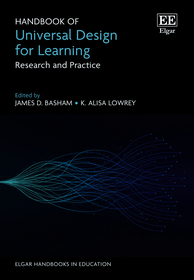
Handbook of Universal Design for Learning
Research and Practice
Sorozatcím: Elgar Handbooks in Education;
-
10% KEDVEZMÉNY?
- A kedvezmény csak az 'Értesítés a kedvenc témákról' hírlevelünk címzettjeinek rendeléseire érvényes.
- Kiadói listaár GBP 215.00
-
97 072 Ft (92 450 Ft + 5% áfa)
Az ár azért becsült, mert a rendelés pillanatában nem lehet pontosan tudni, hogy a beérkezéskor milyen lesz a forint árfolyama az adott termék eredeti devizájához képest. Ha a forint romlana, kissé többet, ha javulna, kissé kevesebbet kell majd fizetnie.
- Kedvezmény(ek) 10% (kb. 9 707 Ft)
- Kedvezményes ár 87 365 Ft (83 205 Ft + 5% áfa)
Iratkozzon fel most és részesüljön kedvezőbb árainkból!
Feliratkozom
97 072 Ft

Beszerezhetőség
Becsült beszerzési idő: A Prosperónál jelenleg nincsen raktáron, de a kiadónál igen. Beszerzés kb. 3-5 hét..
A Prosperónál jelenleg nincsen raktáron.
Why don't you give exact delivery time?
A beszerzés időigényét az eddigi tapasztalatokra alapozva adjuk meg. Azért becsült, mert a terméket külföldről hozzuk be, így a kiadó kiszolgálásának pillanatnyi gyorsaságától is függ. A megadottnál gyorsabb és lassabb szállítás is elképzelhető, de mindent megteszünk, hogy Ön a lehető leghamarabb jusson hozzá a termékhez.
A termék adatai:
- Kiadó Edward Elgar Publishing
- Megjelenés dátuma 2026. április 24.
- ISBN 9781035337842
- Kötéstípus Keménykötés
- Terjedelem406 oldal
- Méret 244x169 mm
- Súly 834 g
- Nyelv angol 783
Kategóriák
Rövid leírás:
This vital Handbook explores Universal Design for Learning (UDL), a flexible framework that helps educators design learning environments that address the diverse needs of all students. James Basham and K. Alisa Lowrey bring together global experts in sociology, neuroscience, education and design to assess how UDL can transform education.
TöbbHosszú leírás:
This vital Handbook explores Universal Design for Learning (UDL), a flexible framework that helps educators design learning environments that address the diverse needs of all students. James Basham and K. Alisa Lowrey bring together global experts in sociology, neuroscience, education and design to assess how UDL can transform education.
Contributing authors explore how UDL’s principles of engagement, representation and expression can be applied across educational contexts from K-12 through to teacher training. They illustrate the ways in which UDL can reduce systemic barriers and encourage designing for learner differences from the start of one’s educational journey, rather than retrofitting lessons after challenges arise. This Handbook addresses pressing issues in the field, including the need for stronger research evidence and implementation, drawing from cutting-edge research in neuroscience, education, and design fields. Focussing on technological innovations such as AI, VR and digital tools, chapters examine practical case studies to emphasize UDL’s potential to promote equity and accessibility.
The Handbook of Universal Design for Learning is an essential resource for students and academics in inclusive education, particularly those focused on instructional design approaches. It will also enlighten educators, educational policymakers and instructional designers developing inclusive educational policy and practice.
‘This Handbook offers a panoramic and generative synthesis of 25 years of scholarship, tracing Universal Design for Learning (UDL) from its early CAST origins to its current status as a global framework shaping instructional design, policy, and technological innovation. The editors craft a historically grounded narrative showing how UDL evolved alongside shifts in digital ecosystems, accessibility movements, and research in learning sciences. The text demonstrates how UDL has become a shared design language for educators, technologists, researchers, and architects committed to building environments structured for learner variability from the outset.
Tartalomjegyzék:
Contents
Preface: A tale of two UDL researchers xv
An introduction to the Handbook of Universal Design for Learning: Research
and Practice 1
James D. Basham and K. Alisa Lowrey
PART I EXPANDING AND EXAMINING UDL
1 The UDL research we have is not the research we need 10
Dave L. Edyburn
2 Universal Design for Learning in the age of artificial intelligence 25
James D. Basham, Angelica Fulchini Scruggs and Yerin Seung
3 Crip methods: Universal Design for Learning in qualitative research 38
Laura N. Sarchet and Samantha G. Daley
4 Reporting on Universal Design for Learning in research 61
Taehyun T. Kim, James D. Basham and Yerin Seung
5 Universal Design for Learning Observation Measurement Tool: Translation
and cross-cultural adaptation into French and Italian 81
Laura Rusconi and Daniela Gäng-Pacifico
PART II UDL ACROSS CONTEXTS AND POSSIBILITIES
6 Universal Design for Learning: What does the law require? 93
MitchellL. Yell, DavidF. Bateman and K.Alisa Lowrey
7 How UDL can support faculty and students in low-resourced settings:
Findings from a mixed methods study in Liberia 108
Nicholas J. Hoekstra and Hayley Niad
8 Preparing for different futures in inclusion: Framing the growth of
the UDL momentum in the K-12 and postsecondary sectors from the
perspective of sustainable development 133
FredericFovet
9 From recommendation to reality: Examining UDL in state education
policies 151
K. Alisa Lowrey, Cassandra H. Williams and L. Denise Williams
10 The pedagogy of possibility: UDL as iteration, critique, and creation 169
Jose Blackorby and Elizabeth Hartmann
11 UDL: A Trojan horse for digital accessibility 188
CynthiaCurry, MindyJohnson andAllisonPosey
PART III DESIGNING WITH INTENTION: UDL AND INCLUSIVE PRACTICE
12 UDL as a process: Intentional and inclusive instructional design for
various learning environments 210
AnyaS. Evmenova and KavitaRao
13 Applying principles of UDL 3.0 to support the inclusion of learners with
complex support needs 223
JenniferA. Kurth and MeganGross
14 The current state of research: Examining Universal Design for Learning
and intellectual disability 235
K.Alisa Lowrey
15 UDL and innovative technologies 247
SeanJ. Smith, AdamCarreon, SamanthaR. Goldman and BridgetC. Smith
16 Environmental design for UDL 262
MichaelC. Ralph, DavidReid
PART IV UDL IN HIGHER EDUCATION AND TEACHER EDUCATION
17 Building expert learners through goal setting and formative feedback 292
SusieL. Gronseth, ThamarSolorio, ManuelMontes-y-Gómez, HugoJ.
Escalante and IoannisA. Kakadiaris
18 The integration of UDL and the Scholarship of Teaching and Learning 300
and EricJ. Moore
19 Application of UDL in higher education and teacher education 311
AleksandraK. Hollingshead and KaeCeeM. Holden
20 The intersection of supports: Accommodations and UDL for student
success 327
JordanShurr and HaleyClark
21 Equipping UDL trainers for change: Skills that support equitable practice 336
LouiLord Nelson and JingrongXie
22 UDL exists in the wild: Where and how we find UDL in higher education 347
CassandraH. Williams and SarahMazur
23 Conclusion: Designing forward—The future of Universal Design for
Learning 358
JamesD. Basham and K.Alisa Lowrey

