

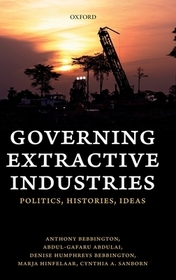
Governing Extractive Industries
Politics, Histories, Ideas
-
10% KEDVEZMÉNY?
- A kedvezmény csak az 'Értesítés a kedvenc témákról' hírlevelünk címzettjeinek rendeléseire érvényes.
- Kiadói listaár GBP 91.00
-
43 475 Ft (41 405 Ft + 5% áfa)
Az ár azért becsült, mert a rendelés pillanatában nem lehet pontosan tudni, hogy a beérkezéskor milyen lesz a forint árfolyama az adott termék eredeti devizájához képest. Ha a forint romlana, kissé többet, ha javulna, kissé kevesebbet kell majd fizetnie.
- Kedvezmény(ek) 10% (cc. 4 348 Ft off)
- Kedvezményes ár 39 128 Ft (37 265 Ft + 5% áfa)
Iratkozzon fel most és részesüljön kedvezőbb árainkból!
Feliratkozom
43 475 Ft

Beszerezhetőség
Megrendelésre a kiadó utánnyomja a könyvet. Rendelhető, de a szokásosnál kicsit lassabban érkezik meg.
Why don't you give exact delivery time?
A beszerzés időigényét az eddigi tapasztalatokra alapozva adjuk meg. Azért becsült, mert a terméket külföldről hozzuk be, így a kiadó kiszolgálásának pillanatnyi gyorsaságától is függ. A megadottnál gyorsabb és lassabb szállítás is elképzelhető, de mindent megteszünk, hogy Ön a lehető leghamarabb jusson hozzá a termékhez.
A termék adatai:
- Kiadó OUP Oxford
- Megjelenés dátuma 2018. július 12.
- ISBN 9780198820932
- Kötéstípus Keménykötés
- Terjedelem292 oldal
- Méret 241x164x22 mm
- Súly 614 g
- Nyelv angol 0
Kategóriák
Rövid leírás:
This book synthesizes findings regarding the political drivers of institutional change in extractive industry governance. It analyses resource governance from the late nineteenth century to the present in Bolivia, Ghana, Peru, and Zambia, focusing on the ways in which resource governance and national political settlements interact.
TöbbHosszú leírás:
This is an open access title available under the terms of a CC BY-NC-ND 4.0 International licence. It is free to read at Oxford Scholarship Online and offered as a free PDF download from OUP and selected open access locations. Proposals for more effective natural resource governance emphasize the importance of institutions and governance, but say less about the political conditions under which institutional change occurs. Governing Extractive Industries synthesizes findings regarding the political drivers of institutional change in extractive industry governance. It analyses resource governance from the late nineteenth century to the present in Bolivia, Ghana, Peru, and Zambia, focusing on the ways in which resource governance and national political settlements interact. The authors focus on the ways in which resource governance and national political settlements interact, exploring the nature of elite politics, the emergence of new political actors, forms of political contention, changing ideas regarding natural resources and development, the geography of natural resource deposits, and the influence of the transnational political economy of global commodity production.
TöbbTartalomjegyzék:
Resource extraction and inclusive development: extending the bases of the political settlements approach
Mining, political settlements, and inclusive development in Peru
Political settlements, natural resource extraction, and inclusion in Bolivia
The politics of natural resource extraction in Zambia
Competitive clientelism and the political economy of mining in Ghana
Conclusions: Interpreting the politics of natural resource extraction

