

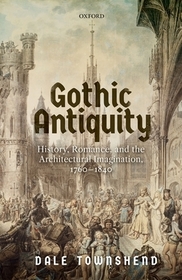
Gothic Antiquity
History, Romance, and the Architectural Imagination, 1760-1840
-
10% KEDVEZMÉNY?
- A kedvezmény csak az 'Értesítés a kedvenc témákról' hírlevelünk címzettjeinek rendeléseire érvényes.
- Kiadói listaár GBP 117.50
-
53 051 Ft (50 525 Ft + 5% áfa)
Az ár azért becsült, mert a rendelés pillanatában nem lehet pontosan tudni, hogy a beérkezéskor milyen lesz a forint árfolyama az adott termék eredeti devizájához képest. Ha a forint romlana, kissé többet, ha javulna, kissé kevesebbet kell majd fizetnie.
- Kedvezmény(ek) 10% (cc. 5 305 Ft off)
- Kedvezményes ár 47 746 Ft (45 473 Ft + 5% áfa)
Iratkozzon fel most és részesüljön kedvezőbb árainkból!
Feliratkozom
53 051 Ft

Beszerezhetőség
Megrendelésre a kiadó utánnyomja a könyvet. Rendelhető, de a szokásosnál kicsit lassabban érkezik meg.
Why don't you give exact delivery time?
A beszerzés időigényét az eddigi tapasztalatokra alapozva adjuk meg. Azért becsült, mert a terméket külföldről hozzuk be, így a kiadó kiszolgálásának pillanatnyi gyorsaságától is függ. A megadottnál gyorsabb és lassabb szállítás is elképzelhető, de mindent megteszünk, hogy Ön a lehető leghamarabb jusson hozzá a termékhez.
A termék adatai:
- Kiadó OUP Oxford
- Megjelenés dátuma 2019. szeptember 26.
- ISBN 9780198845669
- Kötéstípus Keménykötés
- Terjedelem432 oldal
- Méret 242x161x28 mm
- Súly 752 g
- Nyelv angol
- Illusztrációk 23 Illustrations 0
Kategóriák
Rövid leírás:
The first closely historicized study of the relationship between Gothic architecture and Gothic and Romantic literature.
TöbbHosszú leírás:
Gothic Antiquity: History, Romance, and the Architectural Imagination, 1760-1840 provides the first sustained scholarly account of the relationship between Gothic architecture and Gothic literature (fiction; poetry; drama) in the late eighteenth and early nineteenth centuries. Although the relationship between literature and architecture is a topic that has long preoccupied scholars of the literary Gothic, there remains, to date, no monograph-length study of the intriguing and complex interactions between these two aesthetic forms. Equally, Gothic literature has received only the most cursory of treatments in art-historical accounts of the early Gothic Revival in architecture, interiors, and design. In addressing this gap in contemporary scholarship, Gothic Antiquity seeks to situate Gothic writing in relation to the Gothic-architectural theories, aesthetics, and practices with which it was contemporary, providing closely historicized readings of a wide selection of canonical and lesser-known texts and writers. Correspondingly, it shows how these architectural debates responded to, and were to a certain extent shaped by, what we have since come to identify as the literary Gothic mode. In both its 'survivalist' and 'revivalist' forms, the architecture of the Middle Ages in the long eighteenth century was always much more than a matter of style. Incarnating, for better or for worse, the memory of a vanished 'Gothic' age in the modern, enlightened present, Gothic architecture, be it ruined or complete, prompted imaginative reconstructions of the nation's past--a notable 'visionary' turn, as the antiquary John Pinkerton put it in 1788, in which Gothic writers, architects, and antiquaries enthusiastically participated.
The volume establishes a series of dialogues between Gothic literature, architectural history, and the antiquarian interest in the material remains of the Gothic past, and argues that these discrete yet intimately related approaches to vernacular antiquity are most fruitfully read in relation to one another.
Townshend's book is a comprehensive, thoroughly researched, clearly written, quite convincing, and powerfully argued answer—at last—to the incompleteness and polarization in this array of scholarship... Gothic Antiquity, then, is a masterpiece of its kind: densely packed because of its scholarly rigor but also a pleasure to read because of its lucid style and its well-crafted, logical organization... All future research on and teaching about the Gothic's heyday in England, the rise of Romanticism, and the beginnings of the Victorian era, in writing and architecture, will need to take account of this monumental achievement in aesthetic, literary, and historical scholarship.
Tartalomjegyzék:
Preface
Introduction: Gothic Antiquity, Gothic Architecture, Gothic Romance
Associationist Aesthetics and the Foundations of the Architectural Imagination
Horace Walpole's Enchanted Castles
From 'Castles in the Air' to the Topographical Gothic: Locating Ann Radcliffe's Architectural Imagination
Improvement, Repair, and the Uses of the Gothic Past: Architecture, Chivalry, and Romance
Venerable Ruin' or 'Nurseries of Superstition': Ecclesiastical Architecture and the Gothic Literary Aesthetic
Antiquarian Gothic Romance: Castles, Ruins, and Visions of Gothic Antiquity
Conclusion: From the Gothic to the Medieval: Historiography, Romanticism, and the Trajectories of the Architectural Imagination

