

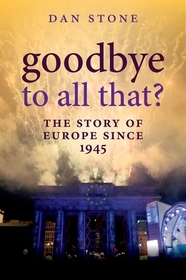
Goodbye to All That?
The Story of Europe Since 1945
-
10% KEDVEZMÉNY?
- A kedvezmény csak az 'Értesítés a kedvenc témákról' hírlevelünk címzettjeinek rendeléseire érvényes.
- Kiadói listaár GBP 31.99
-
14 443 Ft (13 755 Ft + 5% áfa)
Az ár azért becsült, mert a rendelés pillanatában nem lehet pontosan tudni, hogy a beérkezéskor milyen lesz a forint árfolyama az adott termék eredeti devizájához képest. Ha a forint romlana, kissé többet, ha javulna, kissé kevesebbet kell majd fizetnie.
- Kedvezmény(ek) 10% (kb. 1 445 Ft)
- Kedvezményes ár 12 998 Ft (12 380 Ft + 5% áfa)
Iratkozzon fel most és részesüljön kedvezőbb árainkból!
Feliratkozom
14 443 Ft

Beszerezhetőség
Megrendelésre a kiadó utánnyomja a könyvet. Rendelhető, de a szokásosnál kicsit lassabban érkezik meg.
Why don't you give exact delivery time?
A beszerzés időigényét az eddigi tapasztalatokra alapozva adjuk meg. Azért becsült, mert a terméket külföldről hozzuk be, így a kiadó kiszolgálásának pillanatnyi gyorsaságától is függ. A megadottnál gyorsabb és lassabb szállítás is elképzelhető, de mindent megteszünk, hogy Ön a lehető leghamarabb jusson hozzá a termékhez.
A termék adatai:
- Kiadó OUP Oxford
- Megjelenés dátuma 2014. január 23.
- ISBN 9780199697717
- Kötéstípus Keménykötés
- Terjedelem408 oldal
- Méret 240x161x37 mm
- Súly 748 g
- Nyelv angol
- Illusztrációk 15 black and white halftones, 3 maps 0
Kategóriák
Rövid leírás:
The story of Europe's emergence from the catastrophe of fascism and world war - and how the broad anti-fascist consensus on which this was based has ominously unravelled in recent decades.
TöbbHosszú leírás:
In the decade after 1945, as the Cold War freeze set in, a new Europe slowly began to emerge from the ruins of the Second World War, based on a broad rejection of the fascist past that had so scarred the continent's recent history. In the East, this new consensus was enforced by Soviet-imposed Communist regimes. In the West, the process was less coercive, amounting more to a consensus of silence. On both sides, much was deliberately forgotten or obscured.
The years which followed were in many ways golden years for western Europe. Democracy became embedded in Germany, and eventually triumphed over dictatorship in Spain, Portugal, and Greece. Britain and France faced up to the necessity of decolonization. The European Economic Community was founded and went from strength to strength, as the economies of western Europe bounced back from the devastation of the war. The countries of the East lagged far behind and seemed caught in a perpetual game of catch-up, but even there conditions had improved since the end of the war, albeit at a much slower rate. Above all, throughout this period the European world continued to be sustained by the broad anti-fascist consensus that had emerged in the years after 1945.
However, as Dan Stone shows in this new history of the continent since the war, this fundamental consensus began to break down in the wake of the oil shocks of the 1970s, a process which has rapidly accelerated since the end of the Cold War. Globalization, deregulation, and the erosion of social-democratic welfare capitalism in the West, and the collapse of the purported Communist alternative in the East, have all fatally undermined the post-war anti-fascist value system that predominated across Europe in the first four decades after the end of the Second World War.
Ominously, this has been accompanied by a rise in right-wing populism and a widespread revision of the anti-fascist narrative on which this value system was based. The danger of this shift is now evident: financial and social crisis, an increasing inability on the part of European populations to resist historical myth-making, and the re-emergence of fascist ideas. The result, as Dan Stone warns, is socially divisive, politically dangerous, and a genuine threat to the future of a civilized Europe.
A valuable contribution to the historiography of the post-war period.
Tartalomjegyzék:
Preface
Part I: The Rise of the Postwar Consensus
Consensus Enforced: Eastern Europe, 1944-1953
Consensus of Silence: Western Europe, 1944-1953
Part II: Boom to Bust
Golden Years: Western Europe, 1953-1975
Catching Up? Eastern Europe, 1953-1975
Part III: Shock Treatment
Neo-Liberalism: Western Europe, 1975-1989
Gerontocracy: Eastern Europe, 1975-1989
Part IV: The Fall of the Postwar Consensus
Consensus Shattered
Memory Wars
Conclusion
Notes
Index

