

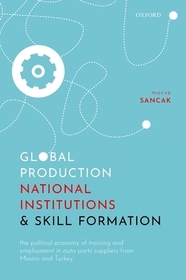
Global Production, National Institutions, and Skill Formation
The Political Economy of Training and Employment in Auto Parts Suppliers from Mexico and Turkey
-
10% KEDVEZMÉNY?
- A kedvezmény csak az 'Értesítés a kedvenc témákról' hírlevelünk címzettjeinek rendeléseire érvényes.
- Kiadói listaár GBP 88.00
-
39 732 Ft (37 840 Ft + 5% áfa)
Az ár azért becsült, mert a rendelés pillanatában nem lehet pontosan tudni, hogy a beérkezéskor milyen lesz a forint árfolyama az adott termék eredeti devizájához képest. Ha a forint romlana, kissé többet, ha javulna, kissé kevesebbet kell majd fizetnie.
- Kedvezmény(ek) 10% (cc. 3 973 Ft off)
- Kedvezményes ár 35 759 Ft (34 056 Ft + 5% áfa)
Iratkozzon fel most és részesüljön kedvezőbb árainkból!
Feliratkozom
39 732 Ft

Beszerezhetőség
Becsült beszerzési idő: A Prosperónál jelenleg nincsen raktáron, de a kiadónál igen. Beszerzés kb. 3-5 hét..
A Prosperónál jelenleg nincsen raktáron.
Why don't you give exact delivery time?
A beszerzés időigényét az eddigi tapasztalatokra alapozva adjuk meg. Azért becsült, mert a terméket külföldről hozzuk be, így a kiadó kiszolgálásának pillanatnyi gyorsaságától is függ. A megadottnál gyorsabb és lassabb szállítás is elképzelhető, de mindent megteszünk, hogy Ön a lehető leghamarabb jusson hozzá a termékhez.
A termék adatai:
- Kiadó OUP Oxford
- Megjelenés dátuma 2022. február 3.
- ISBN 9780198860655
- Kötéstípus Keménykötés
- Terjedelem258 oldal
- Méret 240x162x20 mm
- Súly 536 g
- Nyelv angol 176
Kategóriák
Rövid leírás:
Many middle-income countries face the danger of remaining in the 'middle-income trap' unless they shift to higher value-added activities that require advanced skills. This book examines the skill and training systems of auto parts producers in Mexico and Turkey and the implications of skilling practices for these nations' development prospects.
TöbbHosszú leírás:
Many middle-income countries (MICs) that saw rapid growth in the 1990s and 2000s have been facing the danger of remaining in the 'middle-income trap' unless they shift from labour-intensive, low value-added production to higher value-added activities that require more advanced skills. Intermediate skills and vocational education and training (VET) systems that generate these skills are critical for addressing the challenges for MICs in achieving high-road development.
This book examines the skill systems in Mexico and Turkey, with a focus on auto parts producers, and the implications of these systems for these countries' development. It adopts a multi-layered understanding of the term 'skill system', which comprises firm-level hiring and training practices as well as the national and global dynamics that influence these practices. Drawing on discussions around globalization and the convergence of economic activity vs. national institutions and divergence, as well as interviews with auto parts producers and stakeholders of the skill systems, the book examines how the participation of local firms in global supply chains and these firms' institutional environment affect the firm-level skilling practices. It highlights key differences in the role of the state in the skills systems of Mexico and Turkey and investigates the implications of skilling practices for the high/low-road development prospects of both nations.
... Global Production, National Institutions, and Skill Formation makes a significant contribution to the literature on skilling systems. It should be essential reading for researchers and graduate students pursuing this topic. Labor relations scholars will also find much of value in Sancak's multilevel analysis informed by ideas drawn from several literatures.
Tartalomjegyzék:
Introduction
The Theoretical Approach
The Auto Parts-Automotive Industry in Mexico and Turkey as the Study Case
Patterns of Convergence: Global Auto Parts-Automotive Value Chains and Suppliers' Skill Systems
Institutions of Skill Formation in Turkey: The Role of the State
Institutions of Skill Formation in Mexico: The Role of (Missing) State
The Skilling Practices of Turkish AAI Firms and Their Outcomes for Workers and Firms
Skilling Strategies and Outcomes of the Skill System in Mexico
Concluding remarks

