

-
10% KEDVEZMÉNY?
- A kedvezmény csak az 'Értesítés a kedvenc témákról' hírlevelünk címzettjeinek rendeléseire érvényes.
- Kiadói listaár GBP 16.99
-
7 670 Ft (7 305 Ft + 5% áfa)
Az ár azért becsült, mert a rendelés pillanatában nem lehet pontosan tudni, hogy a beérkezéskor milyen lesz a forint árfolyama az adott termék eredeti devizájához képest. Ha a forint romlana, kissé többet, ha javulna, kissé kevesebbet kell majd fizetnie.
- Kedvezmény(ek) 10% (cc. 767 Ft off)
- Kedvezményes ár 6 903 Ft (6 575 Ft + 5% áfa)
Iratkozzon fel most és részesüljön kedvezőbb árainkból!
Feliratkozom
7 670 Ft

Beszerezhetőség
Becsült beszerzési idő: A Prosperónál jelenleg nincsen raktáron, de a kiadónál igen. Beszerzés kb. 3-5 hét..
A Prosperónál jelenleg nincsen raktáron.
Why don't you give exact delivery time?
A beszerzés időigényét az eddigi tapasztalatokra alapozva adjuk meg. Azért becsült, mert a terméket külföldről hozzuk be, így a kiadó kiszolgálásának pillanatnyi gyorsaságától is függ. A megadottnál gyorsabb és lassabb szállítás is elképzelhető, de mindent megteszünk, hogy Ön a lehető leghamarabb jusson hozzá a termékhez.
A termék adatai:
- Kiadó OUP USA
- Megjelenés dátuma 2025. május 22.
- ISBN 9780197815656
- Kötéstípus Puhakötés
- Terjedelem264 oldal
- Méret 234x152x22 mm
- Súly 363 g
- Nyelv angol 707
Kategóriák
Rövid leírás:
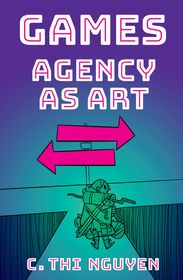
This volume presents a new theory of games which insists on games' unique value in human life. C. Thi Nguyen argues that games are an integral part of how we become mature, free people. Bridging aesthetics and practical reasoning, he gives an account of the special motivational structure involved in playing games. We can pursue goals, not for their own value, but for the sake of the struggle. Playing games involves a motivational inversion from normal life, and the fact that we can engage in this motivational inversion lets us use games to experience forms of agency we might never have developed on our own. Games, then, are a special medium for communication.
TöbbHosszú leírás:
Games are a unique art form. Games work in the medium of agency. Game designers tell us who to be and what to care about during the game. Game designers sculpt alternate agencies, and game players submerge themselves in those alternate agencies. Thus, the fact that we play games demonstrates the fluidity of our own agency. We can throw ourselves, for a little while, into a different and temporary motivations.
This volume presents a new theory of games which insists on their unique value. C. Thi Nguyen argues that games are an integral part our systems of communication and our art. Games sculpt our practical activities, allowing us to experience the beauty of our own actions and reasoning. Bridging aesthetics and practical reasoning, he gives an account of the special motivational structure involved in playing games. When we play games, we can pursue a goal, not for its own value, but for the value of the struggle. Thus, playing games involves a motivational inversion from normal life. We adopt an interest in winning temporarily, so we can experience the beauty of the struggle. Games offer us a temporary experience of life under utterly clear values, in a world engineered to fit to our abilities and goals.
Games also let us to experience forms of agency we might never have developed on our own. Games, it turns out, are a special technique for communication. They are a technology that lets us record and transmit forms of agency. Our games form a "library of agency" and we can explore that library to develop our autonomy. Games use temporary restrictions to force us into new postures of agency.
This book is a total joy to read. Thi Nguyen's energy radiates from every page
Tartalomjegyzék:
Chapter 1: Agency as art
PART I: GAMES AND AGENCY
Chapter 2: The possibility of striving play
Chapter 3: Layers of agency
Chapter 4: Games and autonomy
PART II: AGENCY AND ART
Chapter 5: The aesthetics of agency
Chapter 6: Framed agency
Chapter 7: The distance in the game
PART III: SOCIAL AND MORAL TRANSFORMATIONS
Chapter 8: Games as social transformation
Chapter 9: Gamification and value capture
Chapter 10: The value of striving

