

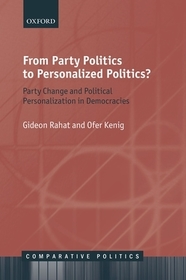
From Party Politics to Personalized Politics?
Party Change and Political Personalization in Democracies
Sorozatcím: Comparative Politics;
-
10% KEDVEZMÉNY?
- A kedvezmény csak az 'Értesítés a kedvenc témákról' hírlevelünk címzettjeinek rendeléseire érvényes.
- Kiadói listaár GBP 110.00
-
52 552 Ft (50 050 Ft + 5% áfa)
Az ár azért becsült, mert a rendelés pillanatában nem lehet pontosan tudni, hogy a beérkezéskor milyen lesz a forint árfolyama az adott termék eredeti devizájához képest. Ha a forint romlana, kissé többet, ha javulna, kissé kevesebbet kell majd fizetnie.
- Kedvezmény(ek) 10% (cc. 5 255 Ft off)
- Kedvezményes ár 47 297 Ft (45 045 Ft + 5% áfa)
Iratkozzon fel most és részesüljön kedvezőbb árainkból!
Feliratkozom
52 552 Ft

Beszerezhetőség
Megrendelésre a kiadó utánnyomja a könyvet. Rendelhető, de a szokásosnál kicsit lassabban érkezik meg.
Why don't you give exact delivery time?
A beszerzés időigényét az eddigi tapasztalatokra alapozva adjuk meg. Azért becsült, mert a terméket külföldről hozzuk be, így a kiadó kiszolgálásának pillanatnyi gyorsaságától is függ. A megadottnál gyorsabb és lassabb szállítás is elképzelhető, de mindent megteszünk, hogy Ön a lehető leghamarabb jusson hozzá a termékhez.
A termék adatai:
- Kiadó OUP Oxford
- Megjelenés dátuma 2018. július 5.
- ISBN 9780198808008
- Kötéstípus Keménykötés
- Terjedelem402 oldal
- Méret 241x163x27 mm
- Súly 756 g
- Nyelv angol 0
Kategóriák
Rövid leírás:
This volumes examines two major developments in contemporary democratic politics-- the change in party-society linkage and political personalization--and their relation to each other.
TöbbHosszú leírás:
What do Beppe Grillo, Silvio Berlusconi, Emmanuel Macron (and also Donald Trump) have in common? They are prime examples of the personalization of politics and the decline of political parties.
This volume systematically examines these two prominent developments in contemporary democratic politics and the relationship between them. It presents a cross-national comparative comparison that covers around 50 years in 26 democracies through the use of more than 20 indicators. It offers the most comprehensive comparative cross-national estimation of the variance in the levels and patterns of party change and political personalization among countries to date, using existing works as well injecting fresh cross-national comparative data. In the case of party change, it offers an analysis that extends beyond the dichotomous debate of party decline versus party adaptation. In the matter of political personalization, the emphasis on variance helps in bridging between the high theoretical expectations and disappointing empirical findings. As for the theoretically sound linkage between the two phenomena, not only is this the first study to comprise a comprehensive cross-national examination, but it also proposes a more nuanced understanding of this relationship.
Comparative Politics is a series for researchers, teachers, and students of political science that deals with contemporary government and politics. Global in scope, books in the series are characterised by a stress on comparative analysis and strong methodological rigour. The series is published in association with the European Consortium for Political Research. For more information visit: www.ecprnet.eu.
The series is edited by Emilie van Haute, Professor of Political Science, Université libre de Bruxelles; Ferdinand Müller-Rommel, Director of the Center for the Study of Democracy, Leuphana University; and Susan Scarrow, John and Rebecca Moores Professor of Political Science, University of Houston.
Tartalomjegyzék:
Introduction
Part One: Party Change
Party Change: The Variance Hiding Behind the General Trend
Indicators of Party Change
The Presence and Success of National-Level Parties in Local and Regional Elections
A Cross-National Comparison of Party Change
Part Two: Political Personalization
Political Personalization: Definition, Typology, and Causes
Indicators of Political Personalization
Parties vs. Politicians Online
A Cross-National Analysis of Political Personalization
Part Three: Party Change and Political Personalization
Party Change and Political Personalization: A Critical Overview of the Literature
Party Change and Political Personalization: An Empirical Analysis
Summary and Conclusions
Appendices

