

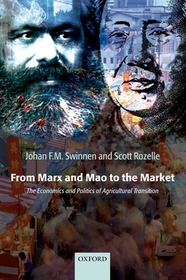
From Marx and Mao to the Market
The Economics and Politics of Agricultural Transition
-
10% KEDVEZMÉNY?
- A kedvezmény csak az 'Értesítés a kedvenc témákról' hírlevelünk címzettjeinek rendeléseire érvényes.
- Kiadói listaár GBP 142.50
-
64 338 Ft (61 275 Ft + 5% áfa)
Az ár azért becsült, mert a rendelés pillanatában nem lehet pontosan tudni, hogy a beérkezéskor milyen lesz a forint árfolyama az adott termék eredeti devizájához képest. Ha a forint romlana, kissé többet, ha javulna, kissé kevesebbet kell majd fizetnie.
- Kedvezmény(ek) 10% (cc. 6 434 Ft off)
- Kedvezményes ár 57 905 Ft (55 148 Ft + 5% áfa)
Iratkozzon fel most és részesüljön kedvezőbb árainkból!
Feliratkozom
64 338 Ft

Beszerezhetőség
Megrendelésre a kiadó utánnyomja a könyvet. Rendelhető, de a szokásosnál kicsit lassabban érkezik meg.
Why don't you give exact delivery time?
A beszerzés időigényét az eddigi tapasztalatokra alapozva adjuk meg. Azért becsült, mert a terméket külföldről hozzuk be, így a kiadó kiszolgálásának pillanatnyi gyorsaságától is függ. A megadottnál gyorsabb és lassabb szállítás is elképzelhető, de mindent megteszünk, hogy Ön a lehető leghamarabb jusson hozzá a termékhez.
A termék adatai:
- Kiadó OUP Oxford
- Megjelenés dátuma 2006. január 26.
- ISBN 9780199288915
- Kötéstípus Keménykötés
- Terjedelem240 oldal
- Méret 243x163x19 mm
- Súly 510 g
- Nyelv angol
- Illusztrációk 18 figures and 12 tables 0
Kategóriák
Rövid leírás:
Studying agrarian transition in more than 25 countries from Central and Eastern Europe, the former Soviet Union, and East Asia, this book is the first effort to analyze the economics and politics of the reforms in agriculture by comparing the reform processes, their causes and their effects across this vast region.
TöbbHosszú leírás:
The emergence of China as a global economic powerhouse, the uncertain path of Russia towards a market economy, and the integration of ten Central and Eastern European countries into the European Union (EU) have occupied the minds and agendas of many policy-makers, business leaders and scholars from around the world at the end of the twentieth and the beginning of the twenty-first century. Twenty years ago these developments were unimaginable. The impact of these changes is so vast that the importance of understanding the forces that unleashed this process, how these changes became possible, and what the lessons are for other developing countries, cannot be overestimated.
This book is the first effort to analyze the economics and politics of agricultural reforms by comparing the reform processes, their causes and their effects across this vast region. The authors draw on a vast set of studies and new data, which compare reforms and economic impacts in more than 25 countries, to come up with a series of conclusions and implications on the role of economic reforms in growth, and the importance of initial conditions and political constraints in explaining the choices that were made and their effects.
The book analyzes some of the most successful sets of agricultural policies in history that have lifted people out of poverty, raising productivity and incomes by staggering amounts. At the same time the book explains the reasons behind dramatic failures in policy processes and reforms that caused hunger, poverty and which had devastating effects on economic growth and development for millions of other people.
Tartalomjegyzék:
Preface
Introduction
The economics of agricultural transition
Patterns of transition
A model of agricultural transition
Policy reforms
The effects of the reforms
The political economy of agricultural transition
Basic determinants of reform strategies
Why did the Communist party reform in China, but not in the Soviet Union?
Determining the pace of market liberalization
The political economy of property rights reform and farm restructuring
Conclusions, lessons and new developments
Conclusions
Lessons of agricultural transition
The second decade of transition

