

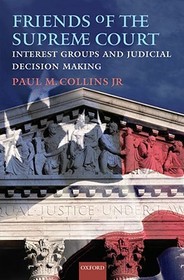
Friends of the Supreme Court: Interest Groups and Judicial Decision Making
-
10% KEDVEZMÉNY?
- A kedvezmény csak az 'Értesítés a kedvenc témákról' hírlevelünk címzettjeinek rendeléseire érvényes.
- Kiadói listaár GBP 120.00
-
54 180 Ft (51 600 Ft + 5% áfa)
Az ár azért becsült, mert a rendelés pillanatában nem lehet pontosan tudni, hogy a beérkezéskor milyen lesz a forint árfolyama az adott termék eredeti devizájához képest. Ha a forint romlana, kissé többet, ha javulna, kissé kevesebbet kell majd fizetnie.
- Kedvezmény(ek) 10% (kb. 5 418 Ft)
- Kedvezményes ár 48 762 Ft (46 440 Ft + 5% áfa)
Iratkozzon fel most és részesüljön kedvezőbb árainkból!
Feliratkozom
54 180 Ft

Beszerezhetőség
Megrendelésre a kiadó utánnyomja a könyvet. Rendelhető, de a szokásosnál kicsit lassabban érkezik meg.
Why don't you give exact delivery time?
A beszerzés időigényét az eddigi tapasztalatokra alapozva adjuk meg. Azért becsült, mert a terméket külföldről hozzuk be, így a kiadó kiszolgálásának pillanatnyi gyorsaságától is függ. A megadottnál gyorsabb és lassabb szállítás is elképzelhető, de mindent megteszünk, hogy Ön a lehető leghamarabb jusson hozzá a termékhez.
A termék adatai:
- Kiadó OUP USA
- Megjelenés dátuma 2008. szeptember 4.
- ISBN 9780195372144
- Kötéstípus Keménykötés
- Terjedelem248 oldal
- Méret 160x236x22 mm
- Súly 488 g
- Nyelv angol 0
Kategóriák
Hosszú leírás:
The U.S. Supreme Court is a public policy battleground in which organized interests attempt to etch their economic, legal, and political preferences into law through the filing of amicus curiae ("friend of the court") briefs. In Friends of the Supreme Court: Interest Groups and Judicial Decision Making, Paul M. Collins, Jr. explores how organized interests influence the justices' decision making, including how the justices vote and whether they choose to author concurrences and dissents. Collins presents theories of judicial choice derived from disciplines as diverse as law, marketing, political science, and social psychology. This theoretically rich and empirically rigorous treatment of decision-making on the nation's highest court, which represents the most comprehensive examination ever undertaken of the influence of U.S. Supreme Court amicus briefs, provides clear evidence that interest groups play a significant role in shaping the justices' choices.
We have a well-documented and thorough examination of amicus participation and the influence of these briefs on the justices and their votes. The data are excellent and the work thorough. For scholars interested in an eclectic approach to the study of the decision making of the justices, it is a book worth reading.
Tartalomjegyzék:
Author Biography
Dedication
Acknowledgements
I. Introduction
II. Interest Group Litigation
III. Amicus Curiae Participation in the Supreme Court
IV. Amici Curiae and Judicial Decision Making
V. Amici Curiae and the Consistency of Judicial Decision Making
VI. Amici Curiae and Dissensus on the Supreme Court
VII. Conclusions and Implications
Appendix: Data and Data Reliability
References
Table of Cases
Index

