

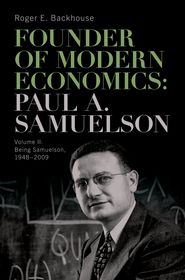
Founder of Modern Economics: Paul A. Samuelson
Volume II: Being Samuelson, 1948?2009
Sorozatcím: Oxford Studies in the History of Economics;
-
10% KEDVEZMÉNY?
- A kedvezmény csak az 'Értesítés a kedvenc témákról' hírlevelünk címzettjeinek rendeléseire érvényes.
- Kiadói listaár GBP 25.99
-
11 734 Ft (11 175 Ft + 5% áfa)
Az ár azért becsült, mert a rendelés pillanatában nem lehet pontosan tudni, hogy a beérkezéskor milyen lesz a forint árfolyama az adott termék eredeti devizájához képest. Ha a forint romlana, kissé többet, ha javulna, kissé kevesebbet kell majd fizetnie.
- Kedvezmény(ek) 10% (kb. 1 174 Ft)
- Kedvezményes ár 10 560 Ft (10 058 Ft + 5% áfa)
Iratkozzon fel most és részesüljön kedvezőbb árainkból!
Feliratkozom
11 734 Ft

Beszerezhetőség
Becsült beszerzési idő: A Prosperónál jelenleg nincsen raktáron, de a kiadónál igen. Beszerzés kb. 3-5 hét..
A Prosperónál jelenleg nincsen raktáron.
Why don't you give exact delivery time?
A beszerzés időigényét az eddigi tapasztalatokra alapozva adjuk meg. Azért becsült, mert a terméket külföldről hozzuk be, így a kiadó kiszolgálásának pillanatnyi gyorsaságától is függ. A megadottnál gyorsabb és lassabb szállítás is elképzelhető, de mindent megteszünk, hogy Ön a lehető leghamarabb jusson hozzá a termékhez.
A termék adatai:
- Kiadó OUP USA
- Megjelenés dátuma 2026. július 9.
- ISBN 9780197812822
- Kötéstípus Keménykötés
- Terjedelem768 oldal
- Méret 243x166x50 mm
- Súly 1225 g
- Nyelv angol 694
Kategóriák
Rövid leírás:
Volume I of this intellectual biography told the story of someone who established himself as the most promising economist of his generation. This volume shows how he went on to dominate the subject. He was well known as a mathematical economist at a time when the use of mathematics in economics was in its infancy but, as this volume shows, he was far more than that.
TöbbHosszú leírás:
Paul A. Samuelson is widely regarded as the world's leading economist in the so-called ?Age of Keynes?, the three decades after WWII, acknowledged by his being the first American to win the Nobel prize in economics. Foundations of Economic Analysis was a manual on how economic theory should be done, and the nineteen editions of Economics: An Introductory Analysis provided the first exposure to economics for millions of students worldwide.
Volume I of this intellectual biography told the story of someone who established himself as the most promising economist of his generation. This volume shows how he went on to dominate the subject. He was well known as a mathematical economist at a time when the use of mathematics in economics was in its infancy but, as this volume shows, he was far more than that. He wrote seminal articles in field after field, including consumer behaviour, international trade, consumer, finance, public expenditure, optimal taxation, the economics of inflation and unemployment, and many others. He had the ability to use his knowledge of mathematics to simplify economic problems, providing the concepts that other economists could use and yet he could write in a style that entertained as well as informed his readers. He helped transform of his department at the Massachusetts Institute of Technology from a relative backwater into the most influential economics department in the United States, its graduates filling influential positions in academia, central banks, and the provision of economic advice to government. He was active in trading commodities and played a significant role in the establishment of index funds. An innovative feature of this biography is that it is not confined to what he called his scientific work but covers his political economy (his analysis of current events and his policy advice) in depth. From the start of his academic career, he was in demand as an economic adviser, his most prominent role being as adviser to President John Kennedy, and he was a regular columnist for newspapers and news magazines from the Financial Times to the Washington Post and Newsweek and a range of Japanese and Korean newspapers.
Tartalomjegyzék:
Introduction
Part I. New Horizons, 1948?60
MIT and Japan
Inflation and Stabilization Policy, 1948?60
RAND and Activity Analysis
Economic Theory, The 1950s
Public Economics, The 1950s
Economics, 1951?59
Science, Natural, and Social
Part II. The Kennedy?Johnson Years, 1960?68
Advising John F. Kennedy, 1960?63
Johnson and Newsweek, 1963?68
Economic Theory, The 1960s
The Two Cambridges
Marxism and the History of Economic Thought
Sunday Painting
Part III. Nobel Prize Winner, 1968?80
Recognition
Monetarism and Economic Crises of the 1970s
Government and the Law
Economic Theory, 1968?80
Mathematical Biology
Part IV. ?Retirement,? 1980?2009
Political Economy After 1980
Mathematical Theory After 1980
Reflections on Economists
Creating Modern Economics

