

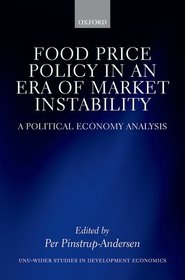
Food Price Policy in an Era of Market Instability
A Political Economy Analysis
Sorozatcím: WIDER Studies in Development Economics;
-
10% KEDVEZMÉNY?
- A kedvezmény csak az 'Értesítés a kedvenc témákról' hírlevelünk címzettjeinek rendeléseire érvényes.
- Kiadói listaár GBP 150.00
-
67 725 Ft (64 500 Ft + 5% áfa)
Az ár azért becsült, mert a rendelés pillanatában nem lehet pontosan tudni, hogy a beérkezéskor milyen lesz a forint árfolyama az adott termék eredeti devizájához képest. Ha a forint romlana, kissé többet, ha javulna, kissé kevesebbet kell majd fizetnie.
- Kedvezmény(ek) 10% (kb. 6 773 Ft)
- Kedvezményes ár 60 953 Ft (58 050 Ft + 5% áfa)
Iratkozzon fel most és részesüljön kedvezőbb árainkból!
Feliratkozom
67 725 Ft

Beszerezhetőség
Megrendelésre a kiadó utánnyomja a könyvet. Rendelhető, de a szokásosnál kicsit lassabban érkezik meg.
Why don't you give exact delivery time?
A beszerzés időigényét az eddigi tapasztalatokra alapozva adjuk meg. Azért becsült, mert a terméket külföldről hozzuk be, így a kiadó kiszolgálásának pillanatnyi gyorsaságától is függ. A megadottnál gyorsabb és lassabb szállítás is elképzelhető, de mindent megteszünk, hogy Ön a lehető leghamarabb jusson hozzá a termékhez.
A termék adatai:
- Kiadó OUP Oxford
- Megjelenés dátuma 2014. november 27.
- ISBN 9780198718574
- Kötéstípus Keménykötés
- Terjedelem544 oldal
- Méret 241x163x35 mm
- Súly 952 g
- Nyelv angol
- Illusztrációk 87 Figures and 21 Tables 0
Kategóriák
Rövid leírás:
Food price volatility is one of the major challenges facing current and future global food systems. This book analyses how and why governments responded as they did to the global food crisis of 2007-09 and what their decisions can teach us about policy interventions.
TöbbHosszú leírás:
This is an open access title available under the terms of a CC BY-NC-SA 3.0 IGO licence. It is free to read at Oxford Scholarship Online and offered as a free PDF download from OUP and selected open access locations.
Food price volatility is one of the major challenges facing current and future global food systems. Since 2006, global food prices have fluctuated greatly around an increasing trend and price spikes were observed for key food commodities such as rice, wheat, and maize. The full or partial transmission of these global food price changes to individual developing countries, together with domestic food price changes, caused by domestic factors such as extreme weather events and market disruptions, caused governments to respond in a variety of ways. While there is ample description of the nature, content, and causes of food price fluctuations during the last 5 to 7 years, very little is known about the processes that led to policy responses or the relative power and behaviour of the participating stakeholder groups. Understanding how and why governments responded as they did is important to enhance the existing knowledge of the political economy of food price policy and to assist governments in their policy-making as they confront future food price fluctuations. This book presents results from political economy studies of food price policy in 14 developing countries as well as the United States and the European Union.
this book presents results from political economy studies of food price policy in 14 developing countries as well as the US and the EU ... Recommended.
Tartalomjegyzék:
Part I: An Overview
The Political Economy of Food Price Policy: An Overview
Part II: Syntheses of Findings from Country Studies
International to Domestic Price Transmission in 14 Developing Countries during the 2007-08 Food Crisis
A Cacophony of Policy Responses: Evidence from 14 Countries during the 2007-08 Food Price Crisis
Policy Processes and Food Price Crises: A Framework for Analysis and Lessons from Country Studies
A Political Economy Synthesis of Food Price Policy in 14 Countries
Part III: The Political Economy of Food Price Policy in Low-Income Landlocked Countries
The Political Economy of Food Price Policy in Ethiopia
The Political Economy of Food Price Policy in Malawi
The Political Economy of Food Price Policy in Zambia
Part IV: The Political Economy of Food Price Policy in Low-Income Countries with Limited Dependence on Food Imports
The Political Economy of Food Price Policy in Kenya
The Political Economy of Food Price Policy in Mozambique
Part V: The Political Economy of Food Price Policy in Low and Middle-Income Countries Heavily Dependent on Food Import
The Political Economy of Food Price Policy in Bangladesh
The Political Economy of Food Price Policy in Egypt
The Political Economy of Food Price Policy in Nigeria
The Political Economy of Food Price Policy in Senegal
Part VI: The Political Economy of Food Price Policy in Large Exporters
The Political Economy of Food Price Policy in Vietnam
The Political Economy of Food Price Policy in India
The Political Economy of Food Price Policy in China
The Political Economy of Food Price Policy in Brazil
The Political Economy of Food Price Policy in South Africa
Part VII: The Political Economy of Food Price Policy in High-Income Countries
US Policy Contributions to Agricultural Commodity Price Fluctuations 2006-12
Food Price Volatility and EU Policies
Part VIII: Conclusions and Recommendations
The Political Economy of Food Price Policy: Key Policy-Related Lessons

