

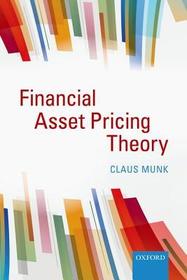
Financial Asset Pricing Theory
-
10% KEDVEZMÉNY?
- A kedvezmény csak az 'Értesítés a kedvenc témákról' hírlevelünk címzettjeinek rendeléseire érvényes.
- Kiadói listaár GBP 59.00
-
26 638 Ft (25 370 Ft + 5% áfa)
Az ár azért becsült, mert a rendelés pillanatában nem lehet pontosan tudni, hogy a beérkezéskor milyen lesz a forint árfolyama az adott termék eredeti devizájához képest. Ha a forint romlana, kissé többet, ha javulna, kissé kevesebbet kell majd fizetnie.
- Kedvezmény(ek) 10% (cc. 2 664 Ft off)
- Kedvezményes ár 23 975 Ft (22 833 Ft + 5% áfa)
Iratkozzon fel most és részesüljön kedvezőbb árainkból!
Feliratkozom
26 638 Ft

Beszerezhetőség
Megrendelésre a kiadó utánnyomja a könyvet. Rendelhető, de a szokásosnál kicsit lassabban érkezik meg.
Why don't you give exact delivery time?
A beszerzés időigényét az eddigi tapasztalatokra alapozva adjuk meg. Azért becsült, mert a terméket külföldről hozzuk be, így a kiadó kiszolgálásának pillanatnyi gyorsaságától is függ. A megadottnál gyorsabb és lassabb szállítás is elképzelhető, de mindent megteszünk, hogy Ön a lehető leghamarabb jusson hozzá a termékhez.
A termék adatai:
- Kiadó OUP Oxford
- Megjelenés dátuma 2015. február 12.
- ISBN 9780198716457
- Kötéstípus Puhakötés
- Terjedelem597 oldal
- Méret 156x234x31 mm
- Súly 900 g
- Nyelv angol
- Illusztrációk 21 Figures and 16 Tables 0
Kategóriák
Rövid leírás:
The book presents models for the pricing of financial assets such as stocks, bonds, and options. The models are formulated and analysed using concepts and techniques from mathematics and probability theory. It presents important classic models and some recent 'state-of-the-art' models that outperform the classics.
TöbbHosszú leírás:
Financial Asset Pricing Theory offers a comprehensive overview of the classic and the current research in theoretical asset pricing. Asset pricing is developed around the concept of a state-price deflator which relates the price of any asset to its future (risky) dividends and thus incorporates how to adjust for both time and risk in asset valuation. The willingness of any utility-maximizing investor to shift consumption over time defines a state-price deflator which provides a link between optimal consumption and asset prices that leads to the Consumption-based Capital Asset Pricing Model (CCAPM). A simple version of the CCAPM cannot explain various stylized asset pricing facts, but these asset pricing 'puzzles' can be resolved by a number of recent extensions involving habit formation, recursive utility, multiple consumption goods, and long-run consumption risks. Other valuation techniques and modelling approaches (such as factor models, term structure models, risk-neutral valuation, and option pricing models) are explained and related to state-price deflators.
The book will serve as a textbook for an advanced course in theoretical financial economics in a PhD or a quantitative Master of Science program. It will also be a useful reference book for researchers and finance professionals. The presentation in the book balances formal mathematical modelling and economic intuition and understanding. Both discrete-time and continuous-time models are covered. The necessary concepts and techniques concerning stochastic processes are carefully explained in a separate chapter so that only limited previous exposure to dynamic finance models is required.
This monograph provides a consistent and comprehensive presentation of the classical asset pricing paradigm, from the basics of the theory to the latest developments in the field. The reader's task is simplified by the consistent notation and the integrated conceptual framework that is employed; his technical facility improved by the extensive proofs of the main results that are offered; and his curiosity piqued by the extensive references to the empirical literature. The expert will find it a convenient reference and the student will find it an invaluable guide.
Tartalomjegyzék:
Preface
Introduction and Overview
Uncertainty, Information, and Stochastic Processes
Portfolios, Arbitrage, and Market Completeness
State Prices
Preferences
Individual Optimality
Market Equilibrium
Basic Consumption-Based Asset Pricing
Advanced Consumption-Based Asset Pricing
Factor Models
The Economics of the Term Structure of Interest Rates
Risk-Adjusted Probabilities
Derivatives
Appendix A. A Review of Basic Probability Concepts
Appendix B. Results on the Lognormal Distribution
Appendix C. Results from Linear Algebra

