

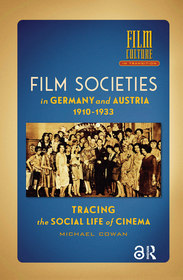
Film Societies in Germany and Austria 1910-1933
Tracing the Social Life of Cinema
Sorozatcím: Film Culture in Transition;
-
10% KEDVEZMÉNY?
- Kiadói listaár GBP 45.99
-
20 764 Ft (19 775 Ft + 5% áfa)
Az ár azért becsült, mert a rendelés pillanatában nem lehet pontosan tudni, hogy a beérkezéskor milyen lesz a forint árfolyama az adott termék eredeti devizájához képest. Ha a forint romlana, kissé többet, ha javulna, kissé kevesebbet kell majd fizetnie.
- Kedvezmény(ek) 10% (cc. 2 076 Ft off)
- Kedvezményes ár 18 687 Ft (17 798 Ft + 5% áfa)
18 687 Ft

Beszerezhetőség
Becsült beszerzési idő: A Prosperónál jelenleg nincsen raktáron, de a kiadónál igen. Beszerzés kb. 3-5 hét..
A Prosperónál jelenleg nincsen raktáron.
Why don't you give exact delivery time?
A beszerzés időigényét az eddigi tapasztalatokra alapozva adjuk meg. Azért becsült, mert a terméket külföldről hozzuk be, így a kiadó kiszolgálásának pillanatnyi gyorsaságától is függ. A megadottnál gyorsabb és lassabb szállítás is elképzelhető, de mindent megteszünk, hogy Ön a lehető leghamarabb jusson hozzá a termékhez.
A termék adatai:
- Kiadás sorszáma 1
- Kiadó Routledge
- Megjelenés dátuma 2025. december 1.
- ISBN 9781041179399
- Kötéstípus Puhakötés
- Terjedelem274 oldal
- Méret 234x156 mm
- Nyelv angol 752
Kategóriák
Rövid leírás:
This study traces the evolution of early film societies in Germany and Austria, from the emergence of mass movie theaters in the 1910s to the turbulent years of the late Weimar Republic.
TöbbHosszú leírás:
This study traces the evolution of early film societies in Germany and Austria, from the emergence of mass movie theaters in the 1910s to the turbulent years of the late Weimar Republic. Examining a diverse array of groups, it approaches film societies as formations designed to assimilate and influence a new medium: a project emerging from the world of amateur science before taking new directions into industry, art and politics. Through an interdisciplinary approach—in dialogue with social history, print history and media archaeology—it also transforms our theoretical understanding of what a film society was and how it operated. Far from representing a mere collection of pre-formed cinephiles, film societies were, according to the book’s central argument, productive social formations, which taught people how to nurture their passion for the movies, how to engage with cinema, and how to interact with each other. Ultimately, the study argues that examining film societies can help to reveal the diffuse agency by which generative ideas of cinema take shape.
TöbbTartalomjegyzék:
LIST OF ILLUSTRATIONS, INTRODUCTION – WHAT WAS A FILM SOCIETY? TOWARDS A NEW ARCHAEOLOGY OF SCREEN COMMUNITIES, CHAPTER 1 – THE KNOWLEDGE COMMUNITY: THE BIRTH OF THE FILM SOCIETY FROM THE SPIRIT OF AMATEUR SCIENCE, CHAPTER 2 – THE PROFESSIONAL COMMUNITY: CONCEPTUALIZING THE FILM INDUSTRY IN THE DEUTSCHE KINOTECHNISCHE GESELLSCHAFT, CHAPTER 3 – COMMUNITIES OF LOVE: CINEPHILIC FILM CLUBS, MOVIE MAGAZINES AND THE VIENNESE KINOGEMEINDE, CHAPTER 4 – THE SKEPTICAL COMMUNITY: LEFT-WING FILM SOCIETIES AND THE MAKING OF THE SUSPICIOUS SPECTATOR, AFTERWORD: WHAT’S IN AN ‘IDEA’?, BIBLIOGRAPHY.
Több
