

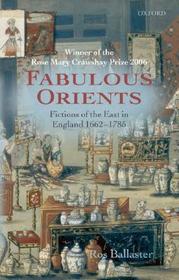
Fabulous Orients
Fictions of the East in England 1662-1785
-
10% KEDVEZMÉNY?
- A kedvezmény csak az 'Értesítés a kedvenc témákról' hírlevelünk címzettjeinek rendeléseire érvényes.
- Kiadói listaár GBP 52.00
-
23 478 Ft (22 360 Ft + 5% áfa)
Az ár azért becsült, mert a rendelés pillanatában nem lehet pontosan tudni, hogy a beérkezéskor milyen lesz a forint árfolyama az adott termék eredeti devizájához képest. Ha a forint romlana, kissé többet, ha javulna, kissé kevesebbet kell majd fizetnie.
- Kedvezmény(ek) % (cc. 0 Ft off)
- Kedvezményes ár 0 Ft (0 Ft + 5% áfa)
Iratkozzon fel most és részesüljön kedvezőbb árainkból!
Feliratkozom
23 478 Ft

Beszerezhetőség
Megrendelésre a kiadó utánnyomja a könyvet. Rendelhető, de a szokásosnál kicsit lassabban érkezik meg.
Why don't you give exact delivery time?
A beszerzés időigényét az eddigi tapasztalatokra alapozva adjuk meg. Azért becsült, mert a terméket külföldről hozzuk be, így a kiadó kiszolgálásának pillanatnyi gyorsaságától is függ. A megadottnál gyorsabb és lassabb szállítás is elképzelhető, de mindent megteszünk, hogy Ön a lehető leghamarabb jusson hozzá a termékhez.
A termék adatai:
- Kiadó OUP Oxford
- Megjelenés dátuma 2007. november 1.
- ISBN 9780199234295
- Kötéstípus Puhakötés
- Terjedelem424 oldal
- Méret 215x137x21 mm
- Súly 529 g
- Nyelv angol
- Illusztrációk 19 black-and-white halftones 0
Kategóriák
Rövid leírás:
The first book-length study of the oriental tale in England since 1908, Fabulous Orients is an original work of criticism which illustrates the centrality of narratives of and from the eastern territories of Turkey, Persia, China, and India in the formation of the novel and constructions of western identity in a culture on the threshold of empire.
TöbbHosszú leírás:
Narrative moves. Stories migrate from one culture to another, over vast distances sometimes, but their path is often difficult to trace and obscured by time. Fabulous Orients looks at the traffic of narrative between Orient and Occident in the eighteenth century, and challenges the assumption that has dominated since the publication of Edward Said's Orientalism (1978) that such traffic is always one-way. Eighteenth-century readers in the West came to draw their mental maps of oriental territories and distinctions between them from their experience of reading tales 'from' the Orient.
In this proto-colonial period the English encounter with the East was largely mediated through the consumption of material goods such as silks, indigo, muslin, spices, or jewels, imported from the East, together with the more 'moral' traffic of narratives about the East, both imaginary and ethnographic. Through analyses of fictional representations (including travellers' accounts, letter narratives such as Letters Writ by a Turkish Spy, and popular sequences of tales such as the Arabian Nights Entertainments) of four oriental territories (Persia, Turkey, China and India), Ros Ballaster demonstrates the ways in which the East came to be understood as a source of story, a territory of fable and narrative.
Fabulous Orients is structured according to territory rather than genre. Each section opens by re-narrating an oriental story in which a feminine character serves to 'figure' western desire for the territory she represents: the courtesan queen of the Ottoman seraglio Roxolana; the riddling Chinese princess Turandocte; and the illusory sati of India, Canzade. The book goes on to explore the range of fabulous writings relating to each territory in order to illustrate how certain narrative tropes can come to dominate its representation: the conflict between the male look and female speech staged in the seraglio in the case of Turkey and Persia, the inauthenticity and/or dullness associated with China and its products such as porcelain, and the illusory dreams that are woven in the space of India and associated with its textile industries.
This is the first book-length study of the oriental tale to appear for almost a century. Informed by recent historiographical and literary re-assessments of western constructions of the East, it develops an original argument about the use of narrative as a form of sympathetic and imaginative engagement with otherness, a disinvestment of the self rather than a confident expression of colonial or imperial ambition.
Review from previous edition a very welcome addition to the available scholarship
Tartalomjegyzék:
1. Narrative moves
Dinarzade, the second string
The state of narrative
2. Shape shifting: oriental tales
Fadlallah and Zemroude, transmigratory desires
The framed sequence
Travellers' tales
Fictional letters
Histories
Heroic drama
A passion for tales
3. Tales of the seraglio: Turkey and Persia
Roxolana: the loquacious courtesan
Speaking likenesses: Turkey and Persia
Loquacious women I: staging the Orient
Loquacious women II: narrating the Orient
Speculative men I: spies and correspondents
Speculative men II: court secrets
'Fabulous and Romantic': the Embassy Letters and the Sultan's Tale
4. 'Bearing Confucius' morals to Britannia's ears': China
Turandocte: the riddling princess
Chinese whispers
Orphans and absolutism: tragedies of state
Empires of Dulness
Narrative transmigrations
Chinese letters of reason
Madness and civilization
5. 'Dreams of men awake': India
Canzade: the illusory sati
India as illusion
'The dreaming priest': Aureng-Zebe
The treasures of the East: Indian tales
Tales of India: weaving illusions
The Indian fable: rational animals
Waking from the dream
6. Epilogue: Romantic revisions of the Orient

