

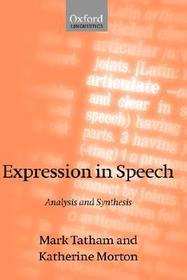
Expression in Speech
Analysis and Synthesis
-
10% KEDVEZMÉNY?
- A kedvezmény csak az 'Értesítés a kedvenc témákról' hírlevelünk címzettjeinek rendeléseire érvényes.
- Kiadói listaár GBP 290.00
-
130 935 Ft (124 700 Ft + 5% áfa)
Az ár azért becsült, mert a rendelés pillanatában nem lehet pontosan tudni, hogy a beérkezéskor milyen lesz a forint árfolyama az adott termék eredeti devizájához képest. Ha a forint romlana, kissé többet, ha javulna, kissé kevesebbet kell majd fizetnie.
- Kedvezmény(ek) 10% (kb. 13 094 Ft)
- Kedvezményes ár 117 842 Ft (112 230 Ft + 5% áfa)
Iratkozzon fel most és részesüljön kedvezőbb árainkból!
Feliratkozom
130 935 Ft

Beszerezhetőség
Megrendelésre a kiadó utánnyomja a könyvet. Rendelhető, de a szokásosnál kicsit lassabban érkezik meg.
Why don't you give exact delivery time?
A beszerzés időigényét az eddigi tapasztalatokra alapozva adjuk meg. Azért becsült, mert a terméket külföldről hozzuk be, így a kiadó kiszolgálásának pillanatnyi gyorsaságától is függ. A megadottnál gyorsabb és lassabb szállítás is elképzelhető, de mindent megteszünk, hogy Ön a lehető leghamarabb jusson hozzá a termékhez.
A termék adatai:
- Kiadó OUP Oxford
- Megjelenés dátuma 2003. október 16.
- ISBN 9780199250677
- Kötéstípus Keménykötés
- Terjedelem432 oldal
- Méret 242x162x27 mm
- Súly 900 g
- Nyelv angol 0
Kategóriák
Rövid leírás:
All human speech has expression. It is part of the 'humanness' of speech, and is a quality listeners expect to find. Without expression, speech sounds lifeless and artificial. Remove expression, and what's left is the bare bones of the intended message, but none of the feelings which surround the message. The purpose of this book is to present research examining expressive content in speech with a view to simulating expression in computer speech. Human beings communicate expressively with each other in conversation: now in the computer age there is a perceived need for machines to communicate expressively with humans in dialogue.
TöbbHosszú leírás:
This book is about the nature of expression in speech. It is a comprehensive exploration of how such expression is produced and understood, and of how the emotional content of spoken words may be analysed, modelled, tested, and synthesized. Listeners can interpret tone-of-voice, assess emotional pitch, and effortlessly detect the finest modulations of speaker attitude; yet these processes present almost intractable difficulties to the researchers seeking to identify and understand them. In seeking to explain the production and perception of emotive content Mark Tatham and Katherine Morton review the potential of biological and cognitive models. They examine how the features that make up the speech production and perception systems have been studied by biologists, psychologists, and linguists, and assess how far biological, behavioural, and linguistic models generate hypotheses that provide insights into the nature of expressive speech.
The authors use recent techniques in speech synthesis and automatic speech recognition as a test bed for models of expression in speech. Acknowledging that such testing presupposes a comprehensive computational model of speech production, they put forward original proposals for its foundations and show how the relevant data structures may be modelled within its framework.
This pioneering book will be of central interest to researchers in linguistics and in speech science, pathology, and technology. It will also be valuable for behavioural and cognitive scientists wanting to know more about this vital and elusive aspect of human behaviour.
suggests a new way of looking at the problem ... will interest anyone studying emotions
Tartalomjegyzék:
Introduction
1 Expression in Speech
Natural Speech
Speech Synthesis
Expression in Natural Speech
Expression in Synthetic Speech
The Perception of Expression
2 Transferring Natural Expression to Synthesis
The State of the Art
Emotion in Speech Synthesis
Recent Developments in Synthesis Models
3 Expression and Emotion: The Research
The Biology and Psychology Perspectives
The Linguistics, Phonology, and Phonetics Perspective
The Speech Technology Perspective
The Influence of Emotion Studies
4 Development of an Integrated Model of Expression
The Beginnings of a Generalized Model of Expression
All Speech is Expression Based
Expressive Synthesis - The Longer Term
An Expression and Prosody Based Model of Speech Production
Conclusion
References

