

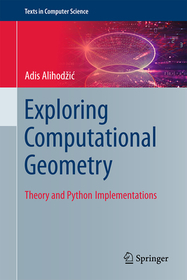
Exploring Computational Geometry
Theory and Python Implementations
Sorozatcím: Texts in Computer Science;
-
20% KEDVEZMÉNY?
- A kedvezmény csak az 'Értesítés a kedvenc témákról' hírlevelünk címzettjeinek rendeléseire érvényes.
- Kiadói listaár EUR 80.24
-
31 341 Ft (29 849 Ft + 5% áfa)
Az ár azért becsült, mert a rendelés pillanatában nem lehet pontosan tudni, hogy a beérkezéskor milyen lesz a forint árfolyama az adott termék eredeti devizájához képest. Ha a forint romlana, kissé többet, ha javulna, kissé kevesebbet kell majd fizetnie.
- Kedvezmény(ek) 20% (cc. 6 268 Ft off)
- Kedvezményes ár 25 073 Ft (23 879 Ft + 5% áfa)
- A kedvezmény érvényes eddig: 2026. június 30.
Iratkozzon fel most és részesüljön kedvezőbb árainkból!
Feliratkozom
27 580 Ft

Beszerezhetőség
Még nem jelent meg, de rendelhető. A megjelenéstől számított néhány héten belül megérkezik.
Why don't you give exact delivery time?
A beszerzés időigényét az eddigi tapasztalatokra alapozva adjuk meg. Azért becsült, mert a terméket külföldről hozzuk be, így a kiadó kiszolgálásának pillanatnyi gyorsaságától is függ. A megadottnál gyorsabb és lassabb szállítás is elképzelhető, de mindent megteszünk, hogy Ön a lehető leghamarabb jusson hozzá a termékhez.
A termék adatai:
- Kiadó Springer Nature Switzerland
- Megjelenés dátuma 2026. június 1.
- ISBN 9783032063922
- Kötéstípus Keménykötés
- Terjedelem425 oldal
- Méret 279x210 mm
- Nyelv angol
- Illusztrációk XXXV, 425 p. 221 illus., 65 illus. in color. 700
Kategóriák
Hosszú leírás:
"
Computational geometry plays a vital role in fields ranging from algorithms, data structures, robotics, and computer graphics to geographic information systems and AI. Providing a comprehensive toolkit, this core textbook constructs a strong bridge between rigorous geometric theory and practical, real-world implementations—making complex concepts accessible and engaging. Uniquely, the volume presents a modern approach to computational geometry through the lens of Python programming. Emphasizing clarity, structure, and visualization, the book introduces core geometric structures and algorithms, supported by detailed illustrations and interactive examples. With its project-based learning orientation and emphasis on conceptual understanding, it can serve as both a textbook and a reference guide for those exploring the computational side of geometry.
Topics and features:
· All geometric algorithms implemented in native Python
· 400+ illustrations and visualizations
· Includes project-based exercises for students
· Coverage: Core Structures and Algorithms, Geometric Objects in Python, Algorithms for Geometric Objects, Convex Hull Algorithms in 2D and 3D, Polygon Triangulation Methods, Delaunay Triangulation, Voronoi Diagrams, Visualization Techniques, Algorithms for Space Exploration, Quadtrees, Robot Motion Planning, AI in Computational Geometry
· Suitable for advanced undergraduate and graduate courses
· GitHub repository with all source code
Ideal for students of computer science, the textbook/reference will have real utility as well for those in mathematics and engineering. Researchers and practitioners working in computational geometry, algorithm design, data visualization, or related disciplines will find the work an indispensable resource and guide.
Adis Alihodžić is a Full Professor at the Department of Mathematics and Computer Science, Faculty of Natural Sciences and Mathematics, University of Sarajevo.
" TöbbTartalomjegyzék:
Core Structures and Algorithms.- Geometric Objects in Python.- Algorithms for Geometric Objects.- Convex Hull Algorithms.- Polygon Triangulation Methods.- Delaunay Triangulation.- Voronoi Diagrams.- Visualization Techniques.- Algorithms for Space Exploration.- Quadtrees.- Robot Motion Planning.- AI in Computational Geometry.
Több
