

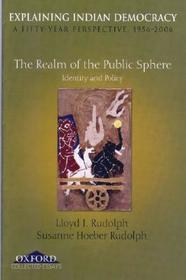
Explaining Indian Democracy: A Fifty Year Perspective, 1956-2006
Volume III: The Realm of the Public Sphere: Identity and Policy
-
10% KEDVEZMÉNY?
- A kedvezmény csak az 'Értesítés a kedvenc témákról' hírlevelünk címzettjeinek rendeléseire érvényes.
- Kiadói listaár GBP 25.99
-
11 734 Ft (11 175 Ft + 5% áfa)
Az ár azért becsült, mert a rendelés pillanatában nem lehet pontosan tudni, hogy a beérkezéskor milyen lesz a forint árfolyama az adott termék eredeti devizájához képest. Ha a forint romlana, kissé többet, ha javulna, kissé kevesebbet kell majd fizetnie.
- Kedvezmény(ek) 10% (cc. 1 173 Ft off)
- Kedvezményes ár 10 560 Ft (10 058 Ft + 5% áfa)
Iratkozzon fel most és részesüljön kedvezőbb árainkból!
Feliratkozom
11 734 Ft

Beszerezhetőség
Bizonytalan a beszerezhetőség. Érdemes még egyszer keresni szerzővel és címmel. Ha nem talál másik, kapható kiadást, forduljon ügyfélszolgálatunkhoz!
Why don't you give exact delivery time?
A beszerzés időigényét az eddigi tapasztalatokra alapozva adjuk meg. Azért becsült, mert a terméket külföldről hozzuk be, így a kiadó kiszolgálásának pillanatnyi gyorsaságától is függ. A megadottnál gyorsabb és lassabb szállítás is elképzelhető, de mindent megteszünk, hogy Ön a lehető leghamarabb jusson hozzá a termékhez.
A termék adatai:
- Kiadó OUP India
- Megjelenés dátuma 2008. február 14.
- ISBN 9780195693669
- Kötéstípus Keménykötés
- Terjedelem454 oldal
- Méret 241x158x29 mm
- Súly 817 g
- Nyelv angol
- Illusztrációk tables and figures 0
Kategóriák
Rövid leírás:
These essays reflect the works of the authors over a period of 50 years since their first visit to India in 1956. They re-emphasize the importance of area studies challenging American parochialism in the social sciences. They challenge the use of statistics to identify universal patterns that underlie economic and political systems. 9/11 reinforced the authors' methods and modes of inquiry. It challenged America's parochialism. It reminded America that it was a part
of a diverse world and that they did not have the means to grasp its complexities.
Hosszú leírás:
This volume is the third of the three volumes that collect the Rudolphs' life works over a period of fifty years since their first visit to India in 1956. Volume III comprises four parts: Identity Politics, Interpreting Lives: Gandhi and Amar Singh, Making US Foreign Policy, and Writing as Public Intellectuals. The five essays in the first section, Identity Politics, discuss caste and the politics of identity as a dominant category in the Indian political scenario.
In the four essays in the second section, Interpreting Lives: Gandhi and Amar Singh, the Rudolphs address their central concern, that is, the method, validity, and scope of subjective knowledge available from first person narratives such as an autobiography or a diary. In the five essays in the third
section, Making US Foreign Policy, the authors address the causes of regional instability in South Asia; how US policy impacts the South Asia region; and the interaction of foreign and domestic politics. The nine essays in the last section, Writing as Public Intellectuals, are distinguished from academic writing and were written to influence thought and opinion in the American public sphere.
Tartalomjegyzék:
Preface;
Acknowledgements;
I. Identity Politics
Introduction
1. The Political Role of Indias Caste Associations (Lloyd I. Rudolph and Susanne Hoeber Rudolph);
2. Urban Life and Populist Radicalism: Dravidian Politics in Madras (Lloyd I. Rudolph);
3. The Modernity of Tradition: The Democratic Incarnation of Caste in India (Lloyd I. Rudolph);
4. Regional Patterns of Education: Rimland and Heartland in Indian Education (Lloyd I. Rudolph and Susanne Hoeber Rudolph);
5. Student Politics and National Politics in India (Lloyd I. Rudolph and Susanne Hoeber Rudolph [With Karuna Ahmed]);
II. Interpreting Lives: Gandhi and Amar Singh
INTRODUCTION
6. Becoming a Diarist: The Making of an Indian Personal Document (Susanne Hoeber Rudolph and Lloyd I. Rudolph);
7. Setting the Table: Amar Singh aboard the SS Mohawk (Susanne Hoeber Rudolph and Lloyd I. Rudolph);
8. Self as Other: Amar Singhs Diary as Reflexive Native Ethnography (Lloyd I. Rudolph);
9. The New Courage: An Essay on Gandhis Psychology (Susanne Hoeber Rudolph);
III: Making US Foreign Policy
Introduction
10. The United States, India, and South Asia (Lloyd I. Rudolph and Susanne Hoeber Rudolph)
11. The Great Game in Asia: Revisited and Revised (Lloyd I. Rudolph)
12. The Faltering Novitiate: Rajiv at Home and Abroad in 1988 (Lloyd I. Rudolph);
13. Dehomogenizing Religious Formations: An Alternative to the Clash of Civilizations Thesis (Susanne Hoeber Rudolph);
14. Making US Foreign Policy towards South Asia (Lloyd I. Rudolph and Susanne Hoeber Rudolph);
IV. Writing as Public Intellectuals
INTRODUCTION
15. India Turns to a Conciliator (Lloyd I. Rudolph and Susanne Hoeber Rudolph);
16. India Campaigns: Cows, Corruption and Demonstrations (Lloyd I. Rudolph and Susanne Hoeber Rudolph);
17. From Madras, View of the Southern Film (Susanne Hoeber Rudolph);
18. Jaipur Notes: Experiencing the Emergency (Lloyd I. Rudolph and Susanne Hoeber Rudolph);
19. The East Psychoanalyzed: Review of Lucian Pye with Mary W. Pye, Asian Power and Politics (Lloyd I. Rudolph);
20. All the Raj in Jaipur (Susanne Hoeber Rudolph);
21. Modern Hate: How Ancient Animosities Get Invented (Susanne Hoeber Rudolph and Lloyd I. Rudolph);
22. The Occidental Tagore (Lloyd I. Rudolph);
23. Organized Chaos: Why India Works (Lloyd I. Rudolph and Susanne Hoeber Rudolph);
Index

