

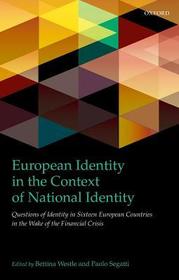
European Identity in the Context of National Identity
Questions of Identity in Sixteen European Countries in the Wake of the Financial Crisis
Sorozatcím: IntUne;
-
10% KEDVEZMÉNY?
- A kedvezmény csak az 'Értesítés a kedvenc témákról' hírlevelünk címzettjeinek rendeléseire érvényes.
- Kiadói listaár GBP 105.00
-
47 407 Ft (45 150 Ft + 5% áfa)
Az ár azért becsült, mert a rendelés pillanatában nem lehet pontosan tudni, hogy a beérkezéskor milyen lesz a forint árfolyama az adott termék eredeti devizájához képest. Ha a forint romlana, kissé többet, ha javulna, kissé kevesebbet kell majd fizetnie.
- Kedvezmény(ek) 10% (cc. 4 741 Ft off)
- Kedvezményes ár 42 667 Ft (40 635 Ft + 5% áfa)
Iratkozzon fel most és részesüljön kedvezőbb árainkból!
Feliratkozom
47 407 Ft

Beszerezhetőség
Megrendelésre a kiadó utánnyomja a könyvet. Rendelhető, de a szokásosnál kicsit lassabban érkezik meg.
Why don't you give exact delivery time?
A beszerzés időigényét az eddigi tapasztalatokra alapozva adjuk meg. Azért becsült, mert a terméket külföldről hozzuk be, így a kiadó kiszolgálásának pillanatnyi gyorsaságától is függ. A megadottnál gyorsabb és lassabb szállítás is elképzelhető, de mindent megteszünk, hogy Ön a lehető leghamarabb jusson hozzá a termékhez.
A termék adatai:
- Kiadó OUP Oxford
- Megjelenés dátuma 2016. április 28.
- ISBN 9780198732907
- Kötéstípus Keménykötés
- Terjedelem370 oldal
- Méret 241x164x26 mm
- Súly 692 g
- Nyelv angol 0
Kategóriák
Rövid leírás:
This book provides an unprecedented insight into the multiple ways through which citizens of 16 countries connect their own national identity to European identity.
TöbbHosszú leírás:
In the age of grand recession, nationalism seems to have returned to Europe. In every EU country, many citizens are unhappy with the perceived intrusion of 'Europe' in their way-of-life. Any idea of a genuine pan-European identity seems to be in retreat. This book provides an unprecedented insight into the multiple ways through which citizens of 16 countries connect their own national identity to European identity.
The book's theoretical claim is that European identity, as well as national identity, should be empirically assessed taking into account its multi-dimensionality. The volume's contributors suggest that European identity was always unlikely to be a source of political integration and political legitimacy in the way national identities have been in the past and are today. Europeans' primary identity is national rather than supranational. Mutual trust between European peoples exists, but is somewhat fragile. Yet, European identity is intertwined with national identities in manifold ways. The 'imagined communities' at the national and European level show strong similarities - criteria for being a European are strongly associated with the criteria used to define who national belonging. These complex links also manifest themselves in citizen's feelings of interdependence between the nations in the European Union - which, the volume suggests, support the EU in the face of severe crises.
The IntUne series is edited by Maurizio Cotta (University of Siena) and Pierangelo Isernia (University of Siena).
The INTUNE Project - Integrated and United: A Quest for Citizenship in an Ever Closer Europe - is one of the most recent and ambitious research attempts to empirically study how citizenship is changing in Europe. The book series is organized around the two main axes of the project, to report how the issues of identity, representation and standards of good governance are constructed and reconstructed at the elite and citizen levels, and how mass-elite interactions affect the ability of elites to shape identity, representation and the scope of governance. A first set of four books examines how identity, scope of governance and representation have been changing over time respectively at elites, media and public level. The next two books present cross-level analysis of European and national identity on the one hand and problems of national and European representation and scope of governance on the other, in doing so comparing data at both the mass and elite level. A concluding volume summarizes the main results, framing them in a wider theoretical context.
Tartalomjegyzék:
Introduction
National and European Identity of Elites
Sub-national and National Territorial Identification
National and European Identification - their Relationship and its Determinants
National and European Meanings of Identities
Unpacking the Components of National Identity and Their Effects on Identification with Europe
The Relationship between European Identity and National Identity, Party Identification and Ideological Orientation
Sword or a Shield? Globalization, European Integration, and Public Opinion
Trust Towards Other People: Co-nationals, Europeans, People Outside Europe
The Consequences of European Identity
Conclusions

