

-
10% KEDVEZMÉNY?
- A kedvezmény csak az 'Értesítés a kedvenc témákról' hírlevelünk címzettjeinek rendeléseire érvényes.
- Kiadói listaár GBP 62.00
-
27 993 Ft (26 660 Ft + 5% áfa)
Az ár azért becsült, mert a rendelés pillanatában nem lehet pontosan tudni, hogy a beérkezéskor milyen lesz a forint árfolyama az adott termék eredeti devizájához képest. Ha a forint romlana, kissé többet, ha javulna, kissé kevesebbet kell majd fizetnie.
- Kedvezmény(ek) 10% (kb. 2 799 Ft)
- Kedvezményes ár 25 194 Ft (23 994 Ft + 5% áfa)
Iratkozzon fel most és részesüljön kedvezőbb árainkból!
Feliratkozom
27 993 Ft

Beszerezhetőség
Megrendelésre a kiadó utánnyomja a könyvet. Rendelhető, de a szokásosnál kicsit lassabban érkezik meg.
Why don't you give exact delivery time?
A beszerzés időigényét az eddigi tapasztalatokra alapozva adjuk meg. Azért becsült, mert a terméket külföldről hozzuk be, így a kiadó kiszolgálásának pillanatnyi gyorsaságától is függ. A megadottnál gyorsabb és lassabb szállítás is elképzelhető, de mindent megteszünk, hogy Ön a lehető leghamarabb jusson hozzá a termékhez.
A termék adatai:
- Kiadó OUP Oxford
- Megjelenés dátuma 2002. augusztus 8.
- ISBN 9780199243570
- Kötéstípus Keménykötés
- Terjedelem280 oldal
- Méret 242x163x23 mm
- Súly 632 g
- Nyelv angol
- Illusztrációk numerous maps and tables 0
Kategóriák
Rövid leírás:
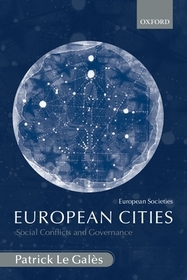
European cities are on the rise, taking advantage of the opportunities of the European integration and globalization processes. But they also face economic changes, social inequalities, poverty, and a new set of constraints. Taking examples through the European Union, the new book shows the impact of the transformation of the nation states on cities and the change of local societies and local governments. It argues that new modes of urban governance are emerging and that cities are becoming collective actors within the European governance.
TöbbHosszú leírás:
European cities are on the rise, and are taking advantage of the opportunities of the European integration and globalization processes. But they also face economic changes, social inequalities, poverty and a new set of constraints. Taking examples through the European Union, European Cities explores the impact of the transformation of the nation states on cities and the change of local societies and local governments. It argues that new modes of urban governance are emerging, and that cities are becoming collective actors within European governance.
European Cities shows why and how the bulk of European cities still appear to be original forms of compromise, aggregation, representation of diverse interests, and culture. Different modes of governance are gradually being structured in most middle size European cities despite processes of social exclusion segregation accompanied by the increased mobility of some citizens. Are Europeans going to invent a new form of institutionalized and territorialized capitalism, of which medium-sized European cities will be one of the pillars and one of the actors ? Failing that, the effects of changing scales could be expressed as profound transformations of the European urban model.
European Societies Series
Series Editor: Colin Crouch
Very few of the existing sociological texts which compare different European societies on specific topics are accessible to a broad range of scholars and students. The European Societies series will help fill this gap in the literature, and attempt to answer questions such as: Is there really such a thing as a 'European model' of society? Do the economic and political integration processes of the European Union also imply convergence in more general aspects of social life, like family or religious behaviour? What do the societies of Western Europe have in common with those further to the east?
This series will cover the main social institutions, although not every author will cover the full range of European countries. As well as surveying existing knowledge in a way that will be useful to students, each book will also seek to contribute to our growing knowledge of what remains in many respects a sociologically unknown continent.
This book addresses an important but complex topic and draws on an extensive, multilingual literature that ranges over sociology, political science and urban history. It is useful descriptively in understanding trends in western European cities and local governments and is effective in countering extreme claims about economic globalization. Its major success lies in demonstrating how analyses of wider processes can be integrated into analyses of cities and specifically that economic globalization does not mean the end of the city as a significant object of enquiry.
Tartalomjegyzék:
Part I : European cities within European societies
Introduction
The long history of the European city
Part II : A 'historical interlude for European cities'?
The loosening grip of the state and the redistribution of authority within the European Union: a new set of parameters to structure modes of urban governance
European cities: a more diverse but robust social structure within eroding national societies
Social and political actors within European cities and the making or urban modes of governance
Cities as incomplete societies: actors and regulations
Dynamic mayors and restructured City councils
Conclusion

