

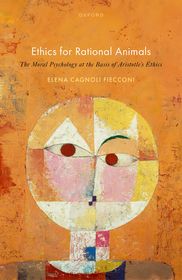
Ethics for Rational Animals
The Moral Psychology at the Basis of Aristotle's Ethics
-
20% KEDVEZMÉNY?
- A kedvezmény csak az 'Értesítés a kedvenc témákról' hírlevelünk címzettjeinek rendeléseire érvényes.
- Kiadói listaár GBP 74.00
-
33 411 Ft (31 820 Ft + 5% áfa)
Az ár azért becsült, mert a rendelés pillanatában nem lehet pontosan tudni, hogy a beérkezéskor milyen lesz a forint árfolyama az adott termék eredeti devizájához képest. Ha a forint romlana, kissé többet, ha javulna, kissé kevesebbet kell majd fizetnie.
- Kedvezmény(ek) 20% (cc. 6 682 Ft off)
- Kedvezményes ár 26 729 Ft (25 456 Ft + 5% áfa)
- A kedvezmény érvényes eddig: 2026. június 30.
Iratkozzon fel most és részesüljön kedvezőbb árainkból!
Feliratkozom
33 411 Ft

Beszerezhetőség
Becsült beszerzési idő: A Prosperónál jelenleg nincsen raktáron, de a kiadónál igen. Beszerzés kb. 3-5 hét..
A Prosperónál jelenleg nincsen raktáron.
Why don't you give exact delivery time?
A beszerzés időigényét az eddigi tapasztalatokra alapozva adjuk meg. Azért becsült, mert a terméket külföldről hozzuk be, így a kiadó kiszolgálásának pillanatnyi gyorsaságától is függ. A megadottnál gyorsabb és lassabb szállítás is elképzelhető, de mindent megteszünk, hogy Ön a lehető leghamarabb jusson hozzá a termékhez.
A termék adatai:
- Kiadó OUP Oxford
- Megjelenés dátuma 2024. március 14.
- ISBN 9780198886846
- Kötéstípus Keménykötés
- Terjedelem240 oldal
- Méret 240x160x17 mm
- Súly 480 g
- Nyelv angol
- Illusztrációk None 487
Kategóriák
Rövid leírás:
Ethics for Rational Animals presents a new account of practical wisdom, virtue, and akrasia (acting against one's best judgement) through an original study of the moral psychology at the basis of Aristotle's ethics. It ranges over his works on ethics, psychology, and biology, and defends a novel view concerning Aristotle's intellectualism.
TöbbHosszú leírás:
Ethics for Rational Animals brings to light a novel account of akrasia, practical wisdom, and character virtue through an original and comprehensive study of the moral psychology at the basis of Aristotle's ethics. It argues that practical wisdom is a persuasive rational excellence, that virtue is a listening excellence, and that the ignorance involved in akrasia is in fact a failure of persuasion. Aristotle's moral psychology emerges from this reconstruction as a qualified intellectualism. The view is intellectualistic because it describes practical wisdom as the sort of knowledge that can govern desire and action and akrasia as involving a form of ignorance. However, Aristotle's intellectualism is qualified because practical wisdom goes beyond grasping the truth about the human good, for it must also be able to convey the truth persuasively to non-rational cognition and desires.
Through a study of Aristotle's works on ethics, psychology, and biology, Elena Cagnoli Fiecconi shows that there are unexplored ways in which rational and non-rational cognition and desire cooperate and influence one another. These include attention, the capacity of the rational part of the soul to manipulate the non-rational part of the soul, and the capacity to exercise phantasia for speculation, creativity, and research. She argues that, despite being integrated with non-rational cognition and desire, rational cognition of value struggles to control human behaviour and motivation. More specifically, she defends the key thesis that grasping the truth about the human good is not sufficient for humans to regulate action and desire. Therefore, practical wisdom does not merely grasp the truth about the human good, but it controls action and desire because it conveys the truth effectively to the non-rational part of the soul. Conversely, akrasia does not merely involve a lack of epistemic access to the truth about the human good, but a failure to persuade the non-rational part of the soul about it. This study of practical wisdom and akrasia also sheds light on character virtue, which emerges as a practical excellence whose task is to listen to reason.
Tartalomjegyzék:
Introduction
Part I: The Peculiar Constitution of the Human Soul
Rational and Non-rational Cognitive Faculties
Rational and Non-rational Desires
Peculiarly Human Psychology
Part II: Cognition of Value, Desires, and Action
Pleasant, Advantageous and Fine
The Cognitive Basis of Desire
Motivational Conflict and Cognitive Conflict
Part III: Ethics for Rational Animals
Practical Excellence
Akrasia
Conclusion
Index Locorum
Bibliography

