

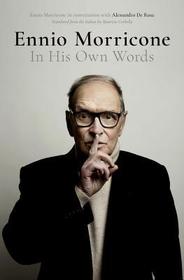
Ennio Morricone
In His Own Words
-
10% KEDVEZMÉNY?
- A kedvezmény csak az 'Értesítés a kedvenc témákról' hírlevelünk címzettjeinek rendeléseire érvényes.
- Kiadói listaár GBP 31.99
-
15 283 Ft (14 555 Ft + 5% áfa)
Az ár azért becsült, mert a rendelés pillanatában nem lehet pontosan tudni, hogy a beérkezéskor milyen lesz a forint árfolyama az adott termék eredeti devizájához képest. Ha a forint romlana, kissé többet, ha javulna, kissé kevesebbet kell majd fizetnie.
- Kedvezmény(ek) 10% (cc. 1 528 Ft off)
- Kedvezményes ár 13 754 Ft (13 100 Ft + 5% áfa)
Iratkozzon fel most és részesüljön kedvezőbb árainkból!
Feliratkozom
15 283 Ft

Beszerezhetőség
Megrendelésre a kiadó utánnyomja a könyvet. Rendelhető, de a szokásosnál kicsit lassabban érkezik meg.
Why don't you give exact delivery time?
A beszerzés időigényét az eddigi tapasztalatokra alapozva adjuk meg. Azért becsült, mert a terméket külföldről hozzuk be, így a kiadó kiszolgálásának pillanatnyi gyorsaságától is függ. A megadottnál gyorsabb és lassabb szállítás is elképzelhető, de mindent megteszünk, hogy Ön a lehető leghamarabb jusson hozzá a termékhez.
A termék adatai:
- Kiadó OUP USA
- Megjelenés dátuma 2019. július 11.
- ISBN 9780190681012
- Kötéstípus Keménykötés
- Terjedelem368 oldal
- Méret 165x239x33 mm
- Súly 1470 g
- Nyelv angol
- Illusztrációk Color insert with 28 photographs; 36 musical examples 0
Kategóriák
Rövid leírás:
This book present a years-long discussion between composers Ennio Morricone and Alessandro De Rosa about life, music, and the unpredictable ways that the two influence each other.
TöbbHosszú leírás:
Master composer Ennio Morricone's scores go hand-in-hand with the idea of the Western film. Often considered the world's greatest living film composer, and most widely known for his innovative scores to The Good, the Bad, and the Ugly and the other Sergio Leone's movies, The Mission, Cinema Paradiso and more recently, The Hateful Eight, Morricone has spent the past 60 years reinventing the sound of cinema. In Ennio Morricone: In His Own Words, composers Ennio Morricone and Alessandro De Rosa present a years-long discussion of life, music, and the marvelous and unpredictable ways that the two come into contact with and influence each other. The result is what Morricone himself defines: "beyond a shadow of a doubt the best book ever written about me, the most authentic, the most detailed and well curated. The truest."
Opening for the first time the door of his creative laboratory, Morricone offers an exhaustive and rich account of his life, from his early years of study to genre-defining collaborations with the most important Italian and international directors, including Leone, Bertolucci, Pasolini, Argento, Tornatore, Malick, Carpenter, Stone, Nichols, De Palma, Beatty, Levinson, Almodóvar, Polanski and Tarantino. In the process, Morricone unveils the curious relationship that links music and images in cinema, as well as the creative urgency at the foundation of his experimentations with "absolute music". Throughout these conversations with De Rosa, Morricone dispenses invaluable insights not only on composing but also on the broader process of adaptation and what it means to be human. As he reminds us, "Coming into contact with memories doesn't only entail the melancholy of something that slips away with time, but also looking forward, understanding who I am now. And who knows what else may still happen."
Among the pages of this skilfully translated and annotated book the readers find a wealth of first-hand insights into the work and life of the world's most prolific and recognisable soundtrack composer ... Morricone calls this 'the most authentic, detailed and trust book' about himself. We wholeheartedly agree, and highly recommend this read to any cinema enthusiast, musician, and filmmaker." -- Cinema Heritage Group
Tartalomjegyzék:
Translator's Note
Preface
Introduction Where These Conversations Come From
Chapter One Playing (Chess) with Mephisto
Chapter Two A Composer Lent to Cinema
2.1. On Arranging
2.2. The Beginnings in Cinema
2.2.1 Paying My Dues
2.2.2 Luciano Salce
2.3 Sergio Leone and the Dollar Trilogy
2.2.1 A Fistful of Dollars: Myth and Reality
2.2.2 For a Few Dollars More
2.2.3 The Good, the Bad and the Ugly
2.4 Pier Paolo Pasolini
2.4.1 The Hawks and the Sparrows and a Strange Poem
2.4.2 Teorema and an Unrealized Story
2.4.3 Surrendering to Pasolini
2.5 Collaborations, Experiments, and Professional Consolidation
2.5.1 Pontecorvo, De Seta, Bellocchio
2.5.2 Bolognini, Montaldo
2.5.3 Wertmüller, Bertolucci
2.5.4 Consensus or Consumption? 1968 and Once Upon a Time in the West
2.5.5 Duck, You Sucker
2.5.6 Elio Petri
2.5.7 Sergio the Producer
2.5.8 Once Upon a Time in America
2.5.9 The "Leningrad Project" and Leone's Death
Chapter Three Music and Images
3.1 Reflections and Memories of a Film Music Composer
3.1.1 No Theme? More Fun !
3.1.2 Giuseppe Tornatore
3.1.3 Singers and Songs in Film: On Music's Adaptability
3.1.4 Quentin Tarantino
3.1.5 Temporality and the "EST" Principle
3.2 Backward Path to the Beginnings in Hollywood
3.2.1 The Academy Honorary Award
3.2.2 The Beginnings in U.S. Cinema
3.2.3 A House in the United States?
3.2.4 U.S. Composers
3.2.5 Terrence Malick
3.2.6 The Interpreter Didn't Help with John Carpenter
3.3 Creativity and Constraints: The Double Aesthetics
3.4 On Theater, the Musical, and Television
3.4.1 The Betrothed
3.4.2 Moses, the Lawgiver
3.4.3 Marco Polo
3.4.4 Secret of the Sahara
3.4.5 The Octopus
3.5 Pains and Experiments
3.5.1 Roberto Faenza
3.5.2 Nino Rota
3.5.3 Difficult Relationships
3.5.4 Joanou, Stone, and the Overtones
3.5.5 Warren Beatty
3.5.6 Pride and Repentance
3.5.7 Fights and Arguments
3.6 Beyond Cinema, Beyond Music
Chapter 4 Mystery and Mastery
4.1 The Mystery of Creation
4.2 What Is Music?
4.2.1 Birth, Death, and Resurrection of Music
4.2.2 In Search of Myself: How to Listen to Contemporary Music
4.2.3 My Way
4.2.4 A Dilated Present
4.2.5 Studying Music Today?
4.3 A Sophisticated Balance between the Predictable and the Unforeseeable
4.4 Digressions
4.4.1 Cinema's Transformations
4.4.2 Timbre, Sound, and Performers
4.4.3 On Teaching
4.4.4 High Productivity? A Healthy Mind in a Healthy Body
Chapter Five An Absolute Music?
5.1 The Roots
5.1.1 A Short Introduction to the "Absolute"
5.1.2 Darmstadt: A Summer of Experiments
5.1.3 Gruppo d'Improvvisazione Nuova Consonanza
5.2 A Response to the Conflict of Times: Towards “Dynamic Immobility”
5.2.1 Suoni per Dino
5.2.2 Vidi Aquam. Id Est Benacum
5.3 Musical Creationism versus Musical Evolutionism
5.3.1 Gestazione
5.3.2 Beliefs: The Origins of Life and the Universe
5.4 Mystical Production
5.4.1 Mass for Pope Francis
5.5 The Ideal of Unity: Blend and Hope
5.5.1 The Mission
5.5.2 Voci dal silenzio and La voce dei sommersi
5.5.3 Cantata per l'Europa and a Poem for Maria
5.6 Exchanges, Form, and Linguistic Combinations
5.6.1 UT
5.6.2 The Four Concertos: Form and Non-Form
5.7 The Future of Music: Noise and Silence
Chapter 6 Looking Ahead: A Silent Nod towards the Future
Chronological List of the Absolute Music
Chronological List of the Applied Music
Acknowledgments
Index

