

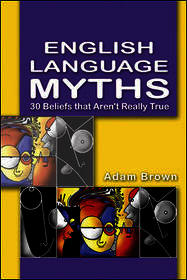
English Language Myths
30 Beliefs that Aren't Really True
-
10% KEDVEZMÉNY?
- A kedvezmény csak az 'Értesítés a kedvenc témákról' hírlevelünk címzettjeinek rendeléseire érvényes.
- Kiadói listaár GBP 22.99
-
10 379 Ft (9 885 Ft + 5% áfa)
Az ár azért becsült, mert a rendelés pillanatában nem lehet pontosan tudni, hogy a beérkezéskor milyen lesz a forint árfolyama az adott termék eredeti devizájához képest. Ha a forint romlana, kissé többet, ha javulna, kissé kevesebbet kell majd fizetnie.
- Kedvezmény(ek) 10% (kb. 1 038 Ft)
- Kedvezményes ár 9 341 Ft (8 897 Ft + 5% áfa)
Iratkozzon fel most és részesüljön kedvezőbb árainkból!
Feliratkozom
10 379 Ft

Beszerezhetőség
Bizonytalan a beszerezhetőség. Érdemes még egyszer keresni szerzővel és címmel. Ha nem talál másik, kapható kiadást, forduljon ügyfélszolgálatunkhoz!
Why don't you give exact delivery time?
A beszerzés időigényét az eddigi tapasztalatokra alapozva adjuk meg. Azért becsült, mert a terméket külföldről hozzuk be, így a kiadó kiszolgálásának pillanatnyi gyorsaságától is függ. A megadottnál gyorsabb és lassabb szállítás is elképzelhető, de mindent megteszünk, hogy Ön a lehető leghamarabb jusson hozzá a termékhez.
A termék adatai:
- Kiadó McGraw-Hill Higher Education
- Megjelenés dátuma 2006. május 1.
- ISBN 9780071205344
- Kötéstípus Puhakötés
- Terjedelem oldal
- Méret 280x530x90 mm
- Súly 219 g
- Nyelv angol 0
Kategóriák
Hosszú leírás:
The aim of the book is to dispel beliefs about
English which are held by English teachers in Singapore, Southeast Asia and
beyond. These beliefs are either wide of the mark or stated too strongly.
However, they are widely held, and thus are taught in schools and in exercise
books, and appear in tests and examinations. The 30 chapters (corresponding to
30 myths examined) cover the nature and status of English, grammar, morphology,
pragmatics, spelling and pronunciation. The approach adopted shows that many of
the beliefs held by teachers are not substantiated by what speakers of English
actually do. Quotations from literature, reference books and from corpus data
are given to support the analysis. The author is an authoritative figure in his
field, and has many years of experience in training English language teachers in
Southeast Asian countries. The discussions that focus on Southeast Asia and
Singapore in particular make this book very relevant to both English language
teachers and students in the region.
Tartalomjegyzék:
English Language Myths:
30 Beliefs that Aren't Really True
Introduction
Acknowledgements
Abbreviations
Myth 1
Singaporeans are not native speakers of English
Myth 2
Singapore English is British English
Myth 3
Singaporeans can switch easily from Singapore colloquial English to Singapore
standard English
Myth 4
How come? is a Singapore expression
Myth 5
Singapore English is short and sweet
Myth 6
Singapore English has no grammar
Myth 7
You can't use more than one tense in a sentence
Myth 8
The present tense means present time
Myth 9
Use the present tense with today
Myth 10
Use the present tense with every
Myth 11
All goes with plural expressions
Myth 12
After and, use plural verbs
Myth 13
When representing future time, would is the polite form of will
Myth 14
Shall adds force to your writing
Myth 15
The past perfect is used for events that happened a long time ago
Myth 16
It is more formal to use you and I than you and me
Myth 17
The word examination in the expression an examination hall is an
adjective
Myth 18
Good at is used to focus on a particular subject. Good in is used
when you need to specify depth and scope
Myth 19
You can't begin a sentence with because, but, and or also
Myth 20
Kindly and please are intechangeable
Myth 21
It is good style to use expressions like Please be informed and Please
find enclosed in business writing
Myth 22
All -us noun endings become -i in the plural
Myth 23
Accomodation and maintainence are spelt this way
Myth 24
An (not a) should be used whenever the following word begins with a,
e, i, o, or u
Myth 25
The is pronounced / / in
British English, / / in American English
Myth 26
RP is the model for pronunciation
Myth 27
Singapore English is syllable-timed
Myth 28
Singaporeans speak with a narrower pitch range than others
Myth 29
All questions are said on a rising intonation
Myth 30
Flower and flour are pronounced differently
References
Index of topics and words
Index of authors and works quoted

