

-
10% KEDVEZMÉNY?
- A kedvezmény csak az 'Értesítés a kedvenc témákról' hírlevelünk címzettjeinek rendeléseire érvényes.
- Kiadói listaár GBP 38.99
-
17 603 Ft (16 765 Ft + 5% áfa)
Az ár azért becsült, mert a rendelés pillanatában nem lehet pontosan tudni, hogy a beérkezéskor milyen lesz a forint árfolyama az adott termék eredeti devizájához képest. Ha a forint romlana, kissé többet, ha javulna, kissé kevesebbet kell majd fizetnie.
- Kedvezmény(ek) 10% (kb. 1 760 Ft)
- Kedvezményes ár 15 843 Ft (15 089 Ft + 5% áfa)
Iratkozzon fel most és részesüljön kedvezőbb árainkból!
Feliratkozom
17 603 Ft

Beszerezhetőség
A kiadónál véglegesen elfogyott, nem rendelhető. Érdemes újra keresni a címmel, hátha van újabb kiadás.
Why don't you give exact delivery time?
A beszerzés időigényét az eddigi tapasztalatokra alapozva adjuk meg. Azért becsült, mert a terméket külföldről hozzuk be, így a kiadó kiszolgálásának pillanatnyi gyorsaságától is függ. A megadottnál gyorsabb és lassabb szállítás is elképzelhető, de mindent megteszünk, hogy Ön a lehető leghamarabb jusson hozzá a termékhez.
A termék adatai:
- Kiadás sorszáma 2
- Kiadó Oxford University Press
- Megjelenés dátuma 2003. május 15.
- ISBN 9780195161526
- Kötéstípus Keménykötés
- Terjedelem622 oldal
- Méret 234x189x29 mm
- Súly 1164 g
- Nyelv angol
- Illusztrációk numerous figures and tables 0
Kategóriák
Rövid leírás:
This text is suitable for undergraduate courses in Engineering Economy. It is a comprhensive introductory text that introduces the basic theory and application of engineering economy. It is also suitable for self-study by practising engineers and for reference during the practice of engineering.
TöbbHosszú leírás:
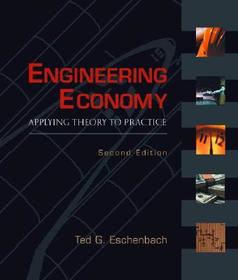
This innovative engineering economy text features spreadsheets, pedagogical graphs, and practical examples for immediate student and industry application. It combines the real-world orientation of Eschenbach's pioneering casebook, Cases in Engineering Economy, with the theoretical foundation of his second edition of Bussey's classic advanced text, The Economic Analysis of Industrial Projects. Eschenbach's Engineering Economy: Applying Theory to Practice,
Second Edition, thoroughly covers the basics of engineering economy that are included in every course and covered in the FE exam. It also includes the tools and concepts--such as cost estimating, sensitivity analysis, probability, and multiple objectives--that are needed to successfully apply engineering economy in industry
practice outside the classroom. This second edition has been thoroughly revised; it incorporates adopter and reviewer suggestions in addition to addressing the needs of hundreds of engineering instructors.
New features include:
BL Simplified spreadsheet presentations that focus on Excel
BL A unique insight into how to use Excel functions for MACRS depreciation
BL Improved coverage of replacement analysis, inflation, and sensitivity analysis
BL New problems, examples, and references
BL A unified discussion of general engineering economy factors now includes arithmetic and geometric gradients
BL The comparison of mutually exclusive alternatives now precedes discussion of constrained project selection/capital budgeting
Tartalomjegyzék:
Note: Each chapter concludes with a Summary. PART I. BASIC CONCEPTS AND TOOLS
Chapter 1. Making Economic Decisions
What Is Engineering Economy
Principles for Decision Making
The Decision Making Process
The Environment for Decisions
The Role of Engineering Economy
Operational Economics
Chapter 2. The Time Value of Money
What is Interest?
Simple vs. Compound Interest
Cash Flow Diagrams
Equivalence for 4 loans
Limits on Equivalence
Compounding Periods Shorter than a Year
Chapter 3. Equivalence-A Factor Approach
Definitions and Assumptions
Tables of Engineering Economy Factors
Single Payment Factors (Ps and Fs)
Uniform Flows
Combining Factors
Arithmetic Gradients
Geometric Gradients
Appendix 3A: Continuous Flow and Continuous Compounding
Chapter 4. Spreadsheets and Economic Analysis
Using Spreadsheets for Economic Analysis
Spreadsheet Modeling
Financial Functions in Spreadsheets
Examples Show Spreadsheet Can Be More Realistic
Using Spreadsheets to Get a Project Funded
PART TWO: ANALYZING A PROJECT
Chapter 5. Present Worth
The Present Worth Measure
Examples of When to Use Present Worth
Rolling Back Irregular Cash Flows for PW Calculations
Salvage Values
Capitalized Cost and Perpetual Life
Staged Projects
Cost of Underutilized Capacity
Spreadsheets and Shorter Periods
Spreadsheets and More Exact Models
Chapter 6. Equivalent Annual Worth
The Equivalent Annual Worth Measure
Assumptions and Sign Conventions
Examples of Annual Evaluations
Finding the EAC of Irregular Cash Flows
EAC Formulas for Salvage Values and Working Capital
Perpetual Life
Repeated Renewals
Spreadsheets and Analyzing Loan Repayments
Chapter 7. Rate of Return
The Internal Rate of Return
Assumptions
Finding the IRR
Loans and Leases
Spreadsheets and the IRR
Multiple Sign Changes
Project Balances over Time
Modified Internal Rate of Return (MIRR)
Chapter 8. Benefit/Cost Ratios and Other Measures
Measures of Economic Attractiveness
Benefit/Cost Ratio
Present Worth Indexes
Future Worth
Payback Period
Discounted Payback
Breakeven Volume
PART THREE: COMPARING ALTERNATIVES AND PROJECTS
Introduction to mutually exclusive and constrained budget problems.
Chapter 9. Mutually Exclusive Alternatives
Applying Engineering Economy to Engineering Design
Key Assumption Is the Interest Rate or Minimum
Comparing Alternatives with Lives of the Same Length
PWs and Explicitly Comparing Different-Length Lives
EAWs and EACs and Implicity Comparing Different-Length Lives
Using EAC for Different-Length Lives Is a Robust Approach
B/C and IRR Comparisons of Mutually Exclusive Alternatives Require Incremental Analysis
Defender / Challenger Analysis
PW, EAW, and IRR Have the Same Reinvestment Assumption
Using Spreadsheet GOAL SEEK Tool to Calculate
Chapter 10. Replacement Analysis
Why Is Equipment Replaced, Retired, or Augmented?
Old and New Are Mutually Exclusive
Sunk Costs, Risks, and Cost Savings vs. Profit Making
Optimal Challengers
Optimal Defenders
Optimal Capacity Problems
Estimating Future Challengers
Replacement and Repair Models
Chapter 11. Constrained Project Selection
The Constrained Project Selection Problem
Ranking Projects
Determining the Minimum Attractive Rate of Return
A Theoretically Optimal Approach for Determining the Capital Budget
Capital Limits in the Real World
Matching Assumptions to the Real World
Present Worth Indexes and Benefit/Cost Ratios
Using the SORT Spreadsheet Tool
Appendix 11A: Mathematical Programming and Spreadsheets
PART FOUR: ENHANCEMENTS FOR THE REAL WORLD
Chapter 12. Depreciation
Introduction
Basic Depreciation Methods
Accelerated Cost Recovery
Gains and Losses on Sales and Recaptured Depreciation
Optimal Depreciation Strategies
PW of a Depreciation Schedule
Depletion of Resources
Section 179 Deduction
Spreadsheet Functions for Depreciation
Chapter 13. Income Taxes
Principles of Income Taxes
Progressive Marginal Tax Rates
Finding Taxable Income when Including Depreciation
Calculating After-Fax Cash Flows and EACs using Tables or Spreadsheets
Calculating After-Tax Cash Flows and EACs using Formulas
Investment Tax Credits (ITC) and Capital Gains
Interest Deductions and an After-Tax IRR
Appendix 13A: Personal Income Taxes
Chapter 14. Public Sector Engineering Economy
Defining Benefits, Disbenefits, and Costs
Why are Public-Sector Problems Difficult?
Correct Methods and Interest Rates
Whose Point of View?
Allocating Costs to Benefit Recipients
Valuing the Benefits of Public Projects
Cost Effectiveness
Chapter 15. Inflation
Defining and Measuring Inflation and Deflation
Consistent Assumptions for Interest Rates and Cash Flow Estimates
Solving for PW or EAC when Including Inflation
Inflation Examples with Multiple Inflation Rates
15.5. Leases and Other Prepaid Expenses
Depreciation and Loan Payments
Inflation Calculations Based on the Equivalent Discount Rate
PART FIVE: DECISION MAKING TOOLS
Chapter 16. Estimating Cash Flows
Introduction Early Project Decisions
Cash Flow Estimating and Life-Cycle Stages
Cash Flow Estimating Standards
Design Criteria and Specifications
Modeling the Base Case
Using Indexes for an Order-of-Magnitude Estimate
Using Capacity Functions for Order-of-Magnitude Estimates
Using Growth Curves
Using Learning Curves
Using Factor Estimates
Chapter 17. Sensitivity Analysis
What Is Sensitivity Analysis?
Uncertain Data and Its Impact
Techniques for Sensitivity Analysis
Spiderplots
Constructing a Spiderplot
Multiple Alternatives
Sensitivity Analysis with Multiple Variables
Chapter 18. Uncertainty and Probability
Probabilities
Computing Expected Values
Choosing Alternatives Using Expected Values
Economic Decision Trees
Risk
Risk/Return Tradeoffs
Probability Distributions for Economic Outcomes
Chapter 19. Multiple Objectives
Multiple Attributes
The Process of Evaluating Multiple Objectives
Identifying the Attributes
Evaluating the Attributes
Graphical Techniques
Numerical Scales for Evaluation
Additive Models
Hierarchical Attributes and Objectives
APPENDIXES
A. Accounting
The Role of Accounting
General Accounting
The Balance Sheet
The Income Statement
Traditional Cost Accounting
Activity Based Costs (ABC)
B. End-of-Period Compound Interest Tables

