

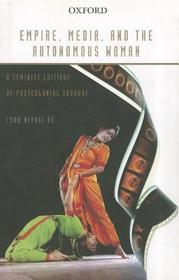
Empire, Media, and the Autonomous Woman
A Feminist Critique of Postcolonial Thought
-
10% KEDVEZMÉNY?
- A kedvezmény csak az 'Értesítés a kedvenc témákról' hírlevelünk címzettjeinek rendeléseire érvényes.
- Kiadói listaár GBP 30.00
-
13 545 Ft (12 900 Ft + 5% áfa)
Az ár azért becsült, mert a rendelés pillanatában nem lehet pontosan tudni, hogy a beérkezéskor milyen lesz a forint árfolyama az adott termék eredeti devizájához képest. Ha a forint romlana, kissé többet, ha javulna, kissé kevesebbet kell majd fizetnie.
- Kedvezmény(ek) 10% (cc. 1 355 Ft off)
- Kedvezményes ár 12 191 Ft (11 610 Ft + 5% áfa)
Iratkozzon fel most és részesüljön kedvezőbb árainkból!
Feliratkozom
13 545 Ft

Beszerezhetőség
Bizonytalan ideig nincs raktáron a kiadónál, rendelése nem javasolt.
Why don't you give exact delivery time?
A beszerzés időigényét az eddigi tapasztalatokra alapozva adjuk meg. Azért becsült, mert a terméket külföldről hozzuk be, így a kiadó kiszolgálásának pillanatnyi gyorsaságától is függ. A megadottnál gyorsabb és lassabb szállítás is elképzelhető, de mindent megteszünk, hogy Ön a lehető leghamarabb jusson hozzá a termékhez.
A termék adatai:
- Kiadó OUP India
- Megjelenés dátuma 2011. szeptember 22.
- ISBN 9780198072553
- Kötéstípus Keménykötés
- Terjedelem264 oldal
- Méret 224x147x23 mm
- Súly 460 g
- Nyelv angol
- Illusztrációk 12 halftone illustrations 0
Kategóriák
Rövid leírás:
Presenting a unique analysis of Indian activist thought through literature, photography, dance drama, television, choreography, and cinema, this book argues for a feminist critique of postcolonial thought by looking at the rise of humanism under colonization and the current influx of neoliberal capitalism.
TöbbHosszú leírás:
Autonomy is commonly linked to liberal individualism, the Enlightenment philosophy which gives primacy to personal existence and interests rather than to the person's place in society and in history. Many see the autonomous individual as harbouring the possessive mentalities of western empire. In this groundbreaking work, Esha Niyogi De radically questions this foundational anti-Enlightenment position on which influential models of Postcolonial critique are based. She argues that the 'individual' has been creatively indigenized in non-western modernities: indigenous activist individuals attentive to empire and gender refuse possessive individualism while they invest in certain ethical premises of Enlightenment thought.
De weaves her radical argument through a rich tapestry of gender portrayals drawn from two transitional moments of Indian modernity: the rise of humanism under colony and the influx of neoliberal capitalism. This book emphasizes the feminist challenge to sexual and racial orthodoxies posed by critical imaginations of the 'autonomous woman' in postcolonial cultures by studying autobiographical texts by nineteenth-century Bengali prostituted women; point-of-view photography; woman-centred dance dramas and essays by Rabindranth Tagore; representations of Tagore's works on mainstream television, video, and stage in India and Indian American diasporas; and feminist cinema, choreography and performance respectively by Aparna Sen and Manjusri Chaki-Sircar.
Tartalomjegyzék:
Preface
Introduction
PART ONE: COLONIAL CONFLICTS:
'Self-ownership on Sexual Margins: Life-Histories, New Media, and the Subjective Autobiography'
'Nation and Individuation: Possessive Manhoods and the Aesthetics of Womanly Desire'
PART TWO: POSTCOLONIAL GLOBALITY:
'Autonomy as Reproductive Labour: The Neoliberal Woman and Visual Networks of Empire'
'Agency under Networks: Belonging and Privacy in Feminist Visual Culture'
Concluding Remarks
Index

