

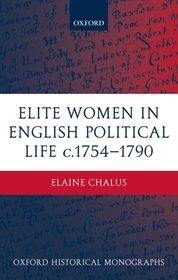
Elite Women in English Political Life c.1754-1790
Sorozatcím: Oxford Historical Monographs;
-
10% KEDVEZMÉNY?
- A kedvezmény csak az 'Értesítés a kedvenc témákról' hírlevelünk címzettjeinek rendeléseire érvényes.
- Kiadói listaár GBP 135.00
-
64 496 Ft (61 425 Ft + 5% áfa)
Az ár azért becsült, mert a rendelés pillanatában nem lehet pontosan tudni, hogy a beérkezéskor milyen lesz a forint árfolyama az adott termék eredeti devizájához képest. Ha a forint romlana, kissé többet, ha javulna, kissé kevesebbet kell majd fizetnie.
- Kedvezmény(ek) 10% (cc. 6 450 Ft off)
- Kedvezményes ár 58 047 Ft (55 283 Ft + 5% áfa)
Iratkozzon fel most és részesüljön kedvezőbb árainkból!
Feliratkozom
64 496 Ft

Beszerezhetőség
Megrendelésre a kiadó utánnyomja a könyvet. Rendelhető, de a szokásosnál kicsit lassabban érkezik meg.
Why don't you give exact delivery time?
A beszerzés időigényét az eddigi tapasztalatokra alapozva adjuk meg. Azért becsült, mert a terméket külföldről hozzuk be, így a kiadó kiszolgálásának pillanatnyi gyorsaságától is függ. A megadottnál gyorsabb és lassabb szállítás is elképzelhető, de mindent megteszünk, hogy Ön a lehető leghamarabb jusson hozzá a termékhez.
A termék adatai:
- Kiadó OUP Oxford
- Megjelenés dátuma 2005. június 16.
- ISBN 9780199280100
- Kötéstípus Keménykötés
- Terjedelem288 oldal
- Méret 224x146x20 mm
- Súly 467 g
- Nyelv angol 0
Kategóriák
Rövid leírás:
Based on wide-ranging, original research into political, personal, and general correspondences across a period of significant social and political change, this book explores the gendered nature of politics and political life in eighteenth-century England by focusing on the political involvement of female members of the political elite. Chalus argues that the personal, social, and particularly the familial nature of eighteenth-century politics provided more women with a wider variety of opportunities for involvement than ever before.
TöbbHosszú leírás:
Based on wide-ranging, original research into political, personal, and general correspondences across a period of significant social and political change, this book explores the gendered nature of politics and political life in eighteenth-century England by focusing on the political involvement of female members of the political elite. Elaine Chalus challenges the notion that only exceptional women were involved in politics, that their participation was necessarily limited and indirect, and that their involvement was inevitably declining after the 1784 Westminster Election. While exceptional women did exist and gender did condition women's participation, the personal, social, and particularly the familial nature of eighteenth-century politics provided more women with a wider variety of opportunities for involvement than ever before. Women from politically active families grew up with politics, absorbing its rituals, and their own involvement extended from politicized socializing up to borough control and election management. Their participation was often accepted, expected, or even demanded, depending upon family traditions, personal abilities, and the demands of political expediency.
Chalus reveals that, although women's involvement in political life was always potentially more problematic than men's, given contemporary concerns about the links between sex, politics, and corruption, their participation was largely unproblematic as long as their activities could be explained by recourse to a familial model which depicted their participation as subordinate and supportive of men's. It was when they came to be seen as the leading political actors in a cause that they overstepped the mark and became targets of sexualized criticism. Contemporary critics worried that politically active women posed a threat to male polity, but what actually made them threatening was that they proved that women were not politically incompetent and implicitly demonstrated that gender was not a reason for political exclusion. Although the dividing line between acceptable and unacceptable female political behaviours was sharper from the late eighteenth century onward, Chalus suggests that women who were willing to work creatively within the familial model could and did remain politically active into - and through - the nineteenth century.
...[an] excellent book
Tartalomjegyzék:
Introduction
Women and Politics
Women's Political Roles
Women and Social Politics
Women and Patronage
Women and the Electoral Process
Maintaining the Family Interest
'Up to the Ears in Electioneering'
Conclusion
Bibliography
Index

