

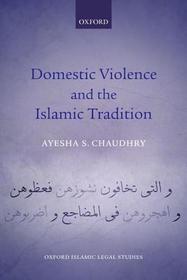
Domestic Violence and the Islamic Tradition
Sorozatcím: Oxford Islamic Legal Studies;
-
10% KEDVEZMÉNY?
- A kedvezmény csak az 'Értesítés a kedvenc témákról' hírlevelünk címzettjeinek rendeléseire érvényes.
- Kiadói listaár GBP 36.99
-
16 700 Ft (15 905 Ft + 5% áfa)
Az ár azért becsült, mert a rendelés pillanatában nem lehet pontosan tudni, hogy a beérkezéskor milyen lesz a forint árfolyama az adott termék eredeti devizájához képest. Ha a forint romlana, kissé többet, ha javulna, kissé kevesebbet kell majd fizetnie.
- Kedvezmény(ek) 10% (cc. 1 670 Ft off)
- Kedvezményes ár 15 030 Ft (14 315 Ft + 5% áfa)
Iratkozzon fel most és részesüljön kedvezőbb árainkból!
Feliratkozom
16 700 Ft

Beszerezhetőség
Megrendelésre a kiadó utánnyomja a könyvet. Rendelhető, de a szokásosnál kicsit lassabban érkezik meg.
Why don't you give exact delivery time?
A beszerzés időigényét az eddigi tapasztalatokra alapozva adjuk meg. Azért becsült, mert a terméket külföldről hozzuk be, így a kiadó kiszolgálásának pillanatnyi gyorsaságától is függ. A megadottnál gyorsabb és lassabb szállítás is elképzelhető, de mindent megteszünk, hogy Ön a lehető leghamarabb jusson hozzá a termékhez.
A termék adatai:
- Kiadó OUP Oxford
- Megjelenés dátuma 2015. november 5.
- ISBN 9780198766193
- Kötéstípus Puhakötés
- Terjedelem270 oldal
- Méret 235x159x14 mm
- Súly 402 g
- Nyelv angol 0
Kategóriák
Rövid leírás:
A frank, personal investigation into the contentious issue of marital violence within Islamic law. Drawing heavily on the author's own experience, the book explores the attempt to reconcile a tradition of patriarchal authority with egalitarian values. The book presents an insightful and provocative contribution to the debate about women in Islam.
TöbbHosszú leírás:
How do modern Muslims' attitudes to marital violence and patriarchy relate to the Islamic tradition?
In recent years, discussion regarding the interpretation of the Qur'an has become highly controversial. Especially contentious is passage 4:34, which covers the legitimacy of marital violence and the subjugation of women within Islam. Scholarly opinion on the topic is heavily influenced by contemporary context, so the issue remains largely unsettled. While pre-colonial Islamic jurists permitted the use of violence against women, they still held ethical concerns about the disciplinary privileges of husbands. Consequently, the debate for these early scholars was focussed on the level of violence permitted, and how to apply the three disciplinary steps: admonishment, abandonment, and physical abuse.
Ayesha Chaudhry argues that all living religious traditions are rooted in a patriarchal, social, and historical context, and they need ways to reconcile gender egalitarian values with religious tradition. Post-colonial, modern Islamic scholars that consult the Qu'ran for gender-egalitarian interpretations must confront a difficult and unique debate: equality vs authority. As in many religions, authority is derived from tradition, rebelling from which results in a loss of authority in the eyes of the community.
Chaudhry reveals that Muslims do not speak with one voice about Islam. Instead, Muslim scholarly discourse is spirited and diverse. The voices of contemporary Muslim scholars enrich the scope of the 'Islamic tradition'.
Many recent works on Islam strive to promote a 'public relations' image of Islam. This book deals with ethical problems of domestic violence as discussed in historic and contemporary Islamic religious doctrine. The stakes are high, and very real. The author confronts the significant issue of how modern Muslims can relate to Islamic tradition and the Qur'anic text.
[T]his work should be applauded as the first sustained analysis of the phrase 'beat them' in the Sunni exegetical and legal sources from the medieval and modern periods. Chaudhry has exposed the variation in interpretations on this command admirably, and has managed to write a book that is as enjoyable to read as it is interesting. Though it engages with the tradition, this book also represents a theological response to a difficult Qur'anic passage, and is an important contribution to the growing movement of Muslim feminist reinterpretations of the Qur'an.
Tartalomjegyzék:
Introduction
Part I: Historical Roots of a Contemporary Debate
The Multiple Contexts of Q. 4:34
The Ethics of Wife-beating
The Legal Boundaries of Marital Discipline
Part II: Restoring Authority in the Living Community
Asserting Authority, Enriching the Tradition
Submissive Texts and Idealized Cosmologies
Conclusion

