

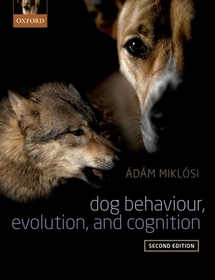
Dog Behaviour, Evolution, and Cognition
-
10% KEDVEZMÉNY?
- A kedvezmény csak az 'Értesítés a kedvenc témákról' hírlevelünk címzettjeinek rendeléseire érvényes.
- Kiadói listaár GBP 62.00
-
27 993 Ft (26 660 Ft + 5% áfa)
Az ár azért becsült, mert a rendelés pillanatában nem lehet pontosan tudni, hogy a beérkezéskor milyen lesz a forint árfolyama az adott termék eredeti devizájához képest. Ha a forint romlana, kissé többet, ha javulna, kissé kevesebbet kell majd fizetnie.
- Kedvezmény(ek) 10% (cc. 2 799 Ft off)
- Kedvezményes ár 25 194 Ft (23 994 Ft + 5% áfa)
Iratkozzon fel most és részesüljön kedvezőbb árainkból!
Feliratkozom
27 993 Ft

Beszerezhetőség
Megrendelésre a kiadó utánnyomja a könyvet. Rendelhető, de a szokásosnál kicsit lassabban érkezik meg.
Why don't you give exact delivery time?
A beszerzés időigényét az eddigi tapasztalatokra alapozva adjuk meg. Azért becsült, mert a terméket külföldről hozzuk be, így a kiadó kiszolgálásának pillanatnyi gyorsaságától is függ. A megadottnál gyorsabb és lassabb szállítás is elképzelhető, de mindent megteszünk, hogy Ön a lehető leghamarabb jusson hozzá a termékhez.
A termék adatai:
- Kiadás sorszáma 2
- Kiadó OUP Oxford
- Megjelenés dátuma 2016. július 21.
- ISBN 9780198787778
- Kötéstípus Puhakötés
- Terjedelem400 oldal
- Méret 245x189x20 mm
- Súly 886 g
- Nyelv angol 0
Kategóriák
Rövid leírás:
A comprehensive update to the first monograph on dog behaviour, evolution and cognition.
TöbbHosszú leírás:
This is the first book to collate and synthesize the recent burgeoning primary research literature on dog behaviour, evolution, and cognition. The author presents a new ecological approach to the understanding of dog behaviour, demonstrating how dogs can be the subject of rigorous and productive scientific study without the need to confine them to a laboratory environment.
This second, fully updated edition of Dog Behaviour, Evolution and Cognition starts with an overview of the conceptual and methodological issues associated with the study of the dog, followed by a brief description of their role in human society. An evolutionary perspective is then introduced with a summary of current research into the process of domestication. The central part of the book is devoted to issues relating to the cognitive aspects of behaviour which have received particular attention in recent years from both psychologists and ethologists. The book's final chapters introduce the reader to many novel approaches to dog behaviour, set in the context of behavioural development and genetics. This second edition recognises and discusses the fact that dogs are increasingly being used as model organisms for studying aspects of human biology, such as genetic diseases and ageing. Specific attention is also given in this edition to attachment behaviour which emerges between humans and dogs, the importance of inter-specific communication in the success of dogs in human communities and the broad aspects of social cognition and how this may contribute to human-dog cooperation
Directions for future research are highlighted throughout the text which also incorporates links to human and primate research by drawing on homologies and analogies in both evolution and behaviour. The book will therefore be of relevance and use to anyone with an interest in behavioural ecology including graduate students of animal behaviour and cognition, as well as a more general audience of dog enthusiasts, biologists, psychologists, veterinarians, and sociologists.
This book combines knowledge on dog behavior, cognition, evolution and even covers some societal aspects. As such, it should find an honorable place in the bookshelves of diverse reader audiences, from researchers interested in specific questions in animal cognition to deeply interested pet owners.
Tartalomjegyzék:
Dogs in historical perspective
Concepts in the study of dog behaviour
Methodological issues in the behavioural study of the dog
Dogs in anthropogenic environments: family and society
Comparative overview of Canis
The story of domestication: Archaeological and phylogenetic evidence
The emergence of phenotypic novelty
Intra-specific social organization in dogs and related forms
The perceptual world of the dog
Physical-ecological problem solving
Affiliative and agonistic social relationships
Communication, play and collaboration
Social learning and social problem solving
Change of behaviour in time: From birth to death
The organisation of individual behaviour
The genetic contribution to behaviour

