

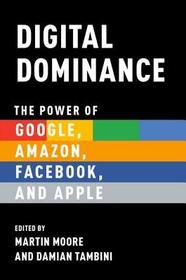
Digital Dominance
The Power of Google, Amazon, Facebook, and Apple
-
10% KEDVEZMÉNY?
- A kedvezmény csak az 'Értesítés a kedvenc témákról' hírlevelünk címzettjeinek rendeléseire érvényes.
- Kiadói listaár GBP 122.50
-
58 524 Ft (55 737 Ft + 5% áfa)
Az ár azért becsült, mert a rendelés pillanatában nem lehet pontosan tudni, hogy a beérkezéskor milyen lesz a forint árfolyama az adott termék eredeti devizájához képest. Ha a forint romlana, kissé többet, ha javulna, kissé kevesebbet kell majd fizetnie.
- Kedvezmény(ek) 10% (cc. 5 852 Ft off)
- Kedvezményes ár 52 671 Ft (50 163 Ft + 5% áfa)
Iratkozzon fel most és részesüljön kedvezőbb árainkból!
Feliratkozom
58 524 Ft

Beszerezhetőség
Megrendelésre a kiadó utánnyomja a könyvet. Rendelhető, de a szokásosnál kicsit lassabban érkezik meg.
Why don't you give exact delivery time?
A beszerzés időigényét az eddigi tapasztalatokra alapozva adjuk meg. Azért becsült, mert a terméket külföldről hozzuk be, így a kiadó kiszolgálásának pillanatnyi gyorsaságától is függ. A megadottnál gyorsabb és lassabb szállítás is elképzelhető, de mindent megteszünk, hogy Ön a lehető leghamarabb jusson hozzá a termékhez.
A termék adatai:
- Kiadó OUP USA
- Megjelenés dátuma 2018. július 26.
- ISBN 9780190845124
- Kötéstípus Keménykötés
- Terjedelem440 oldal
- Méret 163x239x30 mm
- Súly 839 g
- Nyelv angol 0
Kategóriák
Rövid leírás:
Are Google, Apple, Facebook, Amazon and Microsoft too powerful? Martin Moore and Damian Tambini draw together the world's leading researchers to examine the economic, political, and social impacts of these digital giants.
TöbbHosszú leírás:
Across the globe, Google, Amazon, Facebook, Apple and Microsoft have accumulated power in ways that existing regulatory and intellectual frameworks struggle to comprehend. A consensus is emerging that the power of these new digital monopolies is unprecedented, and that it has important implications for journalism, politics, and society.
It is increasingly clear that democratic societies require new legal and conceptual tools if they are to adequately understand, and if necessary check the economic might of these companies. Equally, that we need to better comprehend the ability of such firms to control personal data and to shape the flow of news, information, and public opinion.
In this volume, Martin Moore and Damian Tambini draw together the world's leading researchers to examine the digital dominance of technologies platforms and look at the evidence behind the rising tide of criticism of the tech giants. In fifteen chapters, the authors examine the economic, political, and social impacts of Google, Amazon, Facebook, Apple, and Microsoft, in order to understand the different facets of their power and how it is manifested. Digital Dominance is the first interdisciplinary volume on this topic, contributing to a conversation which is critical to maintaining the health of democracies across the world.
In the backdrop of the complex world that we live in, Digital Dominance: The Power of Google, Amazon, Facebook, and Apple, offers all readers the opportunity to learn about how the entire digital infrastructure is controlled by corporations while also posing many unanswered questions facing the future of the web. While a large number of users of social media today in the developing world are oblivious to the various concerns raised in the book, it is important for those who are at the helm of digital policymaking and those who are concerned with issues around internet governance to read this book without fail
Tartalomjegyzék:
Introduction, Martin Moore and Damian Tambini
Section 1: Economy
1. The Evolution of Digital Dominance: how and why we got to GAFA
Patrick Barwise and Leo Watkins
2. Platform dominance: the shortcomings of antitrust policy
Diane Coyle
3. When data evolves into market power - data concentration and data abuse under competition law
Inge Graef
4.An Infrastructure Service and Its Challenge to Current Antitrust Law
Lina Khan
Section 2: Society
5. Platform reliance, information intermediaries and news diversity: A look at the evidence
Nic Newman and Richard Fletcher
6. Challenging diversity - social media platforms and a new conception of media diversity
Natali Helberger
7. The Power of Providence: the role of platforms in leveraging the legibility of users to accentuate inequality
Orla Lynskey
8. Digital agenda setting: re-examining the role of platform monopolies
Justin Schlosberg
9. Free Expression? Dominant information intermediaries as arbiters of internet speech
Ben Wagner
10. The Dependent Press: how Silicon Valley threatens independent journalism
Emily Bell
Section 3: Politics
11. Social media power and election legitimacy
Damian Tambini
12. Manipulating Minds: the power of search engines to influence votes and opinions
Robert Epstein
13. I vote for - how search informs our choice of candidate
Nick Diakopoulos, Daniel Trielli and Jennifer Stark
14. Social Dynamics in the Age of Credulity: the misinformation risk and its fallout
Fabiana Zollo and Walter Quattriociochi
15. Platform Power and Responsibility in the Attention Economy
John Naughton
Conclusion
Damian Tambini and Martin Moore

