

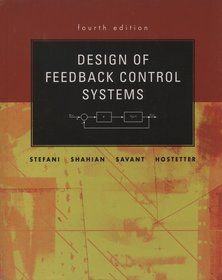
Design of Feedback Control Systems
Sorozatcím: The Oxford Series in Electrical;
-
10% KEDVEZMÉNY?
- A kedvezmény csak az 'Értesítés a kedvenc témákról' hírlevelünk címzettjeinek rendeléseire érvényes.
- Kiadói listaár GBP 258.99
-
116 933 Ft (111 365 Ft + 5% áfa)
Az ár azért becsült, mert a rendelés pillanatában nem lehet pontosan tudni, hogy a beérkezéskor milyen lesz a forint árfolyama az adott termék eredeti devizájához képest. Ha a forint romlana, kissé többet, ha javulna, kissé kevesebbet kell majd fizetnie.
- Kedvezmény(ek) 10% (kb. 11 693 Ft)
- Kedvezményes ár 105 240 Ft (100 229 Ft + 5% áfa)
Iratkozzon fel most és részesüljön kedvezőbb árainkból!
Feliratkozom
116 933 Ft

Beszerezhetőség
Megrendelésre a kiadó utánnyomja a könyvet. Rendelhető, de a szokásosnál kicsit lassabban érkezik meg.
Why don't you give exact delivery time?
A beszerzés időigényét az eddigi tapasztalatokra alapozva adjuk meg. Azért becsült, mert a terméket külföldről hozzuk be, így a kiadó kiszolgálásának pillanatnyi gyorsaságától is függ. A megadottnál gyorsabb és lassabb szállítás is elképzelhető, de mindent megteszünk, hogy Ön a lehető leghamarabb jusson hozzá a termékhez.
A termék adatai:
- Kiadás sorszáma 4
- Kiadó OUP USA
- Megjelenés dátuma 2001. október 11.
- ISBN 9780195142495
- Kötéstípus Keménykötés
- Terjedelem864 oldal
- Méret 197x242x37 mm
- Súly 1488 g
- Nyelv angol
- Illusztrációk numerous line figures 0
Kategóriák
Rövid leírás:
This text is designed for undergraduates studying electrical and mechanical engineering. This edition incorporates comprehensive keying of this text to MATLAB. There are now sections of "Computer Aided Learning" in which each student can learn how the MATLAB® platform can be used to verify all figures and tables included in the text. The text can be divided into six areas that represent the building blocks of constructing a course.
TöbbHosszú leírás:
Ideal for junior/senior level control systems courses, this new edition of Design of Feedback Control covers control systems for electrical and mechanical engineering and includes complete and up-to-date integration of analytical software such as MATLAB®.
TöbbTartalomjegyzék:
Chapter 1. Continuous-Time System Description
Preview
Basic Concepts
Control System Terminology
The Feedback Concept
Modeling
System Dynamics
Electrical Components
Mesh Analysis
State Variables
Node Analysis
Analyzing Operational Amplifier Circuits
Operational Amplifier Applications
Translational Mechanical Components
Free Body Diagrams
State Variables
Rotational Mechanical Components
Free Body Diagrams
Analogies
Gear Trains and Transformers
Electromechanical Components
Aerodynamics
Nomenclature
Dynamics
Lateral and Longitudinal Motion
Thermal Systems
Hydraulics
Transfer Functions and Stability
Transfer Functions
Response Terms
Multiple Inputs and Outputs
Stability
Block Diagrams
Block Diagram Elements
Block Diagram Reductions
Multiple Inputs and Outputs
Signal Flow Graphs
Comparison and Block Diagrams
Mason's Rule
A Positioning Servo Example
Controller Model of a Thyroid Gland
Stick-Slip Response of an Oil Well Drill
Summary
References
Problems
Chapter 2. Continuous-Time System Response
Preview
Response of First-Order Systems
Response of Second-Order Systems
Time Response
Overdamped Response
Critically Damped Response
Underdamped Response
Undamped Natural Frequency and Damping Ratio
Rise Time, Overshoot and Settling Time
Higher-Order System Response
Stability Testing
Coefficient Tests
Routh-Hurwitz Testing
Significance of the Array Coefficients
Left-Column Zeros
Row of Zeros
Eliminating a Possible Odd Divisor
Multiple Roots
Parameter Shifting
Adjustable Systems
Khartinov's Theorem
An Insulin Delivery System
Analysis of an Aircraft Wing
Summary
References
Problems
Chapter 3. Performance Specifications
Preview
Analyzing Tracking Systems
Importance of Tracking Systems
Natural Response, Relative Stability and Damping
Forced Response
Steady State Error
Initial and Final Values
Steady State Errors to Power-of-Time Inputs
Power-of-Time Error Performance
System Type Number
Achieving a Given Type Number
Unity Feedback Systems
Unity Feedback Error Coefficients
Performance Indices and Optimal Systems
System Sensitivity
Calculating the Effects of Changes in Parameters
Sensitivity Functions
Sensitivity to Disturbance Signals
Time Domain Design
Process Control
Ziegler-Nichols Compensation
Chien-Hrones-Reswick Compensation
An Electric Rail Transportation System
Phase-Locked Loop for a CB Receiver
Bionic Eye
Summary
References
Problems
Chapter 4. Root Locus Analysis
Preview
Pole-Zero Plots
Poles and Zeros
Graphical Evaluation
Root Locus for Feedback Systems
Angle Criterion
High and Low Gains
Root Locus Properties
Root Locus Construction
More About Root Locus
Root Locus Calibration
Computer-Aided Root Locus
Root Locus for Other Systems
Systems with Other Forms
Negative Parameter Ranges
Delay Effects
Design Concepts (Adding Poles and Zeros)
A Light-Source Tracking System
An Artificial Limb
Control of a Flexible Spacecraft
Bionic Eye
Summary
References
Problems
Chapter 5. Root Locus Design
Preview
Shaping a Root Locus
Adding and Canceling Poles and Zeros
Adding a Pole or Zero
Canceling a Pole or Zero
Second-Order Plant Models
An Uncompensated Example
Cascade Proportional Plus Integral (PI) Compensation
General Approach to Compensator Design
Cascade PI Compensation
Cascade Lag Compensation
Cascade Lead Compensation
Cascade Lag-Lead Compensation
Rate Feedback Compensation (PD)
Proportional-Integral-Derivative Compensation (PID)
Pole Placement
Algebraic Compensation
Selecting the Transfer Function
Incorrect Plant Transmittance
Robust Algebraic Compensation
Fixed-Structure Compensation
An Unstable High-Performance Aircraft
Control of a Flexible Space Station
Control of a Solar Furnace
Summary
References
Problems
Chapter 6. Frequency Response Analysis
Preview
Frequency Response
Forced Sinusoidal Response
Frequency Response Measurement
Response at Low and High Frequencies
Graphical Frequency Response Methods
Bode Plots
Amplitude Plots in Decibels
Real Axis Roots
Products of Transmittance Terms
Complex Roots
Using Experimental Data
Finding Models
Irrational Transmittances
Nyquist Methods
Generating the Nyquist (Polar) Plot
Interpreting the Nyquist Plot
Gain Margin
Phase Margin
Relation between Closed Loop and Open Loop Frequency Response
Frequency Response of a Flexible Spacecraft
Summary
References
Problems
Chapter 7. Frequency Response Design
Preview
Relationship between Root Locus, Time Domain and Frequency Domain
Compensation Using Bode Plots
Uncompensated System
Cascade Proportional Plus Integral (PI) and Cascade Lag Compensation
Cascade Lead Compensation
Cascade Lag-Lead Compensation
Rate Feedback Compensation (PD)
Proportional-Integral-Derivative Compensation
An Automobile Driver as a Compensator
Summary
References
Problems
Chapter 8. State Space Analysis
Preview
State Space Representation
Phase-Variable Form
Dual Phase-Variable Form
Multiple Inputs and Outputs
Physical State Variables
Transfer Functions
State Transformations and Diagonalization
Diagonal Forms
Diagonalization Using Partial-Fraction Expansion
Complex Conjugate Characteristic Roots
Repeated Characteristic Roots
Time Response From State Equations
Laplace Transform Solution
Time-Domain Response of First-Order Systems
Time-Domain Response of Higher-Order Systems
System Response Computation
Stability
Asymptotic Stability
BIBO Stability
Internal Stability
Controllability and Observability
The Controllability Matrix
The Observability Matrix
Controllability, Observability and Pole-Zero Cancellation
Causes of Uncontrollability
Inverted Pendulum Problems
Summary
Chapter 9. State Space Design
Preview
State Feedback and Pole Placement
Stabilizability
Choosing Pole Locations
Limitations of State Feedback
Tracking Problems
Integral Control
Observer Design
Control Using Observers
Separation Property
Observer Transfer Function
Reduced-Order Observer Design
Separation Property
Reduced-Order Observer Transfer Function
A Magnetic Levitation System
Summary
Chapter 10. Advanced State Space Methods
Preview
The Linear Quadratic Regulator Problem
Properties of the LQR Design
Return Difference Inequality
Optimal Root Locus
Optimal Observers--The Kalman Filter
The Linear Quadratic Gaussian (LQG) Problem
Critique of LGQ
Robustness
Feedback Properties
Uncertainty Modeling
Robust Stability
Loop Transfer Recovery (LTR)
H-- Control
A Brief History
Some Preliminaries
H-- Control: Solution
Weights in H-- Control Problem
Summary
References
Problems
Chapter 11. Digital Control
Preview
Computer Processing
Computer History and Trends
A/D and D/A Conversion
Analog-to-Digital Conversion
Sample and Hold
Digital-to-Analog Conversion
Discrete-Time Signals
Representing Sequences
Z-Transformation and Properties
Inverse z-Transform
Sampling
Reconstruction of Signals from Samples
Representing Sampled Signals with Impulses
Relation between the z-Transform and the Laplace Transform
The Sampling Theorem
Discrete-Time Systems
Difference Equations Response
Z-Transfer Functions
Block Diagrams and Signal Flow Graphs
Stability and the Bilinear Transformation
Computer Software
State Variable Description of Discrete-Time Systems
Simulation Diagrams and Equations
Response and Stability
Controllability and Observability
Digitizing Control Systems
Step-Invariant Approximation
z-Transfer Functions of Systems with Analog Measurements
A Design Example
Direct Digital Design
Steady State Response
Deadbeat Systems
A Design Example
Summary
References
Problems
Appendix A. Matrix Algebra
Preview
Nomenclature
Addition and Subtraction
Transposition
Multiplication
Determinants and Cofactors
Inverse
Simultaneous Equations
Eigenvalues and Eigenvectors
Derivative of a Scalar with Respect to a Vector
Quadratic Forms and Symmetry
Definiteness
Rank
Partitioned Matrices
Problems
Appendix B. Laplace Transform
Preview
Definition and Properties
Solving Differential Equations
Partial Fraction Expansion
Additional Properties of the Laplace Transform
Real Translation
Second Independent Variable
Final Value and Initial Value Theorems
Convolution Integral

