

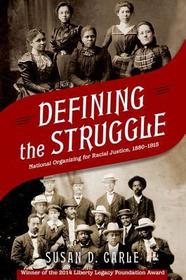
Defining the Struggle
National Organizing for Racial Justice, 1880-1915
-
10% KEDVEZMÉNY?
- A kedvezmény csak az 'Értesítés a kedvenc témákról' hírlevelünk címzettjeinek rendeléseire érvényes.
- Kiadói listaár GBP 35.99
-
16 249 Ft (15 475 Ft + 5% áfa)
Az ár azért becsült, mert a rendelés pillanatában nem lehet pontosan tudni, hogy a beérkezéskor milyen lesz a forint árfolyama az adott termék eredeti devizájához képest. Ha a forint romlana, kissé többet, ha javulna, kissé kevesebbet kell majd fizetnie.
- Kedvezmény(ek) 10% (cc. 1 625 Ft off)
- Kedvezményes ár 14 624 Ft (13 928 Ft + 5% áfa)
Iratkozzon fel most és részesüljön kedvezőbb árainkból!
Feliratkozom
16 249 Ft

Beszerezhetőség
Megrendelésre a kiadó utánnyomja a könyvet. Rendelhető, de a szokásosnál kicsit lassabban érkezik meg.
Why don't you give exact delivery time?
A beszerzés időigényét az eddigi tapasztalatokra alapozva adjuk meg. Azért becsült, mert a terméket külföldről hozzuk be, így a kiadó kiszolgálásának pillanatnyi gyorsaságától is függ. A megadottnál gyorsabb és lassabb szállítás is elképzelhető, de mindent megteszünk, hogy Ön a lehető leghamarabb jusson hozzá a termékhez.
A termék adatai:
- Kiadó OUP USA
- Megjelenés dátuma 2015. június 18.
- ISBN 9780190235246
- Kötéstípus Puhakötés
- Terjedelem424 oldal
- Méret 231x155x27 mm
- Súly 612 g
- Nyelv angol 0
Kategóriák
Rövid leírás:
This book punctures the myth that important national civil rights organizing in the United States began with the NAACP, showing that earlier national organizations developed key ideas about law and racial justice activism that the NAACP later pursued.
TöbbHosszú leírás:
Since its founding in 1910--the same year as another national organization devoted to the economic and social welfare aspects of race advancement, the National Urban League--the NAACP has been viewed as the vanguard national civil rights organization in American history. But these two flagship institutions were not the first important national organizations devoted to advancing the cause of racial justice. Instead, it was even earlier groups -- including the National Afro American League, the National Afro American Council, the National Association of Colored Women, and the Niagara Movement - that developed and transmitted to the NAACP and National Urban League foundational ideas about law and lawyering that these latter organizations would then pursue.
With unparalleled scholarly depth, Defining the Struggle explores these forerunner organizations whose contributions in shaping early twentieth century national civil rights organizing have largely been forgotten today. It examines the motivations of their leaders, the initiatives they undertook, and the ideas about law and racial justice activism they developed and passed on to future generations. In so doing, it sheds new light on how these early origins helped set the path for twentieth century legal civil rights activism in the United States.
Susan Carle's Defining the Struggle: National Organizing for Racial Justice, 18801915 provides a useful entry point into an examination of the legal history of civil rights and its relationship to the historiography of the long civil rights movement.
Tartalomjegyzék:
Introduction
Chapter 1. A New Generation of Post-Reconstruction Leaders
Chapter 2. The Legal and Political Vision of T. Thomas Fortune, Founder of the National Afro American League, 1880-1890
Chapter 3. The National Afro American League's Founding and Law-Related
Work, 1887-1895
Chapter 4: The Dispute between the "Radicals " and the "Accommodationists " within the Afro American Council: Reverdy Ransom and Booker T. Washington's Contrasting Visions of Racial Justice, 1895-1902
Chapter 5: The Afro American Council's Internal History, 1898-1908
Chapter 6: "Should Not a Nation Be Just to All of Her Citizens? ": The Afro American Council's Legal Work, 1898-1908
Chapter 7: "Unity in Diversity ": The National Association of Colored Women's Dual Social Welfare and Civil Rights Agenda, 1895-1910
Chapter 8: Asserting "Manhood " Rights: The Niagara Movement's First Year, 1905
Chapter 9: The Beginnings of Twentieth Century Protest in the Niagara Movement's Experience, 1906-1909
Chapter 10: Atlanta and New York City; Founding the National Urban League
Chapter 11: Founding the NAACP: Building the Organization, 1908-1915
Chapter 12: Building the NAACP's Legal Agenda, 1910-1915
Conclusion
Acknowledgements
Notes
Bibliography
Index

