

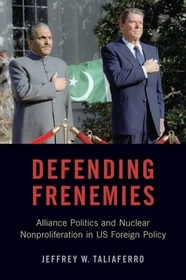
Defending Frenemies
Alliances, Politics, and Nuclear Nonproliferation in US Foreign Policy
-
10% KEDVEZMÉNY?
- A kedvezmény csak az 'Értesítés a kedvenc témákról' hírlevelünk címzettjeinek rendeléseire érvényes.
- Kiadói listaár GBP 31.49
-
14 217 Ft (13 540 Ft + 5% áfa)
Az ár azért becsült, mert a rendelés pillanatában nem lehet pontosan tudni, hogy a beérkezéskor milyen lesz a forint árfolyama az adott termék eredeti devizájához képest. Ha a forint romlana, kissé többet, ha javulna, kissé kevesebbet kell majd fizetnie.
- Kedvezmény(ek) 10% (kb. 1 422 Ft)
- Kedvezményes ár 12 795 Ft (12 186 Ft + 5% áfa)
Iratkozzon fel most és részesüljön kedvezőbb árainkból!
Feliratkozom
14 217 Ft

Beszerezhetőség
Becsült beszerzési idő: A Prosperónál jelenleg nincsen raktáron, de a kiadónál igen. Beszerzés kb. 3-5 hét..
A Prosperónál jelenleg nincsen raktáron.
Why don't you give exact delivery time?
A beszerzés időigényét az eddigi tapasztalatokra alapozva adjuk meg. Azért becsült, mert a terméket külföldről hozzuk be, így a kiadó kiszolgálásának pillanatnyi gyorsaságától is függ. A megadottnál gyorsabb és lassabb szállítás is elképzelhető, de mindent megteszünk, hogy Ön a lehető leghamarabb jusson hozzá a termékhez.
A termék adatai:
- Kiadó OUP USA
- Megjelenés dátuma 2019. október 16.
- ISBN 9780190939311
- Kötéstípus Puhakötés
- Terjedelem312 oldal
- Méret 155x231x20 mm
- Súly 454 g
- Nyelv angol
- Illusztrációk 2 black and white line drawings 0
Kategóriák
Rövid leírás:
Defending Frenemies examines the nonproliferation strategies that United States pursued toward vulnerable and often obstreperous allies in three volatile regions of the globe, the Middle East, South Asia, and East Asia, from the early 1960s to the early 1990s. Jeffrey W. Taliaferro shows that superpower competition and regional power dynamics, as filtered through US domestic politics, shaped the types of strategies US policymakers adopted toward the nuclear proliferation by Israel, Pakistan, South Korea, and Taiwan during the Cold War. The overriding goals of successive US administrations were to contain the growth of the Soviet Union's influence in the Middle East and South Asia, as well as to enlist China as an ally of convenience against the Soviets in East Asia.
TöbbHosszú leírás:
The United States maintains defense ties with as many as 60 countries, which not only enables its armed forces to maintain command globally and to project its force widely, but also enables its government to exert leverage over allies' foreign policies and military strategies. In Defending Frenemies, Jeffrey W. Taliaferro presents a historical and comparative analysis of how successive US presidential administrations have employed inducements and coercive diplomacy toward Israel, Pakistan, South Korea, and Taiwan over nuclear proliferation. Taliaferro shows that the ultimate goals in each administration, from John F. Kennedy to George H. W. Bush, have been to contain the Soviet Union's influence in the Middle East and South Asia and to enlist China as an ally of convenience against the Soviets in East Asia. Policymakers' inclinations to pursue either accommodative strategies or coercive nonproliferation strategies toward allies have therefore been directly linked to these primary objectives. Defending Frenemies is sharp examination of how regional power dynamics and US domestic politics have shaped the nonproliferation strategies the US has pursued toward vulnerable and often obstreperous allies.
The great strength of this book lies in the well-written and well-sourced narratives detailing relations between each frenemy state and the US. Taliaferro places these narratives in the context of four theoretical frameworks, concluding that neoclassical realism offers the most compelling explanation of US behavior.
Tartalomjegyzék:
Acknowledgments
Abbreviations and Acronyms used in the Texts and Notes
Chapter 1: Introduction
Chapter 2: Neoclassical Realist Theory, Alliance Politics, and Nonproliferation
Chapter 3: The United States and Israel's Nuclear Weapons Program, 1961-1973
Chapter 4: The United States and Pakistan's Nuclear Weapons Program, 1975-1990
Chapter 5: The United States and South Korea's Nuclear Weapons Program, 1971-1981
Chapter 6: The United States and Taiwan's Nuclear Weapons Program, 1967-1978
Chapter 7: Conclusions

