

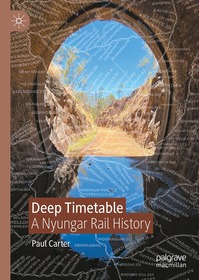
Deep Timetable
A Nyungar Rail History
-
17% KEDVEZMÉNY?
- A kedvezmény csak az 'Értesítés a kedvenc témákról' hírlevelünk címzettjeinek rendeléseire érvényes.
- Kiadói listaár EUR 139.09
-
54 328 Ft (51 741 Ft + 5% áfa)
Az ár azért becsült, mert a rendelés pillanatában nem lehet pontosan tudni, hogy a beérkezéskor milyen lesz a forint árfolyama az adott termék eredeti devizájához képest. Ha a forint romlana, kissé többet, ha javulna, kissé kevesebbet kell majd fizetnie.
- Kedvezmény(ek) 12% (cc. 6 519 Ft off)
- Kedvezményes ár 47 809 Ft (45 532 Ft + 5% áfa)
- A kedvezmény érvényes eddig: 2026. augusztus 5.
Iratkozzon fel most és részesüljön kedvezőbb árainkból!
Feliratkozom
47 809 Ft

Beszerezhetőség
Még nem jelent meg, de rendelhető. A megjelenéstől számított néhány héten belül megérkezik.
Why don't you give exact delivery time?
A beszerzés időigényét az eddigi tapasztalatokra alapozva adjuk meg. Azért becsült, mert a terméket külföldről hozzuk be, így a kiadó kiszolgálásának pillanatnyi gyorsaságától is függ. A megadottnál gyorsabb és lassabb szállítás is elképzelhető, de mindent megteszünk, hogy Ön a lehető leghamarabb jusson hozzá a termékhez.
A termék adatai:
- Kiadó Springer Nature Singapore
- Megjelenés dátuma 2026. július 29.
- ISBN 9789819594580
- Kötéstípus Keménykötés
- Terjedelem269 oldal
- Méret 210x148 mm
- Nyelv angol
- Illusztrációk XX, 269 p. 29 illus., 2 illus. in color. 700
Kategóriák
Hosszú leírás:
"
Deep Timetable is a Nyungar history of Western Australia’s rail network. The phrase ‘deep timetable’ refers to a precolonial communications network of bidi (tracks) and kaleeps (camping places, water sources) that formed the basis of infrastructural colonisation. It alludes to two profoundly different understandings of how places are connected and people related.
Information for the project came from documentary sources, notably employment records kept in the Western Australian Government Railways’ archives, but most importantly from over fifty ‘Nyungar-on-Nyungar’ yarning sessions. In a departure from conventional ethnographic method, participating Elders determined which memory tracks and railway places were visited.
Deep Timetable captures the profoundly ambiguous impact of the spreading rail network on Aboriginal life. Contributing Elders emphasised the positive role rail played in empoyment, housing – and limited escape from Native Welfare surveillance. At the same time, post-1905 government policies of racial segregation, family break-up and child removal, depended critically on the existence of convenient transportation: better connections often meant easier separation.
As a narrative method, yarning re-enacts memory as a journey in the present.Destinations and distances are secondary, what counts is relating, in both senses. Talking about the rail network like this turns it into a network of family survival. Weaving continuities of consciousness between one generation and the next, it shows how a beleaguered community repeatedly found ways to make the system work for them.
" TöbbTartalomjegyzék:
"
1. Introductory: On the platform, the project’s conductor.- 2. Nyungar rail connections: a sketch map.- 3. Networks inside networks: a yarning history.- 4. Working families: survival and sacrifice.- 5. Relating to place: Norm Hayward’s story.- 6. Associations: the railway in everyday life.- 7. Accidents: yarning’s deeper timetable.- 8. Future directions: a Nyungar rail network.- 9. Concluding: Different platforms, shared journeys.
" Több
