

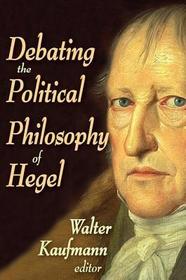
Debating the Political Philosophy of Hegel
-
10% KEDVEZMÉNY?
- Kiadói listaár GBP 54.99
-
24 827 Ft (23 645 Ft + 5% áfa)
Az ár azért becsült, mert a rendelés pillanatában nem lehet pontosan tudni, hogy a beérkezéskor milyen lesz a forint árfolyama az adott termék eredeti devizájához képest. Ha a forint romlana, kissé többet, ha javulna, kissé kevesebbet kell majd fizetnie.
- Kedvezmény(ek) 10% (cc. 2 483 Ft off)
- Kedvezményes ár 22 345 Ft (21 281 Ft + 5% áfa)
22 345 Ft

Beszerezhetőség
Becsült beszerzési idő: A Prosperónál jelenleg nincsen raktáron, de a kiadónál igen. Beszerzés kb. 3-5 hét..
A Prosperónál jelenleg nincsen raktáron.
Why don't you give exact delivery time?
A beszerzés időigényét az eddigi tapasztalatokra alapozva adjuk meg. Azért becsült, mert a terméket külföldről hozzuk be, így a kiadó kiszolgálásának pillanatnyi gyorsaságától is függ. A megadottnál gyorsabb és lassabb szállítás is elképzelhető, de mindent megteszünk, hogy Ön a lehető leghamarabb jusson hozzá a termékhez.
A termék adatai:
- Kiadás sorszáma 1
- Kiadó Routledge
- Megjelenés dátuma 2010. január 30.
- Kötetek száma Paperback
- ISBN 9780202363493
- Kötéstípus Puhakötés
- Terjedelem188 oldal
- Méret 229x152 mm
- Súly 272 g
- Nyelv angol 0
Kategóriák
Rövid leírás:
Few philosophers have had as much influence as Hegel. When he died in 1831, he not only dominated German philosophy, but also left his mark on the study of religion and art, on historical studies, and on political thought. Much later, Lenin insisted that no one could completely comprehend Karl Marx unless he had first made a thorough study of Hegel. Later, it became fashionable to link Hegel with Nazism and communism. There is today broad agreement that knowledge of Hegel's thought adds a critical dimension to our understanding of recent cultural and political history.
This volume, first published in 1970, focuses on Hegel's political philosophy. It brings together ten essays by six authors who present sharply conflicting interpretations. Here are point-by-point discussions, from differing perspectives, on Hegel's philosophy of the state and his ideas about history and war, nationalism and liberty. Never before have these issues been joined in comparable fashion in a single volume.
Sidney Hook sees Hegel as "the very model of a small - minded, timid Continental conservative" and accuses him of "the most specious reasoning that ever disgraced a philosopher," and E. F. Carritt argues for a "totalitarian" reading of Hegel, while T. M. Knox and Shlomo Avineri defend Hegel against these and other charges. The book also contains a short contribution by Z. A. Pelczynski and Walter Kaufmann's "The Hegel Myth and Its Method." Walter Kaufmann, an outstanding historian of European ideas in philosophy, furnished an introduction as well as footnotes that help to clarify perplexing issues and in some cases seek to put an end to long-lived errors. His analysis is itself a major contribution to Hegel's political theories.
TöbbHosszú leírás:
Few philosophers have had as much influence as Hegel. When he died in 1831, he not only dominated German philosophy, but also left his mark on the study of religion and art, on historical studies, and on political thought. Much later, Lenin insisted that no one could completely comprehend Karl Marx unless he had first made a thorough study of Hegel. Later, it became fashionable to link Hegel with Nazism and communism. There is today broad agreement that knowledge of Hegel's thought adds a critical dimension to our understanding of recent cultural and political history. This volume, first published in 1970, focuses on Hegel's political philosophy. It brings together ten essays by six authors who present sharply conflicting interpretations. Here are point-by-point discussions, from differing perspectives, on Hegel's philosophy of the state and his ideas about history and war, nationalism and liberty. Never before have these issues been joined in comparable fashion in a single volume. Sidney Hook sees Hegel as "the very model of a small - minded, timid Continental conservative" and accuses him of "the most specious reasoning that ever disgraced a philosopher," and E. F. Carritt argues for a "totalitarian" reading of Hegel, while T. M. Knox and Shlomo Avineri defend Hegel against these and other charges. The book also contains a short contribution by Z. A. Pelczynski and Walter Kaufmann's "The Hegel Myth and Its Method." Walter Kaufmann, an outstanding historian of European ideas in philosophy, furnished an introduction as well as footnotes that help to clarify perplexing issues and in some cases seek to put an end to long-lived errors. His analysis is itself a major contribution to Hegel's political theories.
TöbbTartalomjegyzék:
Acknowledgment Introduction -WALTER KAUFMANN I The First Debate 1. Hegel and Prussianism -T. M. KNOX 2. Reply -E. F. CARRITT 3. Rebuttal -T. M. KNOX 4. Final Rejoinder -E. F. CARRITT II The Second Debate 5. Hegel Rehabilitated? -SIDNEY HOOK 6. Hook's Hegel -SHLOMO A VINERI 7. Hegel Again -Z. A. PELCZYNSKI 8. Hegel and His Apologists -SIDNEY HOOK III Two Solos 9. Hegel and Nationalism -SHLOMO A VINERI 10. The Hegel Myth and Its Method -WALTER KAUFMANN For Further Reading Index
Több
