

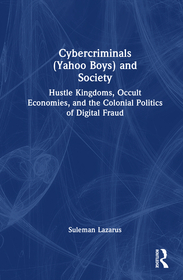
Cybercriminals (Yahoo Boys) and Society
Hustle Kingdoms, Occult Economies, and the Colonial Politics of Digital Fraud
-
10% KEDVEZMÉNY?
- Kiadói listaár GBP 155.00
-
69 982 Ft (66 650 Ft + 5% áfa)
Az ár azért becsült, mert a rendelés pillanatában nem lehet pontosan tudni, hogy a beérkezéskor milyen lesz a forint árfolyama az adott termék eredeti devizájához képest. Ha a forint romlana, kissé többet, ha javulna, kissé kevesebbet kell majd fizetnie.
- Kedvezmény(ek) 10% (cc. 6 998 Ft off)
- Kedvezményes ár 62 984 Ft (59 985 Ft + 5% áfa)
62 984 Ft

Beszerezhetőség
Még nem jelent meg, de rendelhető. A megjelenéstől számított néhány héten belül megérkezik.
Why don't you give exact delivery time?
A beszerzés időigényét az eddigi tapasztalatokra alapozva adjuk meg. Azért becsült, mert a terméket külföldről hozzuk be, így a kiadó kiszolgálásának pillanatnyi gyorsaságától is függ. A megadottnál gyorsabb és lassabb szállítás is elképzelhető, de mindent megteszünk, hogy Ön a lehető leghamarabb jusson hozzá a termékhez.
A termék adatai:
- Kiadás sorszáma 1
- Kiadó Routledge
- Megjelenés dátuma 2026. szeptember 23.
- ISBN 9781032949291
- Kötéstípus Keménykötés
- Terjedelem514 oldal
- Méret 234x156 mm
- Nyelv angol
- Illusztrációk 18 Illustrations, black & white; 8 Halftones, black & white; 10 Line drawings, black & white; 16 Tables, black & white 700
Kategóriák
Rövid leírás:
This book offers a comprehensive sociological account of cyber-enabled fraud in Africa south of the Sahara, centred on Nigeria. Drawing on over a decade of ethnographic research, it examines online fraud not as isolated wrongdoing but as a patterned social response to postcolonial inequality, blocked mobility, and institutional failure.
TöbbHosszú leírás:
This book offers a comprehensive sociological account of cyber-enabled fraud in Africa south of the Sahara, centred on Nigeria but extending across Ghana, Cameroon, Côte d’Ivoire, Jamaica, and Southeast Asia. Drawing on over a decade of ethnographic research, conviction case files, court documents, interviews, and cultural analysis of Afrobeats music, it examines online fraud not as isolated wrongdoing but as a patterned social response to postcolonial inequality, blocked mobility, and institutional failure.
The book introduces the Tripartite Cybercrime Framework, a motivation-centred typology that classifies cybercrime as socio-economic, psychosocial, or geopolitical, shifting attention from technical mechanisms to underlying purpose. It also develops the concept of Hustle Kingdoms, underground fraud “academies” that mimic schooling whilst binding learners through spiritual oaths, psychological pressure, and economic dependency, complicating simple victim–offender binaries. Across comparative chapters, the book connects cultural repertoires of online fraud in Africa south of the Sahara to Southeast Asian scam compounds and argues that coercion should be understood as a spectrum, from overt confinement to socially embedded and spiritually enforced control. It concludes with clear policy and safeguarding implications for prevention, policing, sentencing, and victim support.
This book will be of interest to criminologists, anthropologists and sociologists studying cybercrime, online fraud, money laundering, and informal economies. It will also be useful to scholars of cultural studies, cyberpsychology, and African studies, as well as to policymakers and practitioners working on cybercrime prevention
"An excellent, theoretically sophisticated, highly original, and sensitively researched analysis of cybercrime. It manages to synthesise apparently contradictory elements like Marxist political economy with complex cultural appreciation, and understanding perpetrators with sympathy for the pain of victims. A major contribution to theoretical criminology and policy concerns."
Robert Reiner, Emeritus Professor of Criminology, London School of Economics and Political Science (LSE), UK
"Suleman Lazarus offers a sharp and original account of cyber-enabled fraud in West Africa by placing digital deception within the social worlds that produce it. Refusing familiar caricatures of the Yahoo Boy as merely a criminal deviant, this book shows how fraud emerges through blocked mobility, postcolonial inequality, spiritual economies, kinship networks, and the cultural politics of hustle and aspiration. Drawing on fieldwork, court records, scam scripts, ritual practice, and popular music, it recasts online fraud as a historically grounded social formation rather than a purely technical offence. Conceptually ambitious and empirically rich, this is an important intervention in criminology, African studies, anthropology, and digital culture, and one that forces readers to confront the unequal worlds in which digital crime becomes imaginable, intelligible, and ordinary."
Jovan Scott Lewis, Professor of Geography, Haas Distinguished Chair in Economic Disparities, University of California, Berkeley
"In an era when many scams targeting the Global North originate in West Africa, this book cuts through speculation to deliver the most rigorous and illuminating assessment available. Supported by unparalleled ethnographic research, it is the definitive work on the people, practices, and structures that shape this illicit economy."
Mark Button, Professor, Co-Director of the Centre for Cybercrime and Economic Crime, University of Portsmouth, UK
"Cybercriminals (Yahoo Boys) and Society is an artfully crafted look into the world of the Yahoo Boys and the Hustle Kingdoms they inhabit. Drawing on rigorous, methodologically sound research, Suleman Lazarus goes beyond simplistic caricatures to provide a theoretically rich and deeply contextualised account of the social conditions that give rise to these forms of cybercrime. This is essential reading for anyone with a serious interest in cybercrime."
Heith Copes, Distinguished Professor of Criminal Justice, The University of Alabama at Birmingham
"This book offers a much-needed in-depth sociological analysis of West African cybercrime and beyond, grounded in conviction records, ethnographic depth, and comparative insight. Essential reading for anyone seeking a sociocultural account of digital deviance that replaces cultural-pathology caricatures with rigorous explanation."
Eric Rutger Leukfeldt, Professor, Leiden University; Senior Researcher, Netherlands Institute for the Study of Crime and Law Enforcement; Director, Centre of Expertise Cybersecurity, The Hague University of Applied Sciences
"The academic literature on Cybercrime has grown in volume over the years, yet its focus is still very ‘North’ of the Global North-South digital divide. Suleman Lazarus adds to the literature with a very nuanced and informative analysis of digital fraud and offending in the ‘South’ of the divide'."
David S. Wall, Profsssor, Centre for Criminal Justice Studies, School of Law, University of Leeds
"This book provides a rare and valuable glimpse behind the curtain of cyber fraud and the offenders who operate within it. Drawing on rich ethnographic data, it situates offending behaviours within the wider social, economic, and cultural context of Nigeria. The evidence and insights in this book make a vital contribution to academic knowledge of modern-day fraud, and it is essential reading for practitioners seeking to deepen their understanding and design effective national and international policies to address cyber fraud."
Dr Michael Skidmore, Head of Serious Crime Research, The Police Foundation
"This work provides critical insights into the cultural and social contexts that drive cybercrimes in Nigeria and West Africa."
Thomas J. Holt, Professor, Director of the Center for Cybercrime Investigation and Training, School of Criminal Justice, Michigan State University
"Cybercriminals (Yahoo Boys) and Society: Hustle Kingdoms, Occult Economies, and the Colonial Politics of Digital Fraud gives new insights into the rise of scams in West Africa. Things are not always as simple as the Nigerian Prince story. Suleman Lazarus gives a detailed insight into the different sources of scams and how they came to be. Worthy to read!"
Jorij Abraham, Managing Director, Global Anti-Scam Alliance (GASA)
Tartalomjegyzék:
Introduction PART I: Framing the Terrain Geographies of Cybercrime, Postcolonial Inequalities, and the Spatial Production of Cybercriminals; 2 The Tripartite Cybercrime Framework and the Particularities of Cybercrime in Postcolonial Africa; 3 From Student Activism to Global Fraud Enterprise: The Evolution of Nigerian Confraternities and Their Role in Cybercrime; PART II: Institutions and Infrastructures of Cybercriminal Formation When the School Fails You, the Hustle Kingdom Trains You: The Schools That Formal Education Refused to be in Anglophone West Africa; 5 Degrees of Entrapment in Hustle Kingdoms: Spiritual Coercion and the Victim-Offender Overlap in Cybercrime Academies; 6 Do Mothers’ Hands Both Bless and Bind?: An Ethnographic Account of Yahoo Boys’ Mothers’ Associations (AYBM); 7 Is the Spirit World the Base of the Superstructure?: Empirical Evidence for Inverting Orthodox Marxism in Occult Economies; PART III: Offences, Scripts, and Networked Operations 8 Romance in Ruins and the Hustler’s Gospel of Love and Lies; 9 United States v. Olugbenga Lawal: A Forensic Ethnography of Romance Fraud, Business Email Compromise, and Transnational Money Laundering Circuits; 10 Feminist Criminology and Two Faces of Transgressive Labour: Comparing Male Online Fraudsters (Yahoo Boys) and Female Sex Workers (Ashawo); PART IV: Cultural Grammars and Regional Variants 11 Afrobeats and the Cultural Politics of Online Fraud (2007–2025); 12 Codes of Retaliation and Anti-Colonial Discourses in Digital Fraud: Ghana, Nigeria, and Jamaica; 13 Digital Hustlers Across Postcolonial Ecologies: Comparing Internet Fraudsters in Nigeria, Ghana, Cameroon, and Côte d’Ivoire; PART V: Global Synthesis 14 Imprisoning the Body Versus Colonising the Will: A Comparative Sociology of Coerced Cybercrime in Southeast Asia and West Africa; PART VI: Conclusion Conclusion: Towards a Sociological Criminology of Digital Deviance
Több
