

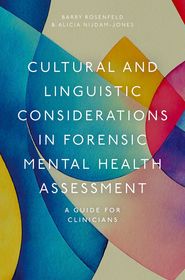
Cultural and Linguistic Considerations in Forensic Mental Health Assessment
A Guide for Clinicians
-
10% KEDVEZMÉNY?
- A kedvezmény csak az 'Értesítés a kedvenc témákról' hírlevelünk címzettjeinek rendeléseire érvényes.
- Kiadói listaár GBP 32.99
-
14 894 Ft (14 185 Ft + 5% áfa)
Az ár azért becsült, mert a rendelés pillanatában nem lehet pontosan tudni, hogy a beérkezéskor milyen lesz a forint árfolyama az adott termék eredeti devizájához képest. Ha a forint romlana, kissé többet, ha javulna, kissé kevesebbet kell majd fizetnie.
- Kedvezmény(ek) 10% (kb. 1 489 Ft)
- Kedvezményes ár 13 405 Ft (12 767 Ft + 5% áfa)
Iratkozzon fel most és részesüljön kedvezőbb árainkból!
Feliratkozom
14 894 Ft

Beszerezhetőség
Megrendelésre a kiadó utánnyomja a könyvet. Rendelhető, de a szokásosnál kicsit lassabban érkezik meg.
Why don't you give exact delivery time?
A beszerzés időigényét az eddigi tapasztalatokra alapozva adjuk meg. Azért becsült, mert a terméket külföldről hozzuk be, így a kiadó kiszolgálásának pillanatnyi gyorsaságától is függ. A megadottnál gyorsabb és lassabb szállítás is elképzelhető, de mindent megteszünk, hogy Ön a lehető leghamarabb jusson hozzá a termékhez.
A termék adatai:
- Kiadó OUP USA
- Megjelenés dátuma 2026. április 13.
- ISBN 9780190900960
- Kötéstípus Puhakötés
- Terjedelem276 oldal
- Méret 234x156x15 mm
- Súly 390 g
- Nyelv angol 678
Kategóriák
Rövid leírás:
This book summarizes the emerging psychological research and legal and mental health practice guidelines surrounding work with ethnically and culturally diverse populations, particularly as these issues pertain to forensic mental health evaluations. It provides clinicians with a foundation for conducting culturally informed and context sensitive assessments and guides researchers by identifying gaps, methodological challenges, and future directions in the study of cross-cultural forensic mental health assessment.
TöbbHosszú leírás:
As English-speaking societies become increasingly diverse, clinical psychologists are often called upon to work with individuals from a wide range of ethnic, cultural, linguistic, and religious backgrounds. These intersecting identities shape an individual's lived experience and can significantly impact the accuracy of psychological evaluations. It is therefore critical for clinicians to account for cultural differences, particularly in forensic mental health assessment, due to the disproportionate number of individuals from diverse backgrounds who come into contact with the legal system and the weighty consequences which can stem from forensic evaluation.
Cultural and Linguistic Considerations in Forensic Mental Health Assessment summarizes the emerging psychological research and legal and mental health practice guidelines surrounding work with diverse populations, particularly as these issues pertain to forensic mental health evaluations. It focuses on the evaluation of individuals whose cultural, linguistic, or community experiences differ from those of the evaluator--an increasingly common reality in clinical practice. The book provides clinicians and trainees with a foundation for conducting culturally informed and context sensitive assessments and guides researchers by identifying gaps, methodological challenges, and future directions in the study of cross-cultural forensic mental health assessment. Ultimately, the authors call for more accurate, equitable, and culturally responsive evaluations for those who are historically overrepresented, yet often underserved, within forensic systems.
Tartalomjegyzék:
The Importance of Culture in Forensic Assessment
Diagnostic and Forensic Interviewing
Assessment of Malingering and Defensiveness
Personality Assessment and Multiscale Inventories
Cognitive and Neuropsychological Assessment
Assessment of Risk for Violence and Reoffending
Assessment of Children and Families
Evaluations for Asylum and International Human Rights Violations
Developing a Culturally Informed Research Agenda
The Importance of Culture in Forensic Assessment
Diagnostic and Forensic Interviewing
Assessment of Malingering and Defensiveness
Personality Assessment and Multiscale Inventories
Cognitive and Neuropsychological Assessment
Assessment of Risk for Violence and Reoffending
Assessment of Children and Families
Evaluations for Asylum and International Human Rights Violations
Developing a Culturally Informed Research Agenda
The Importance of Culture in Forensic Assessment
Diagnostic and Forensic Interviewing
Assessment of Malingering and Defensiveness
Personality Assessment and Multiscale Inventories
Cognitive and Neuropsychological Assessment
Assessment of Risk for Violence and Reoffending
Assessment of Children and Families
Evaluations for Asylum and International Human Rights Violations
Developing a Culturally Informed Research Agenda

