

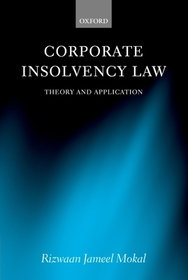
Corporate Insolvency Law
Theory and Application
-
10% KEDVEZMÉNY?
- A kedvezmény csak az 'Értesítés a kedvenc témákról' hírlevelünk címzettjeinek rendeléseire érvényes.
- Kiadói listaár GBP 207.50
-
93 686 Ft (89 225 Ft + 5% áfa)
Az ár azért becsült, mert a rendelés pillanatában nem lehet pontosan tudni, hogy a beérkezéskor milyen lesz a forint árfolyama az adott termék eredeti devizájához képest. Ha a forint romlana, kissé többet, ha javulna, kissé kevesebbet kell majd fizetnie.
- Kedvezmény(ek) 10% (kb. 9 368 Ft)
- Kedvezményes ár 84 318 Ft (80 303 Ft + 5% áfa)
Iratkozzon fel most és részesüljön kedvezőbb árainkból!
Feliratkozom
93 686 Ft

Beszerezhetőség
Megrendelésre a kiadó utánnyomja a könyvet. Rendelhető, de a szokásosnál kicsit lassabban érkezik meg.
Why don't you give exact delivery time?
A beszerzés időigényét az eddigi tapasztalatokra alapozva adjuk meg. Azért becsült, mert a terméket külföldről hozzuk be, így a kiadó kiszolgálásának pillanatnyi gyorsaságától is függ. A megadottnál gyorsabb és lassabb szállítás is elképzelhető, de mindent megteszünk, hogy Ön a lehető leghamarabb jusson hozzá a termékhez.
A termék adatai:
- Kiadó OUP Oxford
- Megjelenés dátuma 2005. április 7.
- ISBN 9780199264872
- Kötéstípus Keménykötés
- Terjedelem384 oldal
- Méret 242x163x25 mm
- Súly 721 g
- Nyelv angol 0
Kategóriák
Rövid leírás:
This volume constructs a detailed theory for the analysis and justification of corporate insolvency law using philosophical and economic tools. This theory is then deployed in an examination of the relevant statutes and leading authorities. The theory is also used to addresses important doctrinal questions which have not yet received judicial attention.
TöbbHosszú leírás:
This volume analyses corporate insolvency law as a coherent whole, stemming from common fundamental principles and amenable to being justified or criticised on that basis. The author explains why consistency of principle must be sought and how it might be found in the relevant statutory and case law. He then constructs an egalitarian theory for the analysis of corporate insolvency law, based on the premise that all the parties affected by this law are to be treated as equals. He argues that this theory can reconcile the dictates of fairness with the demands of economic efficiency.
The theory is employed to analyse some of the most important aspects of insolvency law. Why should the individualistic method of enforcing claims against solvent companies give way to a collective method during insolvency? Why are there different formal mechanisms for dealing with troubled companies? What role does the pari passu principle play in the distribution of an insolvent company s assets? The controversial issues of whether and when secured creditors should be accorded priority over others receive detailed consideration. The functional role of the floating charge and its relationship with receivership are also analysed in this context. The many questions relating to the operation of the new administration procedure introduced by the Enterprise Act 2002 are considered in the light of principle. The book also analyses the role of the wrongful trading provisions. It examines, finally, why insolvency law objects to certain transactions at an undervalue and those having a preferential effect.
This volume aims to enhance understanding of this important branch of the law, and to suggest principled solutions to problems which have not yet received judicial attention.
Tartalomjegyzék:
Preface
Introduction -- Consistency of Principle in Corporate Insolvency
The Creditors' Bargain and the Collectivity of the Liquidation Regime
The Authentic Consent Model -- Justifying the Collective Liquidation Regime
The Pari Passu Principle and its Relationship with Other Methods Of Insolvency Distribution
The Priority of Secured Credit
The Impact of Liquidation on Pre-Insolvency Transactions
'Rescue' Regimes
The Position of Directors
Conclusion
Selected Bibliography

