

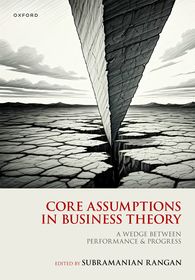
Core Assumptions in Business Theory
A Wedge Between Performance and Progress
-
10% KEDVEZMÉNY?
- A kedvezmény csak az 'Értesítés a kedvenc témákról' hírlevelünk címzettjeinek rendeléseire érvényes.
- Kiadói listaár GBP 119.00
-
53 728 Ft (51 170 Ft + 5% áfa)
Az ár azért becsült, mert a rendelés pillanatában nem lehet pontosan tudni, hogy a beérkezéskor milyen lesz a forint árfolyama az adott termék eredeti devizájához képest. Ha a forint romlana, kissé többet, ha javulna, kissé kevesebbet kell majd fizetnie.
- Kedvezmény(ek) 10% (kb. 5 372 Ft)
- Kedvezményes ár 48 356 Ft (46 053 Ft + 5% áfa)
Iratkozzon fel most és részesüljön kedvezőbb árainkból!
Feliratkozom
53 728 Ft

Beszerezhetőség
Becsült beszerzési idő: A Prosperónál jelenleg nincsen raktáron, de a kiadónál igen. Beszerzés kb. 3-5 hét..
A Prosperónál jelenleg nincsen raktáron.
Why don't you give exact delivery time?
A beszerzés időigényét az eddigi tapasztalatokra alapozva adjuk meg. Azért becsült, mert a terméket külföldről hozzuk be, így a kiadó kiszolgálásának pillanatnyi gyorsaságától is függ. A megadottnál gyorsabb és lassabb szállítás is elképzelhető, de mindent megteszünk, hogy Ön a lehető leghamarabb jusson hozzá a termékhez.
A termék adatai:
- Kiadó OUP Oxford
- Megjelenés dátuma 2025. május 8.
- ISBN 9780198944218
- Kötéstípus Keménykötés
- Terjedelem400 oldal
- Méret 252x181x25 mm
- Súly 846 g
- Nyelv angol 585
Kategóriák
Rövid leírás:
This volume brings together eminent social scientists and philosophers who assess the paradigm of business (field-by-field) and propose pragmatic amendments incorporating moral reasoning and moral roles.
TöbbHosszú leírás:
The modern market-based economy generates wealth, but it lags on well-being; it has mastered efficiency, but struggles with equity; it boasts size, but falls short on sustainability. In other words, our economy delivers performance but neglects progress (i.e., well-being, equity, and sustainability). Many rightly call for tighter regulation, higher (“true”) prices, and longer-term incentives. Others appeal to corporate purpose, shared value, and stakeholder-centricity.
Beyond regulation and the practice of business, we must attend as well to education and the theory of business. In particular, we must look at business theory's core assumptions, whose weaknesses are long known. In an applied field such as business, where theory tends to be normative, flawed assumptions could act as a “wedge” cleaving apart performance and progress.
In this volume, Subramanian Rangan brings together eminent social scientists and philosophers to explore core assumptions in each of the major fields of business-including economics, strategy, marketing, operations, decision science, leadership, governance, technology, and finance. This structured field-by-field reflection reveals and expands the bounds of our rationality. Core Assumptions in Business Theory proposes a revised profit function that integrates harm, outlines how economic actors may draw on moral philosophy to enact Pareto-equity (and not just Pareto-efficiency), suggests a two-stage rationality approach that can attend to well-being, and recasts marketing as consumer education and not merely demand promotion.
With an emphasis on education rather than regulation of economic power, this volume argues that moral reasoning and moral roles can fruitfully supplement prudential reasoning and functional responsibilities. Such an evolution will enable our economy to be both modern and moral.
This is an open access title available under the terms of a CC BY-NC-ND 4.0 International licence. It is free to read on the Oxford Academic platform and offered as a free PDF download from OUP and selected open access locations.
Tartalomjegyzék:
List of Figures
List of Contributors
Introduction
Part I. Economics
From Market-Pareto to Moral-Pareto: Seven Problematic Assumptions in Business Economics Theory
Assumptions in Economics
A Half-Dozen Assumptions That Have Led Economists Astray
Some Assumptions in Labor Economics
Reflection on Tirole's Chapter
Reflections on Autor's and Frank's Chapters
Reflections on Frank's, Kailas's, Rangan's, and Tirole's Chapters
Part II. Strategy
The Social Welfare Implications of Strategic Management Theory
Reflections on Barney's Chapter
Humanitarian Monopolists: Reflections on Barney's Chapter
Part III. Marketing
Fundamental Assumptions in Marketing
Three Assumptions Underlying Customer Value Management: An Interdisciplinary Perspective
Does Anyone Need a Rolex?: Reflections on Kotler's and Plassmann's Chapters
I ''Need'' a Rolex: Reflections on Kotler's and Plassmann's Chapters
Part IV. Decision Science
Theories of Choice and Value Endogeneity
Some Questionable Assumptions in Economic Theory
Reflections on Gilboa's and March's Chapters
Part V. Operations Research
The Assumptions of Operations Research
Reflections on Kaplan's Chapter - I
Reflections on Kaplan's Chapter - II
Part VI. Organization Theory and Sociology
Fundamental Assumptions in Organization Theory
Organization and Management Theory: Our Assumptions and the Quest for a Better World
Assumptions Rational and Not: Reflections on Battilana's and Walsh's Chapters
The Orientation of Economic Sociology: Assumptions and Limits
Assumptions Underlying Sociological Models in Business Schools
Social Science Assumptions: Reflections on Meyer's Chapter
Methodological Individualism-Lessons (?) from Biology: Reflections on Davis's and Meyer's Chapters
Philosophical Concepts in Organization and Leadership
Part VII. Leadership and Corporate Governance
Fundamental Assumptions about True Leaders
A Discussion on Corporate Governance
Incorrect Assumptions That Have Guided Our Economic System
Corporate Governance and Leadership: Reflections on Kailas's and Mendiola's Chapters
On Corporate Governance: Reflections on Kailas's Chapter
Part VIII. Technology
Assumptions Regarding Technology
A Compass for Technology
Situating the Assumptions of Technology in Broader Normative Frameworks: Reflections on Shibulal's and Snabe's Chapters
Concerns about Technology: Reflections on Shibulal's and Snabe's Chapters
Part IX. Finance
Taking Stock of Some Core Assumptions in Finance
The Finance Paradigm
Reflections on Rajan's and Subrahmanyam's Chapters - I
Reflections on Rajan's and Subrahmanyam's Chapters - II
Afterword: Evolving the Theory, Actors, and Practice of Business
Index

