

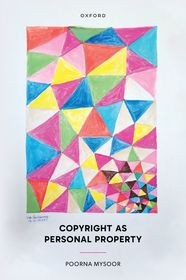
Copyright as Personal Property
-
10% KEDVEZMÉNY?
- A kedvezmény csak az 'Értesítés a kedvenc témákról' hírlevelünk címzettjeinek rendeléseire érvényes.
- Kiadói listaár GBP 100.00
-
45 150 Ft (43 000 Ft + 5% áfa)
Az ár azért becsült, mert a rendelés pillanatában nem lehet pontosan tudni, hogy a beérkezéskor milyen lesz a forint árfolyama az adott termék eredeti devizájához képest. Ha a forint romlana, kissé többet, ha javulna, kissé kevesebbet kell majd fizetnie.
- Kedvezmény(ek) % (cc. 0 Ft off)
- Kedvezményes ár 0 Ft (0 Ft + 5% áfa)
Iratkozzon fel most és részesüljön kedvezőbb árainkból!
Feliratkozom
45 150 Ft

Beszerezhetőség
Megrendelésre a kiadó utánnyomja a könyvet. Rendelhető, de a szokásosnál kicsit lassabban érkezik meg.
Why don't you give exact delivery time?
A beszerzés időigényét az eddigi tapasztalatokra alapozva adjuk meg. Azért becsült, mert a terméket külföldről hozzuk be, így a kiadó kiszolgálásának pillanatnyi gyorsaságától is függ. A megadottnál gyorsabb és lassabb szállítás is elképzelhető, de mindent megteszünk, hogy Ön a lehető leghamarabb jusson hozzá a termékhez.
A termék adatai:
- Kiadó OUP Oxford
- Megjelenés dátuma 2025. július 31.
- ISBN 9780192864420
- Kötéstípus Keménykötés
- Terjedelem304 oldal
- Méret 240x165x24 mm
- Súly 604 g
- Nyelv angol 708
Kategóriák
Rövid leírás:
This book argues that copyright, though intangible, is more like a property right than a chose in action. It aims to use analogies with tangible things to curtail undue expansion of copyright and to challenge rigid property classifications, proposing a more nuanced spectrum-based view of property rights.
TöbbHosszú leírás:
Copyright statutes in many jurisdictions clearly state that copyright is a property right. However, it's not always clear exactly how. Some see it as no more than a statutory right, while others think of it as a chose in action, like debts or shares. Copyright as Personal Property demonstrates why it is incorrect to conceptualize copyright as a chose in action and argues that, despite being an intangible asset, copyright is more analogous to land and chattels.
This book aims to achieve two main objectives. The first is to demonstrate much against popular belief that the analogies with land and chattels help contain the scope of copyright within normatively justifiable limits. Starting with the "thing-relatedness" of copyright, the monograph draws parallels with the acquisition of copyright, the nature of exclusionary rights, exclusive powers and privileges, their enforcement, and derivative interests. It employs concepts of property theory, such as numerus clausus, to provide the necessary benchmark to guide the boundaries of copyright. The second objective is to challenge the rigid and binary classification of property rights into choses in possession and choses in action. By addressing an important evolutionary gap in the conceptualization of property rights, this work lays the groundwork for a more sophisticated taxonomy, viewing property rights as existing on a spectrum. It goes on to provide the metrics to calibrate this spectrum, ensuring the incremental and orderly development of property rights.
Original and thought-provoking, the analogy this book develops with land and chattels shows how the unjustifiable expansion of copyright can be curbed and offers a more sophisticated classification of property rights than that based simply on tangibility.
Tartalomjegyzék:
Setting the Stage
Thing-Relatedness in Copyright
Acquisition of Copyright
Exclusionary Rights, Exclusive Powers, and Privileges in Copyright
Copyright Enforcement and Remedies
Defences and Limits on Uses
Derivative Interests in Copyright
Final Remarks

